Showing posts with label Copley (artist). Show all posts

Thursday, 3 July 2014

A Boy with a Flying Squirrel

​John Singleton Copley (Massachusetts, America, 3rd July 1738 - London, England, 9th September 1815)


Self-Portrait by John Singleton Copley
Self-Portrait by John Singleton Copley 

Today marks the anniversary of the birth of John Singleton Copley, a painter of precision and skill. Rather than tell the story of Copley's life, I thought instead that I might revisit my occasional series on painters and their work, by taking a closer look at my favourite of Copley's work, A Boy with a Flying Squirrel. It is a work of technical mastery and perfection, intended to make a mark and it succeeded, eventually changing Copley's career for everything.

The work depicts a young boy seated at a table, toying with the lead of a pet squirrel; an exquisitely Georgian scene, at once unexpected and perfectly in place. Everything about the painting was calculated to showcase the artist's skill. The wooden furniture is polished to a gloss, the silk collar of the boy a delicate texture and shade that one might almost touch whilst the animal's fur is rich and vibrant, bright eyes sparkling.

Seated at the table on which stands the squirrel is Copley's half-brother, Henry Pelham. The artist's intention with the work was to create a calling card and and he laboured long hours over the painting, perfecting every detail of a portrait that is thoughtful and evocative of the considered seriousness of the young man, lost in a world of his own with his treasured pet. 


A Boy with a Flying Squirrel by John Singleton Copley, 1765


Once the painting was complete in 1765 Copley sent it to London with Roger Hale, who carried as well instructions that the work should be shown to Benjamin West upon arrival. This instruction was dutifully carried out and West in turn showed it to Joshua Reynolds, who was much taken with the artist and his work.

Although the painting was received with enthusiasm, it was not without criticism. Reynolds found it a little fussy, with the general feeling among the English artists being that the Copley could stand to be somewhat less exacting with his detail. Nevertheless, there was no doubt that this was a supremely talented artist and Reynolds encouraged Copley to come to England and continue his artistic development.

The feedback was exactly what Copley wanted to hear as he was hoping to kickstart his European career. When A Boy with a Flying Squirrel was exhibited in London in 1766, such was the interest that West urged Copley to travel to London in search of success. However, in the event he was unable to leave Boston until 1774, when he sailed from America and never returned.

Wednesday, 7 August 2013

"Tell Charles I die blessing him": Princess Amelia of the United Kingdom

Princess Amelia of the United Kingdom (Windsor, England, 7th August 1783 – Windsor, England, 2nd November 1810) 


Portrait of Princess Amelia (1783-1810), 1797
Princess Amelia by Sir William Beechey, 1797

It has been a bit of a male-dominated Guide of late, what with Emperors, poets and politicians, so I decided the time was right to redress the balance and give a woman who was by all accounts charming, intelligent and beautiful her turn on the front page. Today I shall be wishing happy birthday to a young lady whose short life was beset by ill health and sadness and who was so badly behaved, she contributed to the retirement of a famed portrait painter when she was just two years old!

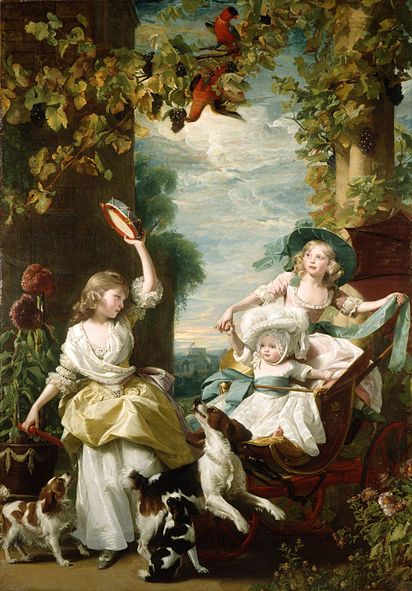
Princess Amelia was the fifteenth and youngest child of George III and Queen Charlotte, born at the Royal Lodge, Windsor, just three months after the death of four year old Octavius, her father's favourite son. Amelia was doted on by her family (who called her Emily) and in particular by George, who had been hit hard by the death of the boy and now transferred his adoration to the new princess. With a wide range of ages amongst her siblings, Amelia spent most of her infancy with her sisters, Mary and Sophia, and it was this badly-behaved trio of girls who drove John Singleton Copley into retirement. 

Being given a commission to paint the three girls in 1785 would have seemed like a fairly run of the mill job for the artist, an acknowledged master of his craft. However, his experience of painting the sisters with various favourite animals and birds was such a trying experience that Copley completed the portrait and then set down his brushes once and for all, entering into retirement.


Portrait of the Three Youngest Daughters of King George III by John Singleton Copley, 1785
The Three Youngest Daughters of King George III by John Singleton Copley, 1785

When Amelia was five years old, her father suffered the first of many recurrent episodes of mental illness. As she grew older these periods of sickness grew more frequent and prolonged and the King's initial plans to take his youngest daughters to Hanover in search of husbands began to falter. Unsettled by the unhappy marriages within his own family George had no desperate wish to see his girls wed and Queen Charlotte welcomed their company as her husband grew more disturbed, keeping her daughters in her own secluded circle. No suitable suitors existed at court and Amelia and her sisters were not exposed to society so, with little opportunity to meet gentlemen of their own, they settled into a quiet domestic life as companions to their mother.


Portrait of Princess Amelia by Andrew Robertson, 1807
Princess Amelia by Andrew Robertson, 1807

As she grew older, Amelia was plagued by ill health and was dispatched to Worthing to take the air and enjoy the benefits of sea bathing following a serious infection in her knee. Though she seemed to recover from that ailment, by 1798 she was already showing early signs of tuberculosis. As her health continued to deteriorate, the young Princess travelled to Weymouth to further take the coastal air, accompanied by the Honourable Sir Charles FitzRoy, an equerry more than two decades her senior. She and FitzRoy fell in love and hoped to marry but their dreams of domestic bliss were dashed when the Queen refused to tell her husband of the affair, terrified of the impact on his mental health. Without her family's consent the marriage could not take place and Amelia never forgave her mother for standing in the way of her love. However, she and FitzRoy continued to correspond and Amelia never lost hope that she might one day be his equerry's wife, even styling herself as AFR, Amelia FitzRoy. 

Recalled to Windsor, Princess Amelia grew increasingly despondent and in 1808 suffered a severe attack of measles, an infection that dramatically weakened her already frail body. In Summer 1810 she took to her bed with Princess Mary as her constant companion and nurse, growing more unwell with every passing day. The intelligent, spirited young woman recognised that her life was drawing to an end and commissioned a mourning ring for the father who doted on her. With the help of her sisters, FitzRoy was given leave to make  visits to Amelia's bedside and this must have given her some small comfort during these final, painful months. On 2nd November, as the family gathered to quietly celebrate Prince Edward's birthday, Princess Amelia passed away. Her final thoughts were for the man she loved; her dying words were were "tell Charles I die blessing him".


Engraving of Apotheosis of the Princes Octavius & Alfred, and of the Princess Amelia byWilliam Marshall Craig, 1820
Apotheosis of the Princes Octavius & Alfred, and of the Princess Amelia by William Marshall Craig, 1820

Her father was distraught at the loss of his youngest daughter and refused to accept that she had gone. In his deluded state he believed that she was living in Hanover with her non-existant husband and children, enjoying rude health and the best of everything.  The royal family were plunged into deep mourning at her passing and it would be a long time before Amelia's siblings could begin to adjust to her loss. FitzRoy was not invited to attend the funeral at Windsor and bore his grief alone, comforted by the letters of Princess Mary and her siblings. 

The Princess left her worldly possessions to Charles FitzRoy, the man to whom she had promised her hand in marriage. Her life cut tragically short, Princess Amelia was laid to rest in St George's Chapel at Windsor Castle, just three miles from the Lodge where she had been born.

Life in the Georgian Court, true tales of 18th century royalty, is available at the links below.

Pen and Sword
Amazon UK
Amazon US
Book Depository (free worldwide shipping)