Showing posts with label Crime. Show all posts

Tuesday, 12 June 2018

Unfortunate Wretches

It's a pleasure to welcome Naomi Clifford, whose latest book, Women and the Gallows 1797-1837: Unfortunate Wretches, looks at the stories of women who were executed in England and Wales. 

Eliza Fenning in the condemned cell at Newgate. On 26 July 1815 she went to her death on the gallows outside Newgate in front of a near-silent crowd, and wore white to symbolise her innocence. (Portrait after George Cruikshank.)

What inspired you to choose executed women to write about?
It started when I became interested in Eliza Fenning, a kitchen maid who was executed in London in 1815 for attempting to poison her employer and his family – and who was most probably innocent. She was hanged at a time of great civil unrest and disruption, probably as a warning to the servant class not to challenge the social order. The circumstantial evidence against her was poor and the judge was warned there were serious doubts about her guilt, but he subjected her to a highly biased trial full of irregularities. Generally I’ve always been fascinated by the ‘down and dirty’ end of Georgian history and found that not much had been published recently specifically about the capital punishment of women.

What made women different to men who were executed in the same period? 
Because women were less criminal than men fewer of them were executed. Overall, the ratio of capital crimes committed was about 1 woman to every 10 men, and it was the same radio for executions. The majority felons were respited. That is, they were not executed but punished in other ways, most of them were transported and a few were imprisoned. In England and Wales in the 41-year period I cover, 131 women were executed, 91 of them for murder or attempted murder, a third of whom were infanticides; 23 women were hanged for deception (forging documents, counterfeiting currency or passing off fake bank notes), ten for stealing, five for arson and two for sheep killing or rustling. A handful were convicted of rare crimes, for women anyway, such as highway robbery. 

The crimes themselves were gendered. Men were hanged more often than women for manufacturing counterfeit notes because they had been trained in the skills required to produce them whereas women were more often charged with uttering (passing off forged banknotes in shops and so on) because they were household consumers and therefore more likely to be exchanging paper money in shops and markets. In crimes such as the murder of a spouse there was a definite bias against women. In fact, until 1828 women guilty of petty treason (essentially, the murder of a husband or employer) were subject to special punishment – they were dragged on a hurdle behind a horse to the place of execution. It almost goes without saying that there was no equivalent punishment for men who killed their wives.

In infanticide cases, courts were often very reluctant to convict women. In the transcripts and reports there is evidence that judges asked medical witnesses questions that might lead a jury to acquit or convict on a lesser crime. Even so, there were awful cases, such as Mary Morgan, a teenager who had killed her newborn baby after a secret pregnancy, and was hanged as a lesson to other young women.  

Prisoners under sentence of death were obliged to attend a Condemned Sermon during which they sat in a special box around an empty coffin. Thomas Rowlandson’s print shows the chapel at Newgate. (From The Microcosm of London, 1809.)

While we’re on the subject of dates, why did you choose to cover the period 1797 to 1837?
I chose 1797 because that was the year of the Bank Restriction Act. That sounds like something quite dull but it was immensely important because it led to so many deaths on the gallows, both men and women. The Act allowed banks to issue low denomination notes for the first time. Before that, they were obliged to ‘pay the bearer’ of a banknote the appropriate value in gold, that is, in gold and silver coins. But in 1795, when gold bullion stocks at the Bank of England were running low, Prime Minister William Pitt persuaded George III to announce the temporary suspension of these payments with immediate effect. The Bank was now allowed to issue one and two pound notes. The notes were ludicrously easy to copy and for many that temptation was too great to resist. When counterfeiting skyrocketed the Bank became ruthlessly determined in its pursuit of forgers and utterers, and this led to a huge increase in execution.

I chose 1837 because it was the beginning of Victoria’s reign, a new era, and it allowed me to cover the end of the so-called Bloody Code, when the death penalty was removed from numerous crimes, most of them involving property.

Were you emotionally affected by the stories of the women?
I tried not to be! However, there are many that were extremely sad and awful. Sometimes I was moved to tears while writing. The infanticide stories were very difficult, both in terms of the terrible loss of the babies and of the awful fate of the mothers, many of whom were very young, destitute or otherwise desperate and some of whom were clearly suffering some form of post-natal mental illness. 

Despite the efforts of the authorities to instill order and solemnity at executions they were often rowdy events. Over 30 people were crushed to death at the execution of Elizabeth Godfrey, shown on the right hand side of the gallows, and two men. (Print reproduced in The Graphic, 5 March 1910.)
What are you working on next? What should we look forward to?
My third book, The Murder of Mary Ashford was published by Pen & Sword on 30 May. Mary, who lived in a village near Birmingham, was raped and killed in 1817 on her way home after a party. The research was fascinating to do and I made a breakthrough in what was previously an officially unsolved case. After that, I have something from a completely different era up my sleeve…

About the Author

Naomi Clifford’s Women and the Gallows 1797-1837: Unfortunate Wretches tells the stories of the 131 women who ended life on the gallows in England and Wales. Her first book, The Disappearance of Maria Glenn: A True Life Regency Mystery, looks at the rollercoaster fortunes of a teenager who was removed from her home to be forcibly married. Her latest, The Murder of Mary Ashford, in which she solves a notorious 200-year-old murder, was published last month. She blogs at naomiclifford.com and tweets as @naomiclifford.

Links:
Women and the Gallows

The Disappearance of Maria Glenn

The Murder of Mary Ashford


Tuesday, 18 July 2017

Detective Bent and the Murder of PC Cock

It's a pleasure to welcome Angela Buckley, author of Who Killed Constable Cock?, to delve into the world of Detective Bent and a mysterious crime.


---oOo---


Who Killed Constable CockIn the early hours of 2 August 1876, 21-year-old PC Nicholas Cock was walking his beat in the quiet suburb of Chorlton-cum-Hardy, Manchester. He stopped briefly at a junction for a chat with a passing law student and a colleague, after which all three men went their separate ways. A few minutes later, two shots rang out in the dark. PC Cock’s companions ran back to the junction to find the young police officer lying in a pool of blood. He had received a bullet to the chest and later died of his injuries. 


When the tragic news reached the police station, Superintendent Bent knew instantly who had killed his officer. Within half an hour of PC Cock’s death, he had arrested the three Habron brothers and charged them with murder. With his prime suspects firmly in his sights, and without considering any other leads, he set out to prove their guilt.

James Bent was born in Eccles, Salford in 1828. His father was a night watchman. At just seven years old, James began working in a silk mill, where he was constantly beaten by the supervisors. On 7 November 1848, Bent joined the Lancashire Constabulary. He was 5 feet 8 inches tall, with a fair complexion, grey eyes and sandy hair. A married man with four children, he was transferred several times and promoted through the ranks, reaching superintendent in 1868, by which time he was stationed at Old Trafford police station, from where he commanded the Manchester division. 

PC Cock
PC Nicholas Cock was tragically murdered in 1876.
Armed with his favourite adage, ‘Always believe everybody guilty until you prove them innocent’, Superintendent Bent investigated many different types of crime, including theft, burglary, illegal gaming and assault. He once tackled an intriguing case of attempted murder by a hawker of blacking who tried to poison his wife, an inmate of Prestwich Lunatic Asylum. During a visit, the itinerant salesman took her some Eccles cakes and, when she tried to eat them, she discovered that inside each cake was a dozen pins twisted into the shape of fish hooks. Superintendent Bent had the cakes analysed and found that they also contained antimony, a lead-based poison. He kept the pins as souvenirs, handing them out to crime enthusiasts. 

Shortly after, Superintendent Bent investigated another complex murder, for which he employed a very controversial method identify the killer. Nineteen-year old maid Sarah Roberts was murdered in her employer’s house by an unknown assailant. When the police failed to find the culprit, Superintendent Bent resorted to having the victim’s eyes photographed, to see if the attacker’s face was imprinted on them. The day before Sarah Jane’s funeral the police lifted the coffin lid and took images of the corpse, in the hope that the figure of the murderer would appear under the examination of a powerful microscope. Despite the image being magnified to the size of half a sheet of ordinary notepaper: ‘there was nothing visible which would furnish the slightest evidence as to the features of the murderer’ (Manchester Courier, 16 January 1880). Sarah Jane’s killer was never caught.
Superintendent James Bent
Superintendent James Bent set out to find PC Cock’s killer.
In 1891, Superintendent Bent published his memoirs, in which he described the murder of PC Cock, and the investigation he had led to catch the perpetrator. The wily detective built his case against the Habron brothers mainly on the discovery of footprints at the crime scene, which matched the suspects’ boots. He also found percussion caps in the youngest brother William’s waistcoat, although the murder weapon was never recovered. In November 1876, William Habron, aged 18, was convicted of Nicholas Cock’s murder. Once again Superintendent Bent had caught his man. Or so he thought. As young William languished behind bars, three years later an astonishing confession by a notorious Victorian cat burglar completely overturned the case and Constable Cock’s real killer was finally revealed.


Who Killed Constable Cock? by Angela Buckley is out now in ebook and paperback. You can find out more about Angela’s work on her website, www.angelabuckleywriter.com and on her Facebook page Victorian Supersleuth.


Tuesday, 25 April 2017

Criminal Conversation and a Tale of Banking

It's a pleasure to welcome back Alison Botterill, with a tale of 18th century adultery...
---oOo---
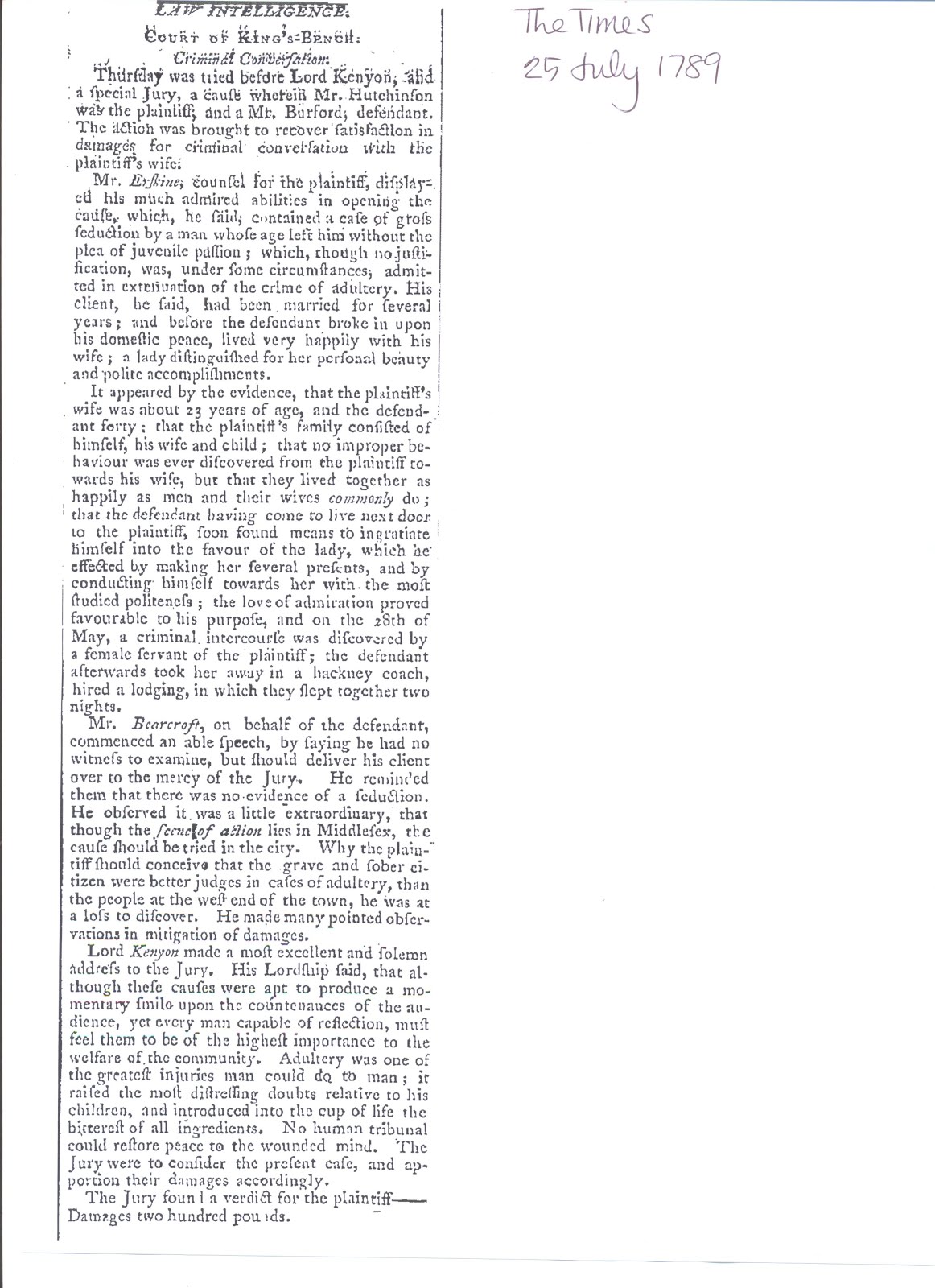
THE TIMES 25TH July 1789

LAW INTELLIGENCE
Court of King’s Bench
Criminal Conversation

Thursday was tried before Lord Kenyon, and a special Jury, a cause wherein Mr. Hutchinson was the plaintiff and a Mr. Burford, defendant. The action was brought to recover satisfaction in damages for criminal conversation with the plaintiff’s wife.

Mr Erskine, counsel for the plaintiff, displayed his much admired abilities in opening the cause, which, he said, contained a case of gross seduction by a man whose age left him without the plea of juvenile passion; which, though no justification, was, under some circumstances, admitted in extenuation of the crime of adultery. His client, he said, had been married for several years; and before the defendant broke in upon his domestic peace, lived very happily with his wife; a lady distinguished for her personal beauty and polite accomplishments.

It appeared by the evidence, that the plaintiff’s wife was about 23 years of age, and the defendant forty; that the plaintiff’s family consisted of himself, his wife and child; that no improper behaviour was ever discovered from the plaintiff towards his wife, but that they lived together as happily as men and their wives commonly do; that the defendant having come to live next door to the plaintiff, soon found means to ingratiate himself into the favour of the lady, which he effected by making her several presents, and by conducting himself towards her with the most studied politeness; the love of admiration proved favourable to his purpose, and on the 28th of May, a criminal intercourse was discovered by a female servant of the plaintiff; the defendant afterwards took her away in a hackney coach, hired a lodging, in which they slept together two nights.

Mr. Bearcroft, on behalf of the defendant, commenced an able speech, by saying he had no witness to examine, but should deliver his client over to the mercy of the Jury.  He reminded them that there was no evidence of a seduction. He observed it was a little extraordinary, that though the scene of action lies in Middlesex, the cause should be tried in the city. Why the plaintiff should conceive that the grave and sober citizen were better judges in cases of adultery, than the people at the west end of the town, he was at a loss to discover. He made many pointed observations in mitigation of damages.

Lord Kenyon made a most excellent and solemn address to the Jury. His Lordship said, that although these causes were apt to produce a momentary smile upon the countenances of the audience, yet every many capable of reflection, must feel them to be of the highest importance to the welfare of the community. Adultery was one of the greatest injuries man could do to man; it raised the most distressing doubts relative to his children, and introduced into the cup of life the bitterest of all ingredients. No human tribunal could restore peace to the wounded mind. The Jury were to consider the present case, and apportion their damages accordingly.

The Jury found a verdict for the plaintiff – Damages two hundred pounds.

THE WAGES OF SIN….

Continuing our genealogical research into our Burford family, my sister and I discovered another sorry tale, this time about Thomas Burford, a clerk at the Bank of England.   In 1789 he appeared as the defendant at the Court of the King’s Bench, in the Guildhall, London, before Lord Justice Kenyon for ‘a criminal connection’ with the wife of the plaintiff, John Hutchinson, a brewer’s clerk, from Mile End, who worked for Charrington & Co.   

Thomas was born in 1749 and we believe he was the son of the Reverend Samuel Burford, minister at the Strict Baptist Chapel in Little Prescott Street, Goodman’s Fields, Whitechapel.   Rev. Burford, who had been minister at Lyme Regis before being invited to London, died suddenly in 1768 leaving a wife and eleven young children, who were then supported by members of the congregation including one of the church’s deacons, Stephen Williams, of the Poultry in the City of London, a wealthy linen draper with businesses both in the City and in Stratford, Essex.   

In 1775 Thomas married a widow, Elizabeth Binley, who died only 5 years later.   There do not appear to have been any children of that marriage.   Two years after her death, Bank of England records [now available free online] show that Thomas joined the Bank as a clerk at an annual salary of £50.   The records also show that Stephen Williams, along with another wealthy London merchant, Andrew Jordaine, stood surety for Thomas, each for the sum of £500.  

Thomas’s misdemeanours first came to light while we were researching the Burford and Williams families’ connection with the Little Prescott Street chapel, and we read in one of the chapel’s original minute books, held at the Baptist Archive in Dunstable, that on 1st July 1789 it had become necessary to reprimand one of their number, Thomas Burford ‘of the Bank’, who had, ‘by his own confession, a criminal intercourse with a married woman’.   Further research led us to the press report which appeared in The Times on 25th July 1789.   

Then came a chance discovery of finding that Thomas’s story had been included in a recent book ‘Cheek by Jowl: A History of Neighbours’ by Emily Cockayne, who very kindly supplied me with a copy of the law report which went into far more detail than had appeared in The Times.   John Hutchinson’s wife, Mary, was born in 1767, the daughter of a nurseryman and seedman, John Hay, of Leytonstone. She married John Hutchinson at St Mary Le Bow in 1783 when still a ‘minor’ and was described in the law report as ‘a lady distinguished for her beauty and polite accomplishments’, and possessed of considerable property.   They had 3 children, but only one living, although the report mentions ‘his two other children’, so it’s possible he was married before despite being described as a bachelor when he married Mary. 

The report went on to say that any misconduct on her part was solely due to the ‘profligacy of the defendant’, who lived next door, ingratiating himself with her as often as he could during the day when her husband was at work.  He even followed the couple when they moved house.   It does not explain however, how, as a bank clerk, he was able to be away from work as much as he appeared to have been.  The servant’s testimony goes into great detail of what she saw and heard, including Burford ‘making free with her [mistress’s] petticoats’!   She confirmed that her master and mistress had lived together harmoniously until Thomas’s seduction of her mistress and their ‘elopement’, taking with them with several items of furniture belonging to her master.

The affair could not have lasted long.   After living with Thomas, who was almost twice her age, for a short while, Mary Hutchinson must have seen the error of her ways and threw herself upon the mercy of her father.   This clearly had some effect, as in John Hay’s will of 1792, written shortly before his death, and replacing an earlier one, Mary is named as sole executrix and the beneficiary of all of his property apart from £20 for her eldest brother.   While records show that her mother had died in 1790, it is not known if her other four siblings were still alive at this point.   Neither is it  known what became of Mary’s husband John, or of their child together. 

From Bank of England records, we discovered that Thomas left the Bank in 1800.   Clearly the court case would have had an enormous effect on him, both financially and in terms of notoriety.   £200 was an enormous sum to find when he was then earning only £70 per annum, and not only did he have to confess his ‘crime’ to fellow members of the chapel, many of whom were related to him, he had to suffer the indignity of reading about it in the national press, reports of which were syndicated the length and breadth of the country.   

However, things must have quietened down as in 1803, Thomas married Lydia Syle in Bloomsbury.  Perhaps with her encouragement or possibly even at her insistence, in 1804 he wrote to the Governor, Deputy Governor and Court of Directors of the Bank of England, begging for them to reinstate him at the Bank, explaining that he was now 55 and destitute, his reason for leaving the Bank in 1800 after 18 years’ service was that he was ‘afflicted with ill-health’ and had been deceived by his ward [we have been unable to discover who this was] who had promised him an annuity.    Amazingly, on receipt of this letter, the Committee of the Treasury agreed to re-elect him to the Bank ‘in consideration of [his] respectable character [!] and of his present unfortunate circumstances’, at the same salary which had risen to £110 per annum.   From correspondence with an academic who has written much on the history of the Bank, this was most unusual  -  perhaps Thomas had friends in high places, as Andrew Jordaine agreed to stand surety for him once again, as did John Williams, a linen draper of the Poultry (a relative of Stephen Williams, who had died in 1797).   

Thomas died in 1811, while still employed at the Bank and living in Princes Street, Red Lion Square.   In his will, he bequeathed to Lydia several annuities held at the Bank which would have provided her with a handsome pension.   There were no children of this marriage so at her death in 1832, she bequeathed the portraits of herself and Thomas to a nephew.   Sadly these are long-since lost.  It is to be regretted that we are not able to see what may have attracted Mary to Thomas – not only did he manage to charm an apparently happily married young woman,  he also persuaded the directors of the Bank of England to give him back his job!   While it is not known whether Mary’s husband ever forgave her, Thomas seems to have come through his ordeal in the end relatively unscathed.   It was ever thus! 

A postscript : I was recently working with someone with the surname Kenyon – it turned out he is a direct descendant of the judge.   It’s interesting to see how paths can cross many generations later!

About the Author

Alison and her sister began their research out of curiosity and have made some totally unexpected discoveries about the Burford line of their family. They just wish their grandmother and her mother were still alive to see what illustrious ancestors they had!


Written content of this post copyright © Alison Botterill, 2017.

Tuesday, 6 December 2016

A less than charming prospect?

It's a pleasure to welcome David Lassman, author of The Circle of Sappho, to delve into the dark side of regency Bath.

---oOo---

Courtest Terence James
 Although Jane Austen is acknowledged as one of the greatest writers English literature has ever produced, she is not without her critics. 
   One of the main accusations leveled at her though, is not concerned about what she actually wrote, but rather what she left out. The main subject for these detractors being the Napoleonic Wars, which raged throughout Europe during the majority of Jane’s writing life and ended not long before her death. To read her writing though, you would not know they even existed. 
   The same is true of the darker side of Regency Bath; the city she visited in the late 1790s, the place she was resident during the opening years of the nineteenth century and the main location for two of her novels; Northanger Abbey and Persuasion. 
  For the characters of these two works, and for the author herself, Bath seemed a pleasure ground of immeasurable capacity. A place the rich, famous and elite, followed not far behind by the emerging middle classes, chose to spend a good part of their year; indulging in all kind of social engagements, while at the same time, for the most part, taking the waters in order to improve their health. 
   Bath has been termed the Las Vegas of its day, but even in this American Mecca to gambling, there lay a sinister underbelly to its glitzy façade. The man who ‘founded’ it, Bugsy Siegal, for example, was assassinated in his own home by a gunman; the identity of which remains unknown to this day, although it is strongly suspected the mafia were behind the hiring of the killer.

   And like Las Vegas, Bath had a dark side, full of disreputable elements; an area where the characters of Jane’s novels or acquaintances in her actual life would fear to tread. It was known as the Avon Street district – although the locals merely knew it as ‘The Hate’ – and it was located in the south of the city, near the river which gave it its name.   


   At the beginning of the eighteenth century, royalty, in the shape of Queen Anne, came to Bath to take the waters – the mineral waters were heralded to contain properties that could ward off all kind of ailments – and with a royal seal of approval the city began a period of expansion and popularity it has never really lost. 
   In the years that followed the royal visits, as the elite followed suit, a city that for the most part remained firmly entrenched within its medieval walls and attitude found itself at the centre of an architectural explosion rarely seen in history, resulting in a city the envy of the whole of Europe. 
   In practical terms, this meant development outwards from the medieval city in all directions. The east saw various parades built, the west gained a number of magnificent squares, and to the north were erected the crowning architectural achievements of the King’s Circus and the Royal Crescent. 
   In the south of the city, however, it was a different story. With its close proximity to the river, this southern area was for all intents and purposes situated on a flood plain; ideally suited for pastoral grazing for the months the land was not under water, but totally incongruous for building on.  In a climate of unbridled greed and ever increasing demand for accommodation, however, it did not take long before plans were being made for elegant and fashionable lodging houses on the land, with only the flimsiest attempt at flood prevention. 
   Once built and after the inevitable flooding happened, the houses swiftly ceased to be acceptable as dwelling-places to the upper and middle class visitors they were intended to attract. As the buildings became uninhabitable to all but the poorest of occupants, the whole district, named after the largest street within it, Avon Street, became ever more dilapidated and synonymous with the criminal element. Because along with the poor, destitute and immigrants, came thieves, pick-pockets and brothel-keepers, as well as all kinds of undesirables with nefarious occupations.
   And it was into this setting, the beginning of the nineteenth century, that myself and a co-writer, Terence James, decided to set a fictional detective. Known as The Regency Detective, reflecting the period it is set in, our main character, Jack Swann, finds himself having to frequently enter the Avon Street district’s foreboding warren of passages and alleyways during the investigations he undertakes. 

   Swann’s back story is such that he is able to move easily between the two worlds which existed in nineteenth century Bath – the Austenesque ‘world’, which we probably know best through the television adaptations of her two ‘Bath’ novels (as well as the books themselves) and this darker, more notorious side that perhaps not unsurprisingly was never mentioned in city guide books. 
    Whether Jane Austen ever visited Avon Street district is not known, although it would seem unlikely given its reputation, while the nearest readers ever get to it through her writing is within Persuasion. It is in this book that she placed Mrs. Smith, a former tutor of Anne Elliot, in lodgings in Westgate Street; and although the address is outside the district’s boundaries, it is still only a stone’s throw from the northern end of Avon Street. 
   The Avon Street district retained its salubrious and dangerous reputation throughout the Victorian age – the suitably titled Avon Street, by Paul Emmanuelle, is set in the city during this time – and well into the twentieth century, when it was known as the city’s main red light district in the post-war years. 
   The majority of the area, however, was eventually demolished during the infamous Sack of Bath of the 1960s and 1970s and for many residents the phrase ‘good riddance’ was no doubt uttered. 
   Yet although it may now be gone, it should not be forgotten, for whenever one thinks of Jane Austen’s Bath, one should always remember that there are two sides to every story, even if one of those sides (outside the confines of fiction) now resides in the dark shadowy recesses of history.

    The Regency Detective series was created and written by David Lassman and Terence James and is published by The History Press. The latest book in the series, The Circle of Sappho, was published in earlier this year.

Wednesday, 22 June 2016

Gothic Horror and Georgian Dublin

Caroline Barry's novel, The Dolocher, is a wonderful read set in the streets of Dublin. A darker than dark Gothic thriller, I don't want to give anything away but don't miss this book and don't miss Caroline guest post today!

---oOo---

Gothic Horror and Georgian Dublin
Cover
Georgian Dublin was a glittering, lively city full of rakes and rascals, eccentrics, scholars, actors, vagabonds and rogues.  The streets bristled with hawkers selling a variety of wares.  
Food came in wooden barrels, there was ‘pease pudding’, ‘oysters’ and ‘Bulrudderie cakes’ and a fresh supply of ‘whey’ should that take your fancy.  You could buy clogs from the travelling cobblers; crockery was carried in a large wooden crate by a two man team and if you wanted a change of coat or jacket there was the second-hand-clothes merchants who carried their stock on a pole on their back.  
The wealthy or middling classes had an array of new shops to venture into, including Jones Periwig shop, you can still see the painted sign advertising it’s wigs on Dawson Street.  Jones’ shop used to keep a supply of bears out in the yard and would regularly kill a bear for it’s grease since it was considered the best substance for keeping curls firm and lustrous.  
For entertainment there were the many theatres, Smock Alley and the Crow Street Theatre where Spranger Barry and the eighteenth century superstar actor Garrick performed, and of course Neale’s music hall on Fishamble Street where famously Handle’s Messiah was first produced.  
There’s a rumour that an Irishman Richard Daly invented the word ‘quiz’.  He ran Smock Alley theatre and supposedly for a bet said that he would invent a word that would be used throughout the capital within forty-eight hours.  He then got a team of actors to paint the word ‘quiz’ on walls around the city and within two days the word was the talk of the town.  It has been argued that ‘quiz’ had already been in use at the time to denote an eccentric, if that is the case and staying with this early meaning of the word there were many ‘quizzical’ inhabitants in Dublin during the seventeen hundreds.
The most striking stories are jaw dropping.  Sometimes they are slight stories, humorously told but struck through with a shivering streak of savagery.  Take for example nick-names.  There was a man who shot his friend Kelly, and another who killed his coachman.  The first got the nickname of ‘Killkelly,’ the second became known as ‘Killcoachy.’ And the black humour continues.  There were three brothers, seemingly of noble birth, all of them famous for deficiencies in their character.  The first brother was a notorious fighter, he would cause a row wherever he went, the second was frequently flung into prison, the third had been disabled from his ‘buckish’ behaviour and they became universally known as ‘Hellgate,’ ‘Newgate,’ and ‘Cripplegate.’ 
Aristocratic men were frequently flung out of the second story window of Daly’s gaming club on College Green, in fact the gambling fever took hold of not only the ascendancy but the lower orders.
I was surprised to learn there were lotteries in Dublin in the seventeen hundreds.  There’s a very interesting story that I can’t quiet shake, it may be apocryphal, but a bit of me wonders if it is true.  The lottery shops were painted bright gaudy colours; the interiors were fitted with mirrors reflecting dazzling glass chandeliers festooned with ribbons.  The décor was especially designed to entice you inside. A scheme was devised where you could ‘insure’ a number for a shilling and each day in the lottery-hall on Capel Street the wheel was turned and a number called.  The story goes that a young blind girl who begged on Sackville Street and had attracted attention because she was so polite and clean and ‘mannerly.’  She had a little basket full of articles covered with a net and made more money than an ordinary beggar.  One night she dreamed of a number, certain it was a premonition she became convinced that she would make her fortune by it.  She ‘insured’ her number over and over until everything she had was gone and she could no longer ‘play.’  On the day that she could no longer take part in the lottery her number came up.  The story goes that she ‘groped her way to the Royal Canal, and threw herself into it.’
I gathered all these stories and many more when I was researching for my gothic novel The Dolocher.  The dazzling Georgian fashions in clothes, architecture and manners have a curiously modern tinge to them.  The current twitter culture seems beautifully reflected in the noisy debating environs of the eighteenth century coffee shop.  Modern open and relaxed attitudes to sexual expression can be found in the jelly and molly houses of the eighteenth century underworld.  But scratch the surface of any culture and you find the gothic.  
Eighteenth century crime in Dublin was exactly like that of London and as a result the prisons were notoriously overcrowded.  We had a debtor’s prison in Dublin called The Black Dog, and it was in the Black Dog prison that the Dolocher ghost story begins.  
The prison was an infamous ‘sink of vice,’ the keeper a vicious psychopath who on one occasion broke the leg of an inmate and left him down in the cellar.  The cellar frequently flooded; the cot beds were known to float on the swelling water of the Liffey.  The poor man with the broken leg took weeks to die and it took a committee on his behalf quite some time to bring a case against the keeper and have him and a number of his turn-key cohorts sacked from their jobs.
It was in this prison that a man called Olocher was incarcerated.  He had been found guilty of the rape and murder of a young girl and was due to be executed.  The night before he was due to be hanged he killed himself.  A week later one of his guards was found at the foot of some steps outside of the prison, he had taken a stroke and was paralysed down one side of his body.  When the guard regained his speech he told everyone that he had been attacked by a demon.  It had come at him from the shadows, from Olocher’s cell.  It was Olocher’s demon, half-beast-half-man, and a legend was born.

The Dolocher terrorised Dublin for a whole winter and fascinated by the tale I was inspired to write a gothic novel reimagining those events that took place many years ago.    
Written content of this post copyright © Caroline Barry, 2016.

Tuesday, 7 June 2016

The Disappearance of Maria Glenn

I am so excited to welcome Naomi Clifford, author of The Disappearance of Maria Glenn, to chat a little more about her fascinating research.

---oOo---

The Disappearance of Maria Glenn
Naomi Clifford’s The Disappearance of Maria Glenn has just been published by Pen & Sword at £15.99. It tells the true story of a 16-year-old girl removed from her home in the middle of the night and taken 30 miles away in preparation for being married to a young farmer. Was she abducted? Or did she later try to cover up the fact that her elopement had gone horribly wrong?

Maria Glenn’s story is not well known. How and where did you find her?
I was rooting around in the British Newspaper Archive, which has to be my favourite occupation, looking for stuff about the area in London where I live and came across a bizarre story about a young man who received an anonymous letter telling him that an heiress was willing to marry him if only he would only rescue her from a large house on the Clapham Road in south London, where she was being treated cruelly by her uncle. It turned out that the occupier of the house had also received an anonymous letter. It was a hoax. That set me thinking about elopement in the Georgian era – and how some people were happy to marry anyone, even a stranger, as long as they had money.

I started hunting down other elopement stories in the newspapers, thinking a collection of the more notable ones would make a good read. Many of them turned out to be horrible cases of stalking or actual abductions. In lots of them the female had very little control over what happened to her.

Maria’s story stood out because of the extent of the coverage of the trial of her alleged abductors and the number of years the dispute between the two parties went on. It was clear to me that because they told such different versions of events, one side had to be lying.

Tell us about the research you did for the book. How difficult was it to get to the facts?
I tracked down as much material in the British Newspaper Archive but I was very lucky in that a collection of letters between Maria’s uncle’s solicitor and his wife had been donated to Somerset Archives, and there were also letters about the case in the Dorset Archives.

The internet was absolutely crucial to the research. One pamphlet was only available at the Library of Congress, so I paid for it to be digitized, and it was sent to me as a PDF for a very reasonable $25.
I also had a massive stroke of luck with Ancestry through which I was able to contact Maria’s descendants who gave me copies of some family letters and a photograph.

Otherwise, it was trips to the National Archive and the British Library – I’ve always felt lucky to live in London, and this project made me even more grateful!

What qualifies you to tell Maria’s story? You say you’ve only got a rusty old history degree…
As a student, I never once handled an original source and I was made to write essays that only covered political history. Real people were entirely missing and no women featured. I don’t know how I got through it. But I always loved hearing about people’s stories so I just kept reading. In 2010 I self-published a book about the men on our local World War One memorial – and that whetted my appetite for a new project.

What style did you use to write Maria’s story? 
I’ve put the narrative at the heart of it. I was very keen for it not to be a history essay. My reviewers will have to tell me if I’ve been successful. It’s fully footnoted but I have also written some imagined scenes, one to kick off each of three acts.

What would you say to others wanting to do something similar, especially those who have deferred writing for publication until later in life?
It’s never too late! I have just turned 58. Writing this kind of book is what I always wanted to do, and now I have done it. For years, I tried to write autobiographical fiction – until I realised that that was not my natural genre. But those attempts meant that I was practicing my skill.

You must have thought about your next project. What have we to look forward to?
I am deep in research into the women who were sent to the gallows in England and Wales between 1797 and 1837. Executions of women were not common, but there are some really fascinating – and utterly heart-breaking – stories there. I wanted to find out why they died, and whether their gender played a part in the decision to kill them.

Tuesday, 8 March 2016

Madame Gilflurt's Georgian Gallimaufry: Dick Turpin

Today, the estimable Mr Gareth Southwell returns to the salon for a new instalment in Madame Gilflurt's Georgian Gallimaufry. The subject of his most talented eye is none other than the notorious Dick Turpin and an account of his life and crimes drawn from the pages of the Newgate Calendar.


A full account of the Life and Transactions of the famous RICHARD TURPIN, who was Hanged at York, for Horse-Stealing.
Turpin
The transactions of this malefactor made a greater noise in the world at the time they happened than those of almost any other offender whose life we have recorded: and we shall therefore be the more particular in our account of him.

He was the son of a farmer at Thackstead in Essex, and having received a common school education, was apprenticed to a butcher in Whitechapel; but was distinguished from his early youth for the impropriety of his behaviour, and the brutality of his manners. 

On the expiration of his apprenticeship, he married a young woman of East Ham in Essex, named Palmer: but he had not been long married before he took to the practice of stealing his neighbours' cattle, which he used to kill and cut up for sale.

Having stolen two oxen belonging to Mr. Giles, of Plaistow, he drove them to his own house; but two of Giles's servants, suspecting who was the robber, went to Turpin's where they saw two beasts of such size as had been lost: but as the hides were stripped from them, it was impossible to say that they were the same: but learning that Turpin used to dispose of his hides at Waltham-Abbey, they went thither, and saw the hides of the individual beasts that had been stolen.

No doubt now remaining who was the robber, a warrant was procured for the apprehension of Turpin; but, learning that the peace- officers were in search of him, he made his escape from the back window of his house, at the very moment that the others were entering at the door.

Having retreated to a place of security, he found means to inform his wife where he was concealed; on which she furnished him with money, with which he travelled into the hundreds of Essex, where he joined a gang of smugglers, with whom he was for some time successful; till a set of the Custom house officers, by one successful stroke, deprived him of all his ill-acquired gains.

Thrown out of this kind of business, he connected himself with a gang of deer-stealers, the principal part of whose depredations were committed on Epping Forest, and the parks in its neighbourhood: but this business not succeeding to the expectation of the robbers, they determined to commence house-breakers.

Their plan was to fix on houses that they presumed contained any valuable property; and, while one of them knocked at the door, the others were to rush in, and seize whatever they might deem worthy of their notice.

The first attack of this kind was at the house of Mr. Strype, an old man who kept a chandler's shop at Watford, whom they robbed of all the money in his possession, but did not offer him any personal abuse.

Turpin now acquainted his associates that there was an old woman at Loughton, who was in possession of seven or eight hundred pounds; whereupon they agreed to rob her; and when they came to the door, one of them knocked, and the rest forcing their way into the house, tied handkerchiefs over the eyes of the old woman and her maid.

This being done, Turpin demanded what money was in the house; and the owner hesitating to tell him, he threatened to set her on the fire if she did not make an immediate discovery. Still, however, she declined to give the desired information; on which the villains actually placed her on the fire, where she sat till the tormenting pains compelled her to discover her hidden treasure; so that the robbers possessed themselves of above 400l. and decamped with the booty.

Some little time after this they agreed to rob the house of a farmer near Barking; and knocking at the door, the people declined to open it; on which they broke it open; and having bound the farmer, his wife, his son-in-law, and the servant maid, they robbed the house of above seven hundred pounds; which delighted Turpin so much that he exclaimed, "Aye, this will do if it would always be so!" and the robbers retired with their prize, which amounted to above eighty pounds for each of them.

This desperate gang, now flushed with success, determined to attack the house of Mr. Mason, the keeper of Epping Forest; and the time was affixed when the plan was to be carried into execution; but Turpin having gone to London, to spend his share of the former booty, intoxicated himself to such a degree, that he totally forgot the appointment.
Nevertheless, the rest of the gang resolved, that the absence of their companion should not frustrate the proposed design; and having taken a solemn oath to break every article of furniture in Mason's house, they set out on their expedition.

Having gained admission, they beat and kicked the unhappy man with great severity. Finding an old man sifting by the fire-side they permitted him to remain uninjured; and Mr. Mason's daughter escaped their fury, by running out of the house, and taking shelter in a hog-stie.

After ransacking the lower part of the house, and doing much mischief, they went up stairs, where they broke every thing that fell in their way, and among the rest a china punchbowl, from which dropped one hundred and twenty guineas, which they made prey of, and effected their escape. They now went to London, in search of Turpin, with whom they shared the booty, though he had not taken an active part in the execution of the villainy.

On the 11th of January, 1735, Turpin and five of his companions went to the house of Mr. Saunders, a rich farmer at Charlton in Kent, between seven and eight in the evening, and having knocked at the door, asked if Mr. Saunders was at home. Being answered in the affirmative, they rushed into the house, and found Mr. Saunders, with his wife and friends, playing at cards in the parlour. They told the company that they should remain uninjured, if they made no disturbance. Having made prize of a silver snuff-box which lay on the table a part of the gang stood guard over the rest of the company, while the others attended Mr. Saunders through the house, and breaking open his escritoires and closets, stole about 100l. exclusive of plate.

During these transactions the servant maid ran up stairs, barring the door of her room, and called out, "Thieves!" with a view of alarming the neighbourhood; but the robbers broke open the door of her room, secured her, and then robbed the house of all the valuable property they had not before taken. Finding some minced-pies, and some bottles of wine, they sat down. to regale themselves; and meeting with a bottle of brandy, they compelled each of the company to drink a glass of it.

Mrs. Saunders fainting through terror, they administered some drops in water to her, and recovered her to the use of her senses. Having staid in the house a considerable time, they packed up their booty and departed, having first declared, that if any of the family gave the least alarm within two hours, or advertised the marks of the stolen plate, they would return and murder them at a future time.

The division of the plunder having taken place, they, on the 18th of the same month, went to the house of Mr. Sheldon, near Croydon, in Surrey, where they arrived about seven in the evening. Having got into the yard, they perceived a light in the stable, and going into it, found the coachman attending his horses. Having immediately bound him, they quitted the stable, and meeting Mr. Sheldon in the yard, they seized him, and compelling him to conduct them into the house, they stole eleven guineas, with the jewels, plate, and other things of value, to a large amount. Having committed this robbery, they returned Mr. Sheldon two guineas, and apologized for their conduct.

This being done, they hastened to the Black Horse, in the Broad- way, Westminster, where they concerted the robbery of Mr. Lawrence, of Edgware, near Stanmore, in Middlesex, for which place they set out on the 4th of February, and arrived at a public-house in that village, about five o'clock in the evening. From this place they went to Mr. Lawrence's house, where they arrived about seven o'clock, just as he had discharged some people who had worked for him.

Having quitted their horses at the outer gate, one of the robbers going forwards, found a boy who had lust returned from folding his sheep; the rest of the gang following, a pistol was presented and instant destruction threatened if he made any noise. They then took off his garters, and tied his hands, and told him to direct them to the door, and when they knocked, to answer, and bid the servants open it, in which case they would not hurt him; but when the boy came to the door he was so terrified that he could not speak; on which one of the gang knocked, and a man servant, imagining it was one of the neighbours, opened the door, whereupon they all rushed in, armed with pistols.

Having seized Mr. Lawrence and his servant, they threw a cloth over their faces, and taking the boy into another room, demanded what fire-arms were in the house; to which he replied, only an old gun, which they broke in pieces. They then bound Mr. Lawrence and his man, and made them sit by the boy; and Turpin searching the old gentleman, took from him a guinea, a Portugal piece, and some silver; but not being satisfied with this booty, they forced him to conduct them up stairs, where they broke open a closet, and stole some money and plate: but that not being sufficient to satisfy them, they threatened to murder Mr. Lawrence, each of them destining him to a different death, as the savageness of his own nature prompted him. At length one of them took a kettle of water from the fire, and threw it over him; but it providentially happened not to be hot enough to scald him.

In the interim, the maidservant who was churning butter in the dairy, hearing a noise in the house, apprehended some mischief; on which she blew out her candle to screen herself; but being found in the course of their search, one of the miscreants compelled her to go up stairs, where he gratified his brutal passion by force. They then robbed the house of all the valuable effects they could find, locked the family in the parlour, threw the key in the garden, and took their ill-gotten plunder to London.

The particulars of this atrocious robbery being represented to the king, a proclamation was issued for the apprehension of the offenders, promising a pardon to any one of them who would impeach his accomplices; and a reward of fifty pounds. was offered, to be paid on conviction. This, however, had no effect; the robbers continued their depredations as before; and, flushed with the success they had met with, seemed to bid defiance to the laws.

On the 7th of February, six of them assembled at the White Bear Inn, in Drury-lane, where they agreed to rob the house of Mr. Francis, a farmer near Mary-le-bone. Arriving at the place, they found a servant in the cow-house, whom they bound fast, and threatened to murder, if he was not perfectly silent. This being done, they led him into the stable, where finding another of the servants, they bound him in the same manner.

In the interim Mr. Francis happening to come home, they presented their pistols to his breast, and threatened instant destruction to him, if he made the least noise or opposition. Having bound the master in the stable with his servants, they rushed into the house, tied Mrs. Francis, her daughter, and the maidservant, and beat them in a most cruel manner. One of the thieves stood as a sentry while the rest rifled the house, in which they found a silver tankard, a medal of Charles the First, a gold watch, several gold rings, a considerable sum of money, and a variety of valuable linen and other effects, which they conveyed to London.

Hereupon a reward of one hundred pounds was offered for the apprehension of the offenders: in consequence of which two of them were taken into custody, tried, convicted on the evidence of an accomplice, and hanged in chains: and the whole gang being dispersed, Turpin went into the country to renew his depredations on the public.

On a journey towards Cambridge, he met a man genteelly dressed, and well mounted: and expecting a good booty, he presented a pistol to the supposed gentleman, and demanded his money. The party thus stopped happened to be one King, a famous highwayman, who knew Turpin; and when the latter threatened destruction if he did not deliver his money, King burst into a fit of laughter, and said, "What, dog eat dog? -- Come, come, brother Turpin; if you don't know me, I know you, and shall be glad of your company."

These brethren in iniquity soon struck the bargain, and immediately entering on business, committed a number of robberies; till at length they were so well known, that no public-house would receive them as guests. Thus situated they fixed on a spot between the King's-Oak and the Loughton Road, on Epping Forest, where they made a cave, which was large enough to receive them and their horses.
Turpin shoots a man
This cave was inclosed within a sort of thicket of bushes and brambles, through which they could look and see passengers on the road, while themselves remained unobserved.
From this station they used to issue, and robbed such a number of persons, that at length the very pedlars who travelled the road, carried fire-arms for their defence: and, while they were in this retreat, Turpin's wife used to supply them with necessaries, and frequently remained in the cave during the night.

Having taken a ride as far as Bungay, in Suffolk, they observed two young women receive fourteen pounds for corn, on which Turpin resolved to rob them of the money. King objected, saying it was a pity to rob such pretty girls: but Turpin was obstinate, and obtained the booty.

Upon their return home on the following day, they stopped a Mr. Bradele, of London, who was riding in his chariot with his children. The gentleman, seeing only one robber, was pre paring to make resistance, when King called to Turpin to hold the horses. They took from the gentleman his watch, money, and an old mourning ring; but returned the latter, as he declared that its intrinsic value was trifling, yet he was very unwilling to part with it.

Finding that they readily parted with the ring, he asked them what he must give for the watch: on which King said to Turpin, "What say ye, Jack? -- Here seems to be a good honest fellow; shall we let him have the watch?" -- Turpin replied, "Do as you please;" on which King said to the gentleman, "You must pay six guineas for it: we never sell for more, though the watch should be worth six and thirty." The gentleman promised that the money should be left at the Dial, in Birchin-lane.

On the 4th of May, 1737, Turpin was guilty of murder, which arose from the following circumstance: A reward of 1001. having been offered for apprehending him, one Thomas Morris, a servant of Mr. Thompson, one of the keepers of Epping Forest, accompanied by a higgler, set out in order to apprehend him. Turpin seeing them approach near his dwelling, Mr. Thompson's man having a gun, he mistook them for poachers; on which he said, there were no hares near that thicket: "No, (said Morris) but I have found a Turpin;" and presenting his gun required him to surrender.

Hereupon Turpin spoke to him, as in a friendly manner, and gradually retreated at the same time, till having seized his own gun, he shot him dead on the spot, and the higgler ran off with the utmost precipitation.

This murder being represented to the Secretary of State, the following proclamation was issued by government, which we give a place to, from its describing the person of this notorious depredator.

"It having been represented to the King, that Richard Turpin did, on Wednesday, the 4th of May last, barbarously murder Thomas Morris, servant to Henry Thompson, one of the keepers of Epping Forest, and commit other notorious felonies and robberies, near London, his Majesty is pleased to promise his most gracious pardon to any of his accomplices, and a reward of 200l. to any person or persons that shall discover him, so that he may be apprehended and convicted.

Turpin was born at Thackstead, in Essex, is about thirty, by trade a butcher, about five feet nine inches high, very much marked with the small-pox, his cheek-bones broad, his face thinner towards the bottom; his visage short, pretty upright, and broad about the shoulders."

Turpin, to avoid the proclamation, went further into the country in search of his old companion King: and in the mean time sent a letter to his wife, to meet him at a public-house at Hertford. The woman attended according to this direction; and her husband coming into the house soon after she arrived, a butcher, to whom he owed five pounds, happened to see him; on which he said, "Come, Dick, I know you have money now; and if you will pay me, it will be of great service."

Turpin told him that his wife was in the next room; that she had money, and that he should he paid immediately; but while the butcher was hinting to some of his acquaintance, that the person present was Turpin, and that they might take him into custody after he had received his debt, the highwayman made his escape through a window, and rode off with great expedition.

Turpin having found King, and a man named Potter, who had lately connected himself with them, they set off towards London, in the dusk of the evening; but when they came near the Green Man, on Epping Forest, they overtook a Mr. Major, who riding on a very fine horse, and Turpin's beast being jaded he obliged the rider to dismount, and exchange horses.

The robbers now pursued their journey towards London, and Mr. Major going to the Green Man, gave an account of the affair; on which it was conjectured that Turpin had been the robber, and that the horse which he exchanged must have been stolen.

It was on a Saturday evening that this robbery was committed; but Mr. Major being advised to print hand-bills immediately, notice was given to the landlord of the Green Man, that such a horse as Mr. Major had lost, had been left at the Red Lion, in Whitechapel. The landlord going thither, determined to wait till some person came for it; and, at about eleven at night, King's brother came to pay for the horse, and take him away: on which he was immediately seized, and conducted into the house.

Being asked what right he had to the horse, he said he had bought it; but the landlord examining a whip which he had in his hand, found a button at the end of the handle half broken off, and the name of Major on the remaining half. Hereupon he was given into the custody of a constable; but as it was not supposed that he was the actual robber, he was told, that he should have his liberty, if he would discover his employer.

Hereupon he said, that a stout man, in a white duffel coat, was waiting for the horse in Red Lion-street; on which the company going thither, saw King, who drew a pistol attempted to fire it, but it flashed in the pan; he then endeavoured to draw out another pistol, but he could not, as it got entangled in his pocket.

At this time Turpin was watching at a small distance and riding towards the spot, King cried out, "Shoot him, or we are taken;" on which Turpin fired, and shot his companion, who called out, "Dick, you have killed me;" which the other hearing, rode off at full speed.
King lived a week after this affair, and gave information that Turpin might be found at a house near Hackney-marsh; and, on inquiry, it was discovered that Turpin had been there on the night that he rode off, lamenting that he had killed King, who was his most faithful associate.

For a considerable time did Turpin skulk about the forest, having been deprived of his retreat in the cave since he shot the servant of Mr. Thompson. On the examination of this cave there were found two shirts, two pairs of stockings, a piece of ham, and a part of a bottle of wine.

Some vain attempts were made to take this notorious offender into custody; and among the rest, the huntsman of a gentleman in the neighbourhood went in search of him with blood-hounds. Turpin perceiving them, and recollecting that King Charles II. evaded his pursuers under covert of the friendly branches of the oak, mounted one of those trees under which the hounds passed, to his inexpressible terror, so that he determined to make a retreat into Yorkshire.

Going first to Long Sutton, in Lincolnshire, he stole some horses, for which he was taken into custody, but he escaped from the constable as he was conducting him before a magistrate, and hastened to Welton, in Yorkshire, where he went by the name of John Palmer, and assumed the character of a gentleman.

He now frequently went into Lincolnshire, where he stole horses, which he brought into Yorkshire, and either sold or exchanged them.

He often accompanied the neighbouring gentlemen on their parties of hunting and shooting; and one evening, on a return from an expedition of the latter kind, he wantonly shot a cock belonging to his landlord. On this Mr. Hall, a neighbour, said, "You have done wrong in shooting your landlord's cock;" to which Turpin replied, that if he would stay while he loaded his gun, he would shoot him also.

Irritated by this insult, Mr. Hall informed the landlord of what had passed; and application being made to some magistrates, a warrant was granted for the apprehension of the offender, who being taken into custody, and carried before a bench of justices, then assembled at the quarter-sessions, at Beverley, they demanded security for his good behaviour, which he being unable, or unwilling to give, was committed to Bridewell.

On inquiry it appeared that he made frequent journeys into Lincolnshire, and on his return always abounded in money, and was likewise in possession of several horses; so that it was conjectured he was a horse-stealer and highwayman.

On this the magistrates went to him on the following day, and demanded who he was, where he lived, and what was his employment? He replied in substance, "that about two years ago he had lived at Long Sutton, in Lincolnshire, and was by trade a butcher, but that having contracted several debts, for sheep that proved rotten, he was obliged to abscond, and come to live in Yorkshire."

The magistrates not being satisfied with this tale, commissioned the clerk of the peace to write into Lincolnshire, to make the necessary inquiries respecting the supposed John Palmer. The letter was carried by a special messenger, who brought an answer from the magistrate in the neighbourhood, importing that John Palmer was well known, though he had never carried on trade there: that he had been accused of sheep-stealing for which he had been in custody but had made his escape from the peace officers: and that there were several informations lodged against him for horse-stealing.

Hereupon the magistrates thought it prudent to remove him to York Castle, where he had not been more than a month, when two persons from Lincolnshire came and claimed a mare and foal, and likewise a horse, which he had stolen in that county.

After he had been about four month in prison, he wrote the following letter to his brother in Essex:

"Dear Brother,

York, Feb. 6, 1739.

I am sorry to acquaint you, that I am now under confinement in York Castle, for horse-stealing. If I could procure an evidence from London to give me a character, that would go a great way towards my being acquitted. I had not been long in this county before my being apprehended, so that it would pass off the readier. For Heaven's sake dear brother, do not neglect me; you will know what I mean, when I say,

I am yours,

JOHN PALMER."

Clipping

This letter being returned, unopened, to the Post-Office in Essex, because the brother would not pay the postage of it, was accidentally seen by Mr. Smith, a school-master, who having taught Turpin to write, immediately knew his hand, on which he carried the letter to a magistrate, who broke it open; by which it was discovered that the supposed John Palmer was the real Richard Turpin.

Hereupon the magistrates of Essex dispatched Mr. Smith to York, who immediately selected him from all the other prisoners in the castle. This Mr. Smith, and another gentle man, afterwards proved his identity on his trial.

On the rumour that the noted Turpin was a prisoner in York Castle, persons flocked from all parts of the country to take a view of him, and debates ran very high whether he was the real person or not. Among others who visited him, was a young fellow who pretended to know the famous Turpin, and having regarded him a considerable time with looks of great attention, he told the keeper he would bet him half a guinea that he was not Turpin; on which the prisoner, whispering the keeper, said, "Lay him the wager, and I'll go your halves."

When this notorious malefactor was brought to trial, he was convicted on two indictments, and received sentence of death.

After conviction he wrote to his father, imploring him to intercede with a gentleman and lady of rank to make interest that his sentence might be remitted; and that he might be transported. The father did what was in his power: but the notoriety of his character was such, that no persons would exert themselves in his favour.

The statement against Turpin
This man lived in the most gay and thoughtless manner after conviction, regardless of all considerations of futurity, and affecting to make a jest of the dreadful fate that awaited him.
Not many days before his execution, he purchased a new fustian frock and a pair of pumps, in order to wear them at the time of his death: and, on the day before, he hired five poor men, at ten shillings each, to follow the cart as mourners: and he gave hatbands and gloves to several other persons: and he also left a ring, and some other articles, to a married woman in Lincolnshire, with whom he had been acquainted.

On the morning of his death he was put into a cart, and being followed by his mourners, as above-mentioned, he was drawn to the place of execution, in his way to which he bowed to the spectators with an air of the most astonishing indifference and intrepidity.

When he came to the fatal tree, he ascended the ladder; when his right leg trembling, he stamped it down with an air of assumed courage, as if he was ashamed of discovering any signs of fear, Having conversed with the executioner about half an hour, he threw himself off the ladder, and expired in a few minutes.

He suffered at York on the 10th of April.

The spectators of the execution were affected at his fate, as he was distinguished by the comeliness of his appearance. The corpse was brought to the Blue Boar, in Castle-Gate, York, where it remained till the next morning, when it was interred in the church- yard of St. George's parish, with an inscription on the coffin, with the initials of his name, and his age. The grave was dug remarkably deep, but notwithstanding the people who acted as mourners took such measures as they thought would secure the body: it was carried off about three o'clock on the following morning; the populace, however, got intimation whither it was conveyed, and found it in a garden belonging to one of the surgeons of the city.

Having got possession of it they laid it on a board, and carried it through the streets in a kind of triumphal manner, they then filled the coffin with unslacked lime, and buried it in the grave where it had been before deposited.

We see, in the cafe of this malefactor, what slight circumstances may lead to the conviction of the most notorious offender. The (hooting of a cock, in the mere wantonness of his heart, occasioned Turpin's being taken into custody: the scrutiny into his character followed of course; and he was brought to condign punishment by an accident that would have been laughed at by any man of unblemished reputation. 

His brother refusing to pay the postage of his letter was another circumstance apparently trivial; yet this produced that fort of evidence which most materially affected him, by the school-master's proving that he was the identical Turpin, who had been so notorious for his enormous offences in the southern counties. 

It is not impossible but that he might have been pardoned, or transported, after a simple conviction for horse-stealing: but the notoriety of his character drew down certain destruction on his head. 

Hence then, the young, the thoughtless, and all those whose dispositions may tempt them to acts of dishonesty, should learn the high value of an unblemished reputation; should consider that a good character is above all price, and that it ought to be preserved as a more precious jewel than could be purchased by all the riches of the eastern world! 


In a word, the laws of the great Creator are, in every instance, so compatible with, and so productive of, the interest and happiness of mankind, that one would think no man could violate them, who did not wilfully seek his own destruction! 

The New and Complete Newgate Calendar, London, 1795.

Original illustrations featured in Madame Gilflurt's Georgian Gallimaufry can be purchased direct from Gareth Southwell. To find out more about Gareth and his work, please visit him at www.patreon.com/woodpig and www.woodpig.co.uk.