Showing posts with label Education. Show all posts

Thursday, 14 January 2016

The Finger Alphabet

It's my pleasure to welcome Charlotte Russell to the salon today; Charlotte brings us the tale of the education for the deaf in the long 18th century, and news of a wonderful new collection of fiction!
---oOo---
VOX OCULIS SUBJECTA, published 1783 in London
“A Dissertation on the most Curious and Important Art of Imparting Speech, and the Knowledge of Language, to the naturally Deaf, and (consequently) Dumb”

This enlightened book was published (anonymously) by a parent whose child attended Thomas Braidwood’s Academy for the Deaf and Dumb in Edinburgh. Braidwood, a teacher by trade, established his school in Scotland in 1760 and was one of the first to use a formal language of signing that was a precursor to British Sign Language. He moved to London in the 1780s and established another school for the deaf there. A relative, Joseph Watson, became headmaster of the London Asylum for the Deaf and Dumb, which opened in 1792.
London Asylum for the Deaf and Dumb, from Wellcome Library, London
London Asylum for the Deaf and Dumb
Prior to the founding of these schools, the education of the deaf was sporadic at best, though there is documentation of a finger alphabet dating back to the 15th century. After decades of evolution, a manual alphabet was codified at last in the publication of Digiti Lingua, written by an anonymous deaf author. This British alphabet, which is two-handed and therefore different from the one-handed alphabet which developed in the United States, survives to this day.
Interestingly enough, it’s not only the British and American finger alphabets which differ. When the American Thomas Hopkins Gallaudet visited England in the hopes of learning about the education of the deaf from Thomas Braidwood, he was turned away when Braidwood refused to share his methods. Gallaudet then traveled onto Paris where he received a warmer reception and spirited cooperation. In consequence, American and British Sign Languages are very different from each other and only partially comprehensible to a signer of the other.
Finger alphabet illustrations from The Invited Alphabet by R.R. published in 1809
Finger alphabet illustrations from The Invited Alphabet by R.R. published in 1809
I only wish the heroine’s family in my most recent story had read Vox Oculis Subjecta. Or perhaps talked to the headmaster of the London Asylum for the Deaf and Dumb. Alas, her family cruelly believed her incapable of comprehension or speech due to her deafness. That, however, did not stop her from communicating with those around her, including the hero. For as the wise father/author of the above book notes, “Man, as a social being, hath an irresistible propensity to communicate with his species, to receive the ideas of others, and to impart his own conceptions.” 
Finger alphabet illustrations from The Invited Alphabet by R.R. published in 1809

Put two people in a room and despite any and all language barriers, they will communicate somehow!

About the Author
Charlotte Russell didn’t always know she wanted to be a writer. At one point she had grand plans to be an architect, until she realized she couldn’t draw anything more complicated than a stick figure. So, she enrolled at the University of Notre Dame and studied her first love—history. Now she puts all that historical knowledge to good use by writing romances set in Regency England. When not pounding on the keyboard, she enjoys watching sports with her husband, chauffeurs her three kids around, volunteers for too many things, and entertains two cats. (Of course there are cats; she’s a writer.) Although she has previously resided in Indiana, Mexico City, Phoenix, and Seattle, she currently lives right in the middle of the country in St. Louis.

Meet my heroine Isabella, who will not be silenced, in The Kissing Bough, part of the 3 Yuletide Wishes anthology.

THREE MEN. THREE VOWS.
THREE HOLIDAY NOVELLAS—
WITH AND WITHOUT PEERS.
Hope by Deneane Clark
His gambler brother the viscount took everything from Milton Anthony Windham, including his chance at love, but Tony is nonetheless determined to save his family estate from ruin. Success will require the help of his cousins the Ackerly sisters and a hasty marriage to a well-situated woman, all before the end of the holiday season. Hope awaits.
A Marchioness for Christmas by Alanna Lucas
Dracon, the 7th Marquess of Trawden, detests Christmastide, which is a reminder of all he has lost. This year, however, during his flight from London merriment to his ancestral home in the country, he will encounter a carriage accident that brings him face to face with Miss Antonia Madeley…and a chance to reverse the mistakes of the past.

The Kissing Bough by Charlotte Russell
Years ago, Jack Telford did what he must in order to “succeed.” It cost him his one true love. Now, haunted by memories of what could have been and dreams of what still might be, despite her “unsuitability”, despite what the act may cost him, he will travel through snow and across country to reunite with Isabella wherever she may be and make her understand the words she was always meant to hear.


Written content of this post copyright © Charlotte Russell, 2016.

Tuesday, 8 December 2015

Opportunities vs. Oppression: A Feminist Man’s Opinion of the 18th Century

It's my pleasure to welcome DD Wynn to the site with a fascinating look at the women on the 18th century...

---oOo---

Opportunities vs. Oppression
A Feminist Man’s Opinion Of The 18th Century

“It was a time when women were so repressed!”
“They lived in a man’s world!”
“There was nothing for women back then!”

These kind of statements drive me mad. I don’t know about other history lovers out there, but it gets on my nerves, intolerably. The 18th Century was such a changing, moving and evolving period that gave opportunities for not just men, but for women alike. I would like to say it is all relative to their class or financial situation, in which yes that is a great part of it. But it was not always the case as I will point out throughout this blog.

But a woman of sure common sense and basic level of intelligence would be surely capable of doing well for herself, no matter what her background was. Like today, things never change, where some of the most accomplished and richest people in the world are women. Yes there was awful sexist attitudes towards the fairer sex from men in this period, but that kind of ignorant thinking hasn’t changed either today. In my opinion, it is futile and intolerant for men to think of themselves superior, when most women have many more attributes that deserve accomplishment than most men of the world.

The 18th Century, of which mainly I speak about in England, was a fantastic era for evolution. The evolution of people’s thinking, ways of making money and basic sense of comfortable living was something that changed so radically. It is a topic not many people know of, which rather annoys me when people say ‘there was nothing for us women out there’. People nowadays like to talk about people who suffer, gritty upbringings and tragedy. But it is from this horror that women mainly could rise in the 1700’s to become so much more. This undoubtable need to have some level of intelligent capability, gave rise to strong and independent women who became icons. 

Ladies wearing the a la mode of French fashion, circa 1750’s. This is the usual fleeting image people think of when they are reminded of 18th Century women.
Ladies wearing the a la mode of French fashion, circa 1750’s.
This is the usual fleeting image people think of when they are reminded of 18th Century women.
Firstly, most ladies of good standing and middle class upwards had one easy way of making themselves much more than just “a woman”. Fashion. Clothes were their best way of expressing themselves and the 1700’s was a time of constant and ever changing way of women upgrading their looks. France led the way with trends and the beau monde of England were sure to become influenced by it. 

But by the end of the period it was infamous ladies like Georgiana Cavendish, the Duchess of Devonshire, who would become pioneering leaders of style. Painters like Gainsborough promoted the youthful look of neoclassical fashion of which was the natural vogue of the late 1700’s and some of the questionable icons from across the pond like Queen Marie Antoinette invented images which we still associate today. Something like a simple wig design has prevailed into the year 2015 as one of the stern symbols of 18th Century fashion and these were coined by ladies, sometimes designed by men but became classic for being on top of a woman’s head.

It was a time where fashion changed and became rather couture like, almost like pieces of wearable art. Any lady would feel proud wearing a gorgeous mantua gown with silk, jewellery, high wigs, feathers and light ruffles. I mean who wouldn’t? I know I would! But this was superficial in terms of accomplishments of the brain. But it still granted them one quick way of finding a stage either for their voice or beauty. It granted women from the day they were born, one sure and unhindered way of expression, almost like today. Except without the invention of Twitter and Facebook to make a mockery of them, the poor ladies of the 1700’s had newspaper and pamphlets to do that.

Duchess of Devonshire and her sister at the gaming table, Devonshire house, 1791.
Georgiana Cavendish, as I mentioned was an icon. An icon of style, attitude and classed too many as the “first celebrity”. The first non-royal celebrity, whom some of you may not know but she is related to our poor Diana, Princess of Wales, many centuries obviously between one another. Georgiana also, which is strange enough to hear now of a lady with such fortune and aristocratic manners, but she was well known for liking science and politics. She collected rock and mineral samples and travelled Europe with her passion for fashion, science and connections with royalty and politics. I mean for a woman who was married to the richest man in all of England (after the king) this was unheard of. Having almost every action and little thing that she did in daily life, became the headline news of all newspapers and magazines. She was the pitiful but yet beautiful first celebrity of the modern world.

But politics was one of the sure parts of her downfall, as well as her gambling, which was the big scandal of her period of life. Politics was something that was so targeted and really only allowed for men to speak of, be involved with and to even work as part of. But the Duchess was a prominent voter of the early women’s suffrage, trying to get women more freedom when it came to such viewpoints of politics and social life.  She was also a Foxite, a supporter of secretary of state, Charles James Fox and regularly went to protests and held rallies for his elections. Mostly on behalf of the Earl Grey, of whom she had a secret affair with. If you have seen the film with Kiera Knightley in, you will understand what I’m speaking of. He is whom the famous tea is named afterwards, by the way.

You may think she was only able to travel, become fashionable, involved with politics and gamble a lot of wealth because of her standing in society and the fact she was married to a Duke. But it isn’t. She was able to do it through passion and her unwavering length of astute sense of mind that made her do these things and take interests in such “manly” hobbies. She had passion that any lady of the period could have had and used it to her best.

Apart from her and other really high aristocratic ladies, there was many women not fortunate to reach those wealthy highs. People like Mary Wollstonecraft (mother of Mary Shelley – author of Frankenstein) who for the time was one of a kind, a marvel, an innovator of women’s liberties and rights. She even wrote a very famous but obviously controversial book called ‘The Vindication of Women’s Rights’. Before the women’s suffrage, the vote, women doing men’s jobs in the War and even before old Germaine Greer, there was Mary
“Strengthen the female mind by enlarging it, and there will be an end to blind obedience.”

Yes it was a time when issues such as work, politics and rights were not as female friendly as they are now, but it was still a time when there were women who were paving the way for their sex in massive strides. What Mary did was not violently portray her gender as the pivotal goddess they should be, but she argued that women were only inferior because most were not as educated like men. Yes, the 18th Century was not as open as it was a 100 years on for education of the opposite sex; you would be surprised of how many accomplished and very smart ladies were induced into high education, higher than most nowadays. 

What Mary did was try to point out that everyone should be treated as rational beings, almost like biblical scripture. She was a woman though, who some of you may look at her and think “Oh look at her, who does she think she is” but she had just as many problems, even worse, than we do today. She tried to kill herself several times, she was married to an anarchist philosopher and led a very controversial and unorthodox lifestyle. But this does not take away the fact she was one of the first feminists who stood up for her sex and told the rest of the world what she though ought to be right. Thus just short of over 100 years later, the women got what they deserved.

The 18th Century was not just a period of women designed dresses that shocked the world or ladies exhuming their beliefs on others, it was an age of sure invention of science and power. One woman, I came across whilst researching for this blog, to me is the epitome of the accomplished lady of an era of oppression. Yes the days held a light at the end of the tunnel for some women, but it was an age of oppressed views and men could destroy a woman with just a few simple words. But one woman, a comet searching and scientific endearing woman paved the way for more women wanting a life of astronomical pursuits. 
William Herschel
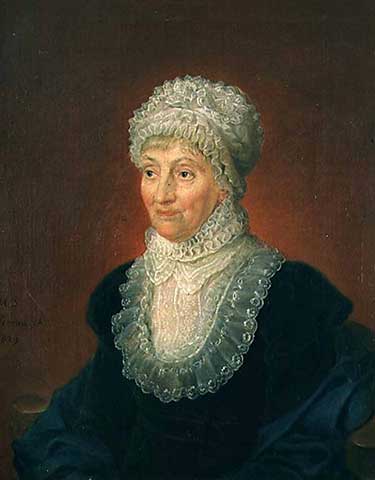
Caroline Herschel
Now here was a woman who, not knowing she even existed up to a few weeks ago, was blown away with what she achieved. She was the sister of the infamous William Herschel who discovered our planet Uranus. She also made significant contributions to the world of astronomy by using a large telescope that her brother so kindly designed for her. The discovery of comets was her main goal and she found quite a few floating around up the there, but the fact of what she discovered and catalogued is by the by for me. I was rather surprised but glad that she was the first woman in history to be paid for her services to science. I mean for a woman 300 years ago that is almost un-heard of. It was hard enough for women like Fanny Burney and Maria Edgeworth to earn money for their novels, let alone getting them published and receiving what they sought too.

Caroline along with Mary Somerville were the first two women to be inducted in the Royal Astronomical Society, something of rather a grand prize, due to it being rather a strict and man only society. But also she went onto live to the prime age of 97. I mean 97! Most men did not get to that age, so that was a feat in itself. She was a woman who did not let the fact she was born to an almost impoverished band stand leader and she was adamantly taught how to sew and learn millinery, let her slow her down. As soon as her brother William left Hanover in Germany for England, she followed to help him run his household and then soon became interested in his life of mapping the stars.

I mean for me, someone like this is so inspirational to women, that most ladies today probably don’t have a clue who she is or what she did. But the fact she was so regarded she was awarded medal after medal for her contributions to the world of science; which was so repressed in its views of women, is outstanding to me. She did not let the fact so many did not agree with her, stop her from achieving everything she wanted. 

If this is not an opportunity to view unguided oppression with such an investigavite eye, then I do not know what it is.

D.D. Wynn


About the Author

D.D. Wynn is my pen-name in dedication to my grandparents, who influenced me to write with their never ending avail of support. My debut novel 'The Choice of Duty' is dedicated to them. It is a book set in the 18th Century, if time travel was real then I would give anything to go back there and re-live it. Most of my novels I plan to write after my debut is soon to be published, will be set in the period, for I am endlessly enchanted with it's music, people, literature, fashion, politics, everything! 

My website features the reasoning behind my novel and a little synopsis of what it entails. It is simply a tale of a family that go through hell and high water for their daughters, who try their hardest to find love, honest true love in a world that is as deceitful and difficult to traverse as ours is today.
For more information here is my website - www.ddwynn.com

Written content of this post copyright © DD Wynn, 2015.

Wednesday, 15 July 2015

Jane Austen at School: “I Could Have Died of Laughter”

It's my pleasure to welcome Lisa Pliscou  to the salon for a tale of Jane Austen's school years!
---oOo---

Jane Austen at School: “I Could Have Died of Laughter”


 When Jane Austen was seven, she and her older sister Cassandra were sent to boarding school in the house of a distant relative. This Mrs. Cawley was said to be cold and stiff — hardly a warm motherly figure welcoming the arrival of two little girls now far from the familiarity, the security, the friendly routine of home.

Leaving Home”: This illustration by Massimo Mongiardo in Young Jane Austen shows Jane, age seven, on her way to Oxford, fifty long miles away.
Some months after their arrival, the girls contracted an illness — possibly typhus — and by all reports Jane nearly died. She and Cassandra were whisked back home by Mrs. Austen where, apparently, Jane’s convalescence was a protracted one.

Two years later, despite the disastrousness of the first foray, the girls were sent away again, to a different school. Long after, Mrs. Austen declared that it was Jane’s decision to join her sister: “if Cassandra’s head had been going to be cut off,” she wrote with an interestingly vivid turn of phrase, “Jane would have her’s [sic] cut off too.”

Some Austen biographers suggest that the girls’ parents scraped together the money to send them to this larger, more well-established school for the express purpose of acquiring genteel “accomplishments” considered desirable on the marriage market. If so, it may well have been a shrewd initiative, given that Cassandra and Jane would have no money of their own, sharply limiting their appeal in a world where such deficiencies mattered.

Off they went to the Abbey School in Reading, twenty miles away, presided over by one Sarah Hackitt, a cheerful, gossipy woman sporting a mysterious cork leg, who despite the fact she was neither French nor spoke French dubbed herself “Madame La Tournelle” — thus lending her little school a certain fashionable cachet.

What do we know about this interval in young Jane’s life? How are we to think of it? And what was most urgent to me, in working with the illustrator of Young Jane Austen, was how to visually present Jane’s experience at the Abbey School in a single evocative image.

Jane herself is silent on the subject, aside from a glancing remark in a letter to Cassandra, ten years after the event: “I could die of laughter at it, as they used to say at school.”

In her mature work as a writer — at a safe remove from the experience — she would issue some scathing little comments about girls’ schools; we come across them in Emma and in Sense and Sensibility.
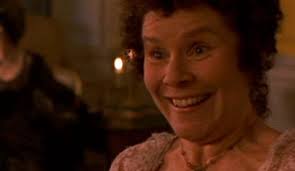
Observes Austen biographer Claire Tomalin: “Charlotte Palmer, in Sense and Sensibility, is said to have spent ‘seven years at a great school in town to some effect’ — the effect being the production of a landscape in coloured silks, and a social manner carrying silliness into surreal realms.” Actress Imelda Staunton, pictured here, created an indelible portrayal of the featherbrained Charlotte in Ang Lee’s 1995 film version.
In Jane Austen: Her Life, Park Honan speculates that it was at the Abbey School, in a setting that included girls from a higher social strata, that Jane — coming from a financially insecure family on the lower fringes of the gentry — encountered her first strong dose of class consciousness. (In the years to come, themes of class and money would certainly dominate her work.) Honan muses, “Ordinary life can be more horrifying than horror fiction and a girls’ school consists of other girls.”

Too, Austen’s more sensitive biographers point to letters both from Jane and about Jane which suggest that she may have been quirky, offbeat, different — as precocious children tend to be. Such children frequently have a difficult time socially.

All in all, what little we know, sifted through and analyzed, interpreted, seems to produce the impression that Jane’s time at the Abbey School was more of an ordeal than not; indeed, such is Claire Tomalin’s strongly stated view in her biography Jane Austen: A Life.

Thus, below, the “snapshot” in Young Jane Austen: dwarfed by her surroundings, we see the small, solitary figure of ten-year-old Jane. Forlorn and excluded from the society of the other girls? Or escaping, breathing deeply, enjoying a few moments of quiet pleasure: “the comfort,” as a beleaguered Jane Fairfax will confide to Emma, “of sometimes being alone.”

“The Abbey School” by Massimo Mongiardo.

It is yet another one of the many mysteries which surround this most fascinating of writers.
***
Lisa Pliscou writes for both children and adults. Her work has been praised by the Wall Street Journal, the Los Angeles Times, the Chicago Sun-Times, Publishers Weekly, Booklist, the Associated Press, VOYA, The Horn Book, and other media. Young Jane Austen: Becoming a Writer is her eighth book, and coming next spring is a new edition of her first novel, Higher Education, which was praised by David Foster Wallace, Betsy Byars, Tara Altebrando, and others. Coming in 2017 is a picture book, Jane Austen, the Girl Who Wrote, to be published by Henry Holt and illustrated by Jen Corace.


Written content of this post copyright © Lisa Pliscou, 2015.


Thursday, 2 July 2015

Johnson, Addison, Austen, Wilde and More

Once again I welcome regular visitor Dr Adam Smith, who brings news of an exciting online (free) course, Literature of the English Country House!

---oOo---

Meet Johnson, Addison, Austen, Wilde and Many More on ‘Literature of the English Country House’!

By Dr Adam James Smith, Co-Lead Educator on the Literature of the English Country House

The School of English at the University of Sheffield have just launched ‘TheLiterature of the English Country House’, a Massive Open Online Course (MOOC) tracing the literary history of the English country house through over 450 years of writing. This free course explores the literature of some of our most celebrated authors. These include famous authors like Jane Austen and Charles Dickens, as well as writers you might be less familiar with, like Joseph Addison and Georgina Duchess of Devonshire. It has been written and presented by a team of researchers in the School of English, and we’ll all be taking part in online videos, discussions and live-broadcasts over the next six weeks.

The course first ran in 2014, but this time round we’ve been able to add a wealth of new material. Last time, the emphasis on the course was firmly on developing skills in literary analysis. This time we also want to demonstrate some of the ways you can build on this initial interpretation. Each week we’ll be exploring a different ‘Research Approach.’ We’ll also be regularly consulting material in the University Library Special Collections Archive to find out what this literature looked like when it was first published (click here to get a closer look at these Special Collection).

Beginning our journey in the sixteenth century, we first approach the country house from the perspective of the tenants, learning that the country house at this time was more than a building. We’ll then consider the country house from the contrasting perspectives of servants, travelling players and residents: a task which requires learners to examine less familiar forms of literature, such as play-texts, manuscripts and literary letters.

It is likely the third week (starting 13th July), however, that will most excite guests at Madame Gilflurt’s Salon. We’ll be stepping outside of the country house to explore the world that it occupied and discovering what it was that the aristocracy was reading at the dawn of the 18th century. We learn all about the politeness, politics and sociability that dominated the coffee houses of the city and trace their influence back to the country house through the writing of Georgiana, Duchess of Devonshire. On the 16th July there will a special live broadcast during  you’ll have the opportunity to pose questions to both Professor Susan Fitzamaurice and myself on the subject of politeness and sociability in the 18th-century country house (bookmark this page if you’d like to join us).

From there we’ll see how the periodical and serialised print of eighteenth-century London informed the emergence of a new kind of literature: the novel. We’ll spend a week with Jane Austen, exploring the role of the country house in Pride and Prejudice. An appreciation of Austen’s use of intertextuality will lead us to Ann Radcliffe and the Gothic novel, Mysteries of Udolpho, where we’ll find the country house and its malevolent owner taking on a more sinister aspect. Likewise, in Charles Dickens’s Great Expectations we’ll meet met the haunting Miss Havisham, whose insistence on stasis won’t hide the fact that rot has begun to set in at the English Country House. Antiquated and in decline, we’ll finally see the country house become host to an actual haunting in Oscar Wilde’s The Canterville Ghost.

If you like reading and discussing literature and you have an interest in the fascinating literary history of the English country house then this is doubtlessly the course for you, I look forward to meeting you on the platform!


This post copyright © Adam Smith, 2015.

Friday, 9 January 2015

22 Hans Place: Mrs. Rowden’s School

It is my pleasure to welcome Caroline Warfield, author of Dangerous Works, today with a tale of 22 Hans Place: Mrs. Rowden’s School.


---oOo---

Education for girls in the Georgian period generally ran from mediocre to truly dismal.  Most girls were schooled, if at all, in a “Dame School,” the general name for a private school taught by a woman.  In Britain such schools varied from glorified day care to institutions that gave a decent grounding in the basics. Sometimes these schools provided boarding in a building dedicated to the school. In other cases they existed in private homes of varying levels.  One school stands out as above the norm: Mrs. Rowden’s School at 22 Hans Place.

The name is something of a misnomer. The school actually belonged Dominique de Saint-Quentin, a French émigré of aristocratic background from Alsace. He had come to England and accepted the position of French teacher at the girl’s school in Reading, sometimes called the Abbey School. Jane Austen and her sister had earlier and unhappily attended that school. It seems to have had a reputation for teaching little more than housekeeping; the headmistress spoke not a word of French, one of the intended subjects. Both discipline and curriculum were loose. St. Quentin raised the reputation for quality and eventually he obtained ownership of the school.  
St. Quentin then moved the operation closer to London and set out to establish a first-rate school for ladies. According to A. G. K. L'Estrange, (in Life of Mary Russell Mitford, 1870)
He was assisted, or rather chaperoned, in his undertaking by his wife, a good-natured, red-faced Frenchwoman, much muffled up in shawls and laces; and by Miss Rowden, an accomplished young lady, the daughter and sister of clergymen, who had been for some years governess in the family of Lord Bessborough

St. Quinten advertised his school as a school of French. He located it at 22 Hans Place, a neighborhood between Kensington and Chelsea just being built between 1770 and 1790. Miss (or as she styled herself, Mrs.) Rowden joined the staff in 1798.

The curriculum sounds moderately robust. 

M. St. Quintin himself taught the pupils French, history, geography, and as much science as he was master of, or as he thought it requisite for a young lady to know; Miss Rowden, with the assistance of finishing masters for Italian, music, dancing, and drawing, superintended the general course of study; while Madam St. Quintin sat dozing, either in the drawing-room with a piece of work, or in the library with a book in her hand, to receive the friends of the young ladies, or any other visitors who might chance to call. (L'Estrange)

The comment about what he thought “requisite for a young lady” would be amusing if it weren’t a sad reflection on expectations for women. Latin and Greek, required of all young gentlemen, are nowhere to be found. The French, however appears to have been first rate.  Letitia Landon for one was reputed to have an exquisitely correct accent. St. Quentin himself published A New Grammar of the French Language (Smart and Cowslade, 1790).   He also wrote A Complete System of the Commercial Geography of England; Laid Down In Plain and Concise Manner For the Use of Schools (William Baynes, 1794).

L’Estrange’s “general course of study,” taught by Mrs. Rowden focused on literature and the arts.  

…she cultivated, what is now so greatly neglected, the committing to memory the English classics, and the reciting before an audience the best passages, as they do now at Harrow and Eton on prize days. She was herself a poetess…
(Mrs. A.T.Thompson and Philip Wharton, The Queens of Society, 1861)

Mrs. Rowden also published her own works, notably: Poetical introduction to the study of botany (1801) and The pleasures of friendship, a poem (1810). What many of her students later remembered most were trips to attend lectures and plays. The school itself came to be known as Rowden’s School.”

The most significant indication of the quality and nature of education at 22 Hans Place, however, lay in the lives and accomplishments of its students.  

In 1795 Lady Caroline Ponsonby, daughter of the Earl of Bessborough, aged ten, was sent to the Rowden School, probably to curb her unruly behavior.  Her family may have actually been trying to get rid of her.  It is unclear how long she stayed, but she certainly took away a love of literature. She grew up, of course, to be Lady Caroline Lamb. As an adult she ran with the literary set and her outrageous obsession with Lord Byron is legendary. Her novel Glenarvon remains in print to this day. 
Letitia Landon
Letitia Landon

Letitia Elizabeth Landon achieved considerable fame as a poet, publishing under the initials L.E.L.  Landon came from a much humbler background than Caroline Lamb.  Her father was a clerk, later partner in a business, and later the owner of a failed agricultural experiment.  She lived at 25 Hans Place as a young child and began studying with Mrs. Rowden at age five in 1807.  She had left two years later, and appears to have been largely self-taught after that. The facts of her life are tough to document. She may have been as scandalous as Caroline Lamb—or not.  What is known is that she published her first poem at 18 and continued until her death at 36. During her lifetime she met with considerable critical success.

Mary Russell Mitford
Much of what we know about Mrs. Rowden comes from Mary Russell Mitford who attended Mrs. Rowden’s school from age ten to fifteen, or approximately between 1788 and 1803.  Mitford wrote poetry, drama, and prose. Her best-known works today are her play Rienzi, her sketches in Our Village (believed to be one of the bases of Gaskell’s Cranford) and her letters and memoirs. In Introduction to Mitford, Dramatic Works (1854) she describes Rowden’s love of the theatre and trips to see plays. Mitford describes her as a “clever woman” and indicates that Mitford’s father hired her to provide one-on-one tutoring outside of school.  Mitford says,
…her whole heart was in the drama, especially as personified by John Kemble; and I am persuaded that she thought she could in no way so well perform her duty, as in taking me to Drury Lane whenever his name was in the bills. (Mitford, Introduction)

The letters of Mitford’s mother mention that both Mrs. St. Quentin and Mrs. Rowden dined with the Mitfords and that Rowden maintained friendship with Lady Bessborough.

By 1809 Rowden took over full management of the school and, upon the death of Mrs. St. Quentin married the owner.  Later, presumably after the fall of Napoleon, they left the school in the hands of a Mrs. Lance and migrated to Paris. In Paris they opened a prestigious school for primarily English girls on Rue d'Angouleme, Champs Elysees. 

One of Rowden’s final pupils, Fanny Kemble, described it as: 

a handsome house, formerly somebody's private hotel, with porte cochere, cour d'honneur, a small garden beyond, and large, lofty ground-floor apartments opening with glass doors upon them. (Kemble, Records of a Girlhood, 1878)

 Kemble, niece of the actor John Kemble, also describes Rowden’s love of poetry and drama. As an adult Kemble became a noted actor and wrote several successful plays. She also published memoires and descriptive travel books. Perhaps most her most notable work still in print is Journal of a Residence on a Georgian Plantation in 1838–1839 (New York: Harper & Bros., 1863), which expressed her outrage over conditions of slavery that she had witnessed.

Schools for women in popular romance are often presented as finishing schools at which young ladies were taught French, music, drawing, and dancing. One fictional exception is Miss Martin’s School For Girls in Bath, setting for a series of wonderful novels by Mary Balogh.  My own most recent work, Dangerous Works, centers on the drive of one woman to succeed in spite of deficiencies in her education.

Perhaps the finishing school is an accurate picture of Mrs. Rowden’s school’ s intent. The accomplishments of so many of Mrs. Rowden’s students, however, argue that it rose above.  The women themselves found their own way to success, driven, one wants to believe, by Mrs. Rowden’s greatest gift, the belief that they could do it.

About the Author
Caroline Warfield has at various times been an army brat, a librarian, a poet, a raiser of children, a nun, a bird watcher, an Internet and Web services manager, a conference speaker, an indexer, a tech writer, a genealogist, and, of course, a romantic. She has sailed through the English channel while it was still mined from WWII, stood on the walls of Troy, searched Scotland for the location of an entirely fictional castle (and found it), climbed the steps to the Parthenon, floated down the Thames from the Tower to Greenwich, shopped in the Ginza, lost herself in the Louvre, gone on a night safari at the Singapore zoo, walked in the Black Forest, and explored the underground cistern of Istanbul. By far the biggest adventure has been life-long marriage to a prince among men.


She sits in front of a keyboard at a desk surrounded by windows, looks out at the trees and imagines. Her greatest joy is when one of those imaginings comes to life on the page and in the imagination of her readers.

Find Caroline on:

Dangerous Works
Lady Georgiana Hayden has struggled for years to do scholarly work in the face of constant opposition and even outright derision from the scholarly community at Cambridge. Her family ignores her as long as she doesn’t draw attention to herself.

A little Greek is one thing; the art of love is another.  Only one man ever tried to teach Georgiana both.  She learned very young to keep her heart safe.  She learned to keep loneliness at bay through work. If it takes a scandalous affair to teach her what she needs to complete her work, she will risk it.  If the man in question chooses not to teach her, she will use any means at her disposal to change his mind.  She is determined to give voice to the ancient women whose poetry has long been neglected.

Some scars cut deeper than others. Major Andrew Mallet returns to Cambridge a battle scarred hero. He dared to love Georgiana once and suffered swift retribution from her powerful family. The encounter cost him eleven years of his life.  Determined to avoid her, he seeks work to heal his soul and make his scholar father proud. The work she offers risks his career, his peace of mind, and (worst of all) his heart.

Andrew and Georgiana battle their way through the work to a fragile partnership. Even poetry, with its musical lyrics and sensual traps, can be dangerous when you partner with the love of your life.  In Regency Cambridge it can lead a lady quickly past improper to positively scandalous.

Buy Dangerous Works

Written content of this post copyright © Caroline Warfield, 2015.