Showing posts with label Frederick. Show all posts

Wednesday, 14 January 2015

The Death of Frederick V of Denmark

Frederick V (Copenhagen, Denmark, 31st March 1723 – Copenhagen, Denmark, 14th January 1766)


Frederik V of Denmark by Carl Gustaf Pilo
Frederick V of Denmark by Carl Gustaf Pilo

Last Autumn we met a lady who presided over a somewhat joyless court, Sophie Magdalene of Brandenburg-Kulmbach. As wife to Christian VI of Denmark of Denmark, she was mother to the man who would succeed his father and become Frederick V and today, I tell the tale of his last weeks. His mother is not the only lady in Frederick's life to visit the Guide and should you wish to meet his first wife, Louise of Great Britain, you can do so here!

After the austere, cold rule of Christian VI, Frederick was a breath of fresh air to the Danish people yet, after two decades, it came to a painful end. In 1760, an inebriated Frederick broke his leg badly and it marked the start of a slow decline into ill-health. A lifetime of high-living, drinking and debauchery now took its toll and the monarch finally began to see the long term impact of his partying lifestyle.

As the years passed following the accident, Frederick grew ever weaker and eventually his physical state was so debilitated that he could barely take care of himself. He was only forty two when he passed away of an undiagnosed ailment, though historian SM Toyne suggested that the cause of death might well be cirrhosis. Regardless of the condition that carried the king off, he was greatly missed by his subjects and, according to his own wishes, was laid to rest beside Louise in Roskilde Cathedral.

Life in the Georgian Court, true tales of 18th century royalty, is available at the links below.

Pen and Sword
Amazon UK
Amazon US
Book Depository (free worldwide shipping)

Saturday, 9 August 2014

Augustus William: The Prince Who Died of a Broken Heart

Prince Augustus William of Prussia (Berlin, Prussia, 9th August 1722 - Oranienburg, Prussia, 12th June 1758)


Augustus William of Prussia by G von Bern
As a lass, I was fascinated by the very concept of Prussia. Something about the word itself seemed impossibly exotic, a land of mystery and, for some reason, snow everywhere. I can't vouch for snow and exoticism but we are in Prussia today to meet Augustus William, a prince of the House of Hohenzollern.

As son of Frederick William I of Prussia and Sophia Dorothea of Hanover, Augustus could count amongst his siblings our old friend and seasoned schemer, Louise Ulrika, and Frederick the Great.

Unlike his sister, Augustus did not hanker after absolutist power and was content to live a life away from the throne. Aged twenty, he married Luise of Brunswick-Wolfenbüttel, the sister of Frederick the Great's wife, and the couple were parents to four children, all but one of whom survived to adulthood. In fact, though Augustus never ruled in his own right, when his brother died leaving no heirs, Augustus' son came to the throne as Frederick William II of Prussia. 

Augustus won the ire of Frederick thanks to a disastrous showing at the Battle of Kolin during the Seven Years War, at which Augustus unwisely chose to retreat. The furious Frederick suffered his first defeat in this battle and he and his brother never fully reconciled. In fact, when Augustus died twelve months later of a brain tumour the rumour spread that the unhappy prince had actually died of a broken heart.

Life in the Georgian Court, true tales of 18th century royalty, is available at the links below.

Pen and Sword
Amazon UK
Amazon US
Book Depository (free worldwide shipping)

Sunday, 22 June 2014

Lord John Sackville: Rake About Town

Lord John Sackville (John Philip Sackville, London, England, 22nd June 1713 - Lake Geneva, Switzerland, 3rd December 1765)

A return engagement today for Lord John Sackville, cricketer, politician and notorious rake about town. My post on his death touched on his somewhat scandalous ways and it is this that I return to today, to look a little more about the sort of behaviour that this particular member of the peerage were indulging in back in the Georgian era!

Lord Sackville was born the son of Elizabeth Colyear and Lionel Sackville, 1st Duke of Dorset and an ambitious career politician. The young man enjoyed an excellent education at Westminster, where he fell in love with the game of cricket, and at the age of 21 became not only Member of Parliament for Tamworth but more importantly for him, captained the Kent team at Sevenoaks. His cricketing prowess raised him to celebrity status in the county but he was almost as famous for his personal life, which might be politely termed, flamboyant.


Knole House, the Sackville family seat

Apart from cricket, there was little that Sackville enjoyed as much as gambling and the company of women. He had numerous lovers and finally, perhaps inevitably, his gadding about led to trouble when, in 1743, fate dealt him a surprise hand.

In 1743, Sackville embarked on a passionate and scandalous affair with Lady Frances Leveson-Gower, daughter of John Leveson-Gower, 1st Earl Gower and Lady Evelyn Pierrepont, whose father was the 1st Duke of Kingston-upon-Hull. The affair resulted in pregnancy and as the couple retreated to Woburn, a scandal erupted around them. The parents of both Sackville and Evelyn were horrified to learn of the affair but there was little they could do, the child was well on its way.

Just two days after their child was born in 1744, the scandalous couple married one another. This did nothing to mollify their parents-in-law and when Sackville's allowance was slashed by his father, financial trouble beckoned for the scandalous newlyweds.

In fact, Sackville's cricketing chum, Frederick, Prince of Wales, stepped in at this point to save his friend from financial ruin. He gave Sackville a paid position on his personal staff, easily making up the shortfall in his allowance. 

Although more trouble, gambling and ultimately madness would follow, for now life seemed settled and the couple adjusted to married life. Sackville never quite curbed his outrageous ways and his son would later follow his father's example, creating scandals of his own.

Tuesday, 10 June 2014

The Unfulfilled Life of Princess Caroline of Great Britain

Princess Caroline of Great Britain (Caroline Elizabeth; Hanover, Germany, 10th June 1713 - London, England, 28th December 1757)
Princess Caroline Elizabeth by Jacopo Amigoni
It is once again time to meet one of the princesses of Great Britain. Today we welcome Princess Caroline, daughter of the man who would become George II and Caroline of Ansbach and a young lady who lived a life that was far from settled, though she was beloved by her family and friends.

Her Serene Highness Princess Caroline of Hanover was born in Herrenhausen Palace, Hanover, just a year before her grandfather became George I. Although her family delayed their travel to England due to her sickly health, they eventually took up residence in St James's Palace and the young princess began a new life in the English court. She was adored by her parents and when Lady Mary Wortley Montagu brought variolation against smallpox to England, Caroline’s mother ensured that her children were treated against the infection.

However, Princess Caroline never found happiness in her personal life. Infatuated with our old friend, Lord Hervey, she was never able to win his affection despite rumours that he was having affairs not only with her own brother, but with a number of ladies within her circle. Though she and Hervey were close friends, her apparent love for him went unreturned. He died when Caroline was just 30 and she was inconsolable, retiring into mournful seclusion at her home.

Although she involved herself in religion and philanthropy, the princess did not emerge from her reclusive lifestyle and never married. Her health was fragile for many years and she died aged just 44, with her remains laid to rest at Westminster Abbey.

Life in the Georgian Court, true tales of 18th century royalty, is available at the links below.

Pen and Sword
Amazon UK
Amazon US
Book Depository (free worldwide shipping)

Wednesday, 19 March 2014

The Frail Life of Princess Louisa of Great Britain

Princess Louisa of Great Britain (Louise Anne; London, England, 19th March 1749 -  London, England, 13th May 1768)


Princess Louisa

Roll out the red carpet and be careful with the best china because once again we welcome a royal lady today. Princess Louisa of Great Britain lived a short life, not marked by any great marriage or scandal; she did not fall victim to a revolution nor did she rule a country, she was simply a young lady who was destined to die tragically young.

HRH Princess Louisa was born at Leicester House, Westminster, to Frederick, Prince of Wales, and Augusta of Saxe-Gotha. Her grandparents were George II and Caroline of Ansbach and she joined a large family, counting future kings and queens amongst her siblings.

Louisa was a bright and cheerful child yet, around the time of the death of her sister, Elizabeth, her health began to fail. She grew weak and frail and would never recover her precarious well being. Because of her health issues, Louise was frequently confined to her bed and was unable to fully participate in court life, nor were any plans made to secure the young lady a marriage.

The young princess passed away at Carlton House aged just 19, the fourth among her siblings to meet an early death.

Life in the Georgian Court, true tales of 18th century royalty, is available at the links below.

Pen and Sword
Amazon UK
Amazon US
Book Depository (free worldwide shipping)

Wednesday, 5 March 2014

The Eventful Life of Princess Mary of Great Britain

Princess Mary of Great Britain (London, England, 5th March 1723 - Hanau, Germany, 14th January 1772)


Princess Mary of Great Britain by George Desmarées

Well it's time to roll out the red carpet and get the best china out of the dresser as we welcome a most noble lady to the salon. Princess Mary of Great Britain's life was not always happy but she faced her domestic strife bravely, proving herself a devoted mother and sister.

Princess Mary was born at Leicester House to Caroline of Ansbach and the Prince of Wales, later to become King George II. On his coronation, Mary took the title of HRH the Princess Mary. Raised by her mother and and elder sister, Caroline, Mary was a bookish and academic girl devoted to books and education, with little interest in high society.

Nevertheless, as a princess of Great Britain it was a given that she would make a good noble marriage and when Mary was 17, it was agreed that she would marry Frederick, later to be Landgrave of Hesse-Kassel. Mary was granted £40,000 by parliament for the marriage and the proxy marriage took place on 8th May 1740, with the young bride travelling to Kassel the following month for a lavish ceremony. There she found a domineering and, according to Walpole, brutish husband waiting for her and from the start, the marriage was deeply unhappy for Mary. Indeed, before they had been married a decade, Mary holidayed in England for an extended period to escape her husband.  Despite their differences the couple did have four children, three of whom survived childhood.


Frederick II, Landgrave of Hesse-Kassel by Johann Heinrich Tischbein the Elder
However, the marriage remained strained and by 1755 the couple were formally separated, with Mary happy to use her husband's conversion to Catholicism as an excuse to leave. Mary moved to Denmark to care for the family of her late sister, Louise, raising her own sons at the Danish court and here she remained for some time, despite her father's entreaties to come home to England.

Eventually Mary and her children took up residence in Hanau, with the support of her father in law, Landgrave Wilhelm VIII. When Wilhelm died in1760, he left instruction that Mary should serve as regent as Hanau until her eldest son came of age and could take his place as Count of Hanau.

The Landgravine Consort of Hesse-Kassel lived happily in Hanau for many years, retiring from public life as her health began to fail. She died peacefully at home and was buried in the Marienkirche, mourned by her family and the people of her adopted land.


Life in the Georgian Court, true tales of 18th century royalty, is available at the links below.

Pen and Sword
Amazon UK
Amazon US
Book Depository (free worldwide shipping)

Saturday, 8 February 2014

An Unloved Princess: Augusta of Saxe-Gotha, Princess of Wales

Augusta of Saxe-Gotha, Princess of Wales (Gotha, Germany, 30th November 1719 - London, England, 8th February 1772)


Augusta of Saxe-Gotha, Princess of Wales by Charles Philips, 1736

A royal lady joins us today; unfairly maligned in her day and mocked, ridiculed and gossiped about, the mother of George III bore her burdens with dignity.

Princess Augusta was born to a life of privilege as the daughter of Frederick II, Duke of Saxe-Gotha-Altenburg and Magdalena Augusta of Anhalt-Zerbst. That she would make a dynastic marriage was never in doubt and, despite her virtual inability to speak English, at the age of 16 the young princess set foot on English shores as the bride-to-be of 29-year old Frederick, Prince of Wales, son of George II and Queen Caroline.

A lavish ceremony was held 27th April 1736 and so began a happy marriage for the new royal couple. Together they had nine children, all of whom survived childhood yet their home life suffered from the unhappy relationship between Frederick and his parents, who he refused to allow to meet his firstborn child. Indeed, when Augusta went into labour whilst at Hampton Court, Frederick was so adamant that his child would not be born under his mother and father's roof that he made the distress mother-to-be flee to St. James’s Palace in the middle of the night.

Despite this, Augusta supported her husband throughout his domestic travails and devoted herself to him, enjoying a civil but cool relationship with the king and queen whom Frederick so loathed. The apparently unassuming, naive Augusta proved her worth following Frederick's death in 1751. Now a valuable political figure as mother the to heir-apparent she threw herself on the sympathy of her bereaved father-in-law and he rallied to support her and her children.

Seeking both a friend and a tutor for her son, Augusta entrusted the young George's education to John Stuart, 3rd Earl of Bute and a man who had been a mutual friend to both Augusta and her late husband. Before long though, the press and public began to whisper that Stuart was doing a lot more in the royal household than simply tutoring the children and the princess was mercilessly and unfairly mocked throughout the land. As her son, the boy who would become George III, grew into a man, she guarded him fiercely and held an enormous influence over his decisions and actions. 

Augusta died of throat cancer aged just 52 yet even at her funeral the peace was shattered, as her coffin was heckled on its passage to its final resting place.

Life in the Georgian Court, true tales of 18th century royalty, is available at the links below.

Pen and Sword
Amazon UK
Amazon US
Book Depository (free worldwide shipping)

Saturday, 1 February 2014

Frederick Louis, A Cricketing Prince

Frederick Louis, Prince of Wales (Friedrich Ludwig; Hanover, Germany, 1st February 1707 – London, England, 31st March 1751) 


Frederick, Prince of Wales by Jacopo Amigoni, 1735

My grandpa Gilflurt likes a bit of sport and always has the time for cricket. Another man who liked the sound of leather on willow was our own Frederick, Prince of Wales, and in honour of his birthday today,  I thought I would share the tale of his love of the game.

Frederick arrived in England from his home in Hanover at the age of 21 to join his mother and father, George II and Caroline of Ansbach, with whom he had a relationship that can politely be described as fraught and, less politely, downright hostile. A keen sportsman who was looking for some way to fit into his adopted country, Frederick turned his eye to cricket and soon found it very much to his taste.

The young man threw himself into his new interest, learning all he could about the game and happily gambling on matches along with his fellow enthusiasts. He was soon something of an expert on the sport and was often in attendance at matches, making friends among the players and followers of the game.

Eventually Frederick's spectator interest began to develop into a wish to do more than just watch the game and on 28th September 1731 he took up the bat on Kennington Common to take part in a Surrey versus London match. No record exists of the Prince's performance, but his appearance was sufficiently novel to be reported in the advertisements for the match and his appearance at other games was documented by the popular press.

By 1733 Frederick was an avowed cricket fanatic. Often on hand to present prizes to winning teams, he also awarded players from his own pocket now and again and formed his own team, the Prince of Wales' XI, for competitive and recreational matches.  His enthusiasm never dimmed and he captained the team with enthusiasm and passion, watching from the sidelines when not actually playing on the field.

There was to be a dark twist to the Prince's love of the game though and popular gossip claimed that it was cricket that eventually caused Frederick's early death and that a cricket ball had struck him in the chest and caused the abscess that killed him. Whether a cricket ball struck the fatal blow is debatable but one thing is for sure and that is the fact that the Prince of Wales loved cricket to his dying day and on his death the practitioners of the game honoured him in turn, playing games dedicated to the memory of their regal patron.

Life in the Georgian Court, true tales of 18th century royalty, is available at the links below.

Pen and Sword
Amazon UK
Amazon US
Book Depository (free worldwide shipping)

Friday, 10 January 2014

The Short Life of Princess Elizabeth of Great Britain

Princess Elizabeth Caroline (London, England, 10th January 1741 - Kew, Surrey, England, 4th September 1759)


Princess Elizabeth by Jean-Étienne Liotard, 1754

Today's entry is a short and sad one, as we meet a young lady who lived for only 18 years and suffered from ill health throughout her short life. Despite being born into a royal household, nothing could be done for the unfortunate girl.

Princess Elizabeth was born at Norfolk House, St James's Square, to Prince Frederick, Prince of Wales, and Princess Augusta of Saxe-Gotha; her grandparents were, of course, King George II and Caroline of Ansbach. The infant princess was christened in the first week of February and was conducted by Thomas Secker,  Bishop of Oxford. 

The little girl suffered from ailments that left her physically weak yet she was a cheery and enthusiastic child, loved by her siblings and keen to take part in their entertainments. However, she was destined to live a short life and at the age of 18 was laid low by an inflammation of the bowels.

Within days of falling ill, Princess Elizabeth passed away at Kew Palace. As her family mourned, the unfortunate girl was laid to rest in Westminster Abbey.

Life in the Georgian Court, true tales of 18th century royalty, is available at the links below.

Pen and Sword
Amazon UK
Amazon US
Book Depository (free worldwide shipping)

Tuesday, 3 December 2013

The Eccentric Days of Lord John Sackville

Lord John Sackville (John Philip Sackville, London, England, 22nd June 1713 - Lake Geneva, Switzerland, 3rd December 1765)

We've met quite a few political movers and shakers so far but not too many sporting stars of the Georgian era. Today's post is a man who had a foot in both of those camps as we say howzat to the rakish, cricketing Member of Parliament for Tamworth, Lord John Sackville.


Knole House, the Sackville family seat

Sackville was born the son of Elizabeth Colyear and career politician Lionel Sackville, 1st Duke of Dorset. Educated at Westminster and raised to follow his father into politics, the young man developed an abiding love of cricket and in 1734 enjoyed two notable achievements. Firstly he was elected as Member of Parliament for Tamworth and secondly, he captained the Kent team against Sussex at Sevenoaks. 

Sackville's cricket career lasted for almost a decade and he became an iconic figure in Kent, captaining his side to numerous victories including one against an All-England team, where Kent triumphed with just one wicket to spare. We cannot know whether his cricketing or political victories which was the greater source of pride but a quick straw poll of the cricketers in my circle has confirmed that winning political office is no contest for opening the batting in a county match.

Sackville's personal life was as eventful as his cricket career and he was known as a rake of highly questionable reputation, indulging his love for girls and gambling at every opportunity. Perhaps inevitably, this somewhat knockabout approach eventually resulted in a child and when Lady Frances Leveson-Gower , daughter of Earl Gower, gave birth to Sackville's son in 1744, the couple were married. The scandal caused a considerable rift between the bride and groom and their families, resulting in a drastic cut to Sackville's allowance.


However, the scandalous sportsman had a valuable ally in Frederick, Prince of Wales. The prince installed his friend as Lord of the Bedchamber and proved himself more than generous, topping up Sackville's salary to ensure that he suffered no embarrassment from the cut to his income.

For all his prowess at the wicket, Sackville proved a less than dynamic politician and prevaricated in the Chamber, happy to take his lead from his brother-in-law, Viscount Weymouth. Sackville's political career did not fly as high as his father's, outside interests and a mercurial personality too often distracting him from the business of government. In fact, Sackville was to prove more than eccentric and in his early 30s was confined in a private asylum, travelling to Lausanne for the good of his health upon his release. He remained in Switzerland until the end of his life and became a curious figure amongst the English community there, dishevelled and troubled yet always ready with a story or anecdote.

As the years wore on Sackville's mental and physical health deteriorated still further, leading some who knew him to speculate that he had become insane. He never returned to England and died at the age of 52, leaving his son to follow in his rakish, cricketing footsteps.

Do gad across to this follow up post for more about Sackville!

Monday, 28 October 2013

A Regent to be Reckoned With: Marie of Hesse-Kassel

Marie Sophie Frederikke of Hesse-Kassel (Hanau, Germany, 28th October 1767 – Copenhagen, Denmark, 21st March 1852)


Marie of Hesse-Kassel by Christoffer Wilhelm Eckersberg
Yesterday I welcomed a guest writer to the salon and was able to spend the day lounging on the chaise longue eating sweetmeats and drinking tea but today I am back at my bureau, quill in hand. Denmark is a land I have visited on a few occasions and the beauty of the land always astounds, so it is a pleasure to tell the tale of a lady of Denmark, Marie of Hesse-Kassel, Queen consort of Denmark and Norway.

Born to Landgrave Charles of Hesse-Kassel and Princess Louise of Denmark, Marie was the great-granddaughter of George II and spent her childhood years in Denmark, where her father held a number of prestigious offices. Marie's place in life was expected to be that of a wife and mother and by the time she was in her early twenties, her cousin, Frederick (later Frederick VI of Denmark) was looking for a suitable spouse.

Determined to choose his own wife and prove to his advisors that he was his own man, Frederick chose to marry Marie and the couple were united in a lavish ceremony that took place in Gottorp on 31st July 1790. Having spent virtually all her life in Denmark, the new bride was welcomed with open arms by the public though at court she found herself playing second fiddle to Princess Louise Auguste, her new sister-in-law and her husband's closest friend. Despite this she settled well into her new life, becoming a popular queen consort of both Denmark and Norway in 1808.

Marie of Hesse-Kassel by Jens Juel, 1790

Marie found the pressure to produce an heir almost unbearable and she bore her husband eight children, six of whom (including all of their sons) died in infancy. This placed a strain on the royal marriage and Marie's final labour resulted in a serious physical injury that caused her to withdraw from sexual relations with Frederick and he took the far-younger Frederikke Dannemand as a long-term mistress; he would have four children with Frederikke but none of these could be a legitimate heir to the throne.

Despite the trials of her personal life, when the Napoleonic Wars called Frederick away from Denmark, Marie proved herself a more than able regent in his absence, steering the country on a steady and untroubled course When Frederick returned she had more than developed a taste for politics and began to write and publish on issues of political interest, establishing herself as a thinker to be reckoned with and remaining one of her husband's most trusted advisors.


Tomb of Marie of Hesse-Kassel
Marie's Tomb

When her husband died, Marie withdrew from public life and continued to indulge her interests in charitable causes, history and politics. Beloved of the people, she was greatly mourned when she died and was buried amid much ceremony in Roskilde Cathedral.

Life in the Georgian Court, true tales of 18th century royalty, is available at the links below.

Pen and Sword
Amazon UK
Amazon US
Book Depository (free worldwide shipping)

Monday, 5 August 2013

Arch, Waspish and Indiscreet: John Hervey, 2nd Baron Hervey of Ickworth

John Hervey, 2nd Baron Hervey of Ickworth (London, England, 13th October 1696 – England, 5th August 1743)


Portrait of John Hervey, 1740-1

Arch, waspish and indiscreet, John Hervey would have been very welcome here on Gin Lane... we always like to be first with the gossip!

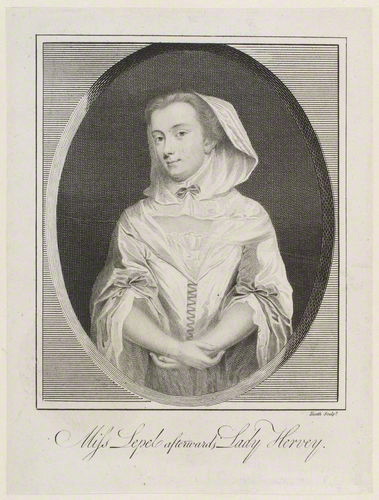
The eldest son of Baron Hervey, our subject today lived a life of privilege. He was educated at Westminster School and Cambridge University before he began a career as a Member of Parliament and, far more thrillingly, court favourite to the Hanovers. Married to a lady-in-waiting, Mary Lepell, Hervey was great friends with Frederick, Prince of Wales, but an argument over a mistress led them to part company and Hervey became one of Frederick's greatest critics, his reputation and career protected by his close association with Prime Minister Robert Walpole.


Engraving of Mary Leppell by James Heath, 1748
Mary Leppell by James Heath, 1748

Although physically weak and often unwell, Hervey was popular with ladies and gentlemen alike. Despite his apparently happy marriage he enjoyed at least one affair with Anne Vane, the subject of his quarrel with Frederick,  and possibly  had more lovers besides. He spent time living with male partners too, his flamboyant private life occasionally seized upon by political opponents. Though some found him magnetic, others found him distinctly repellant and he achieved some small notoriety as a constant target of Alexandre Pope, who based a number of unpleasant characters on the Baron. The reason for this vitriol appears to have been Pope and Hervey's shared affection for Lady Mary Wortley Montagu, rumoured to have been another of Hervey's lovers. In 1735's Epistle to Arbuthnot, Pope apparently described him as, among other things, "this painted child of dirt that stinks and stings...", though the writer denied that his target was Hervey.


Portrait of Lady Mary Wortley Montagu by Charles Jervas
Lady Montagu said this "world consisted of men, women, and Herveys"

Under Walpole's administration Hervey enjoyed no small influence at court, eventually rising to the position of Lord Privy Seal in 1740. His highest office would last only two years though and when Walpole fell,  Hervey went with him. He continued to write political pamphlets and remained as opinionated as ever, his name linked with a number of anonymous and unflattering letters and articles, a number of which were addressed to Pope.

In his lifetime Hervey was known to the public mostly as the object of Pope's derision and yet the Baron had written a work of his own, detailing in minute and highly unflattering detail the behaviour of Frederick and the king over the course of a decade, reserving his warmest praise for the women of the royal household. Memoirs of the Court of George II was suppressed by Hervey's family until 1848 and though heavily edited upon release the memoir revealed a bitter court at odds with itself and George II as a man of little intelligence and even less common sense, his decisions taken by Hervey's adored Queen Caroline and a government who saw him as little more than an obstacle to be navigated. Taken alone the book might be seen as a bitter last work but read alongside Walpole's own memoirs of the court one cannot help but be struck by similarities; indeed, it seems that the house of Hanover was anything but a happy place to be!

Thursday, 11 July 2013

The Short, Scandalous Life of Queen Caroline Mathilde

Caroline Matilda of Great Britain (London, England, 11th July 1751 - Celle, Germany, 10th May 1775)


Portrait of Caroline Mathilde by Francis Cotes
Caroline Mathilde by Francis Cotes

She went from the House of Hanover to the court of Denmark and ended in scandalous exile and a tragically early death - today marks the birthday of Queen Caroline Matilde.

One of the women to whom grandmother Gilflurt was often favourably compared for the bloom in her cheeks and the grace of her manners, Caroline Mathilde was the youngest child of Frederick, Prince of Wales and Princess Augusta of Saxe-Gotha. A world away from the formal manners and customs of the Hanoverian court, Caroline's was raised in seclusion following the death of her father and she enjoyed a relatively simple life, delighting in nature and equestrian pursuits.

This quiet, settled existence was to end at the age of 15 when a very reluctant Caroline Mathilde travelled to Copenhagen to become the wife of her cousin, King Christian VII of Denmark. Known as something of an eccentric, the full extent of Christian's mental illness had yet to show itself and from the start their marriage was a far from happy one. Reluctant to consummate the marriage, Christian preferred to spend time with courtesans and prostitutes, frequenting the brothels of the city whilst rejecting all contact with his wife. With the line of succession in jeapardy, Christian's advisers became to whisper that it would be a shame if the king were to be thought of as impotent; their scheming did the trick and the couple finally produced the all-important heir.

By 1769 Christian's eccentricities growing more and more extreme and his decision to bring doctor Johann Friedrich Struensee to court was applauded by his counsellors, who saw the physician as a much-needed stabilising influence. In fact it was to prove a pivotal moment in the history of the Danish monarchy, shaking the house of Oldenburg to its very foundations.  Within a year the queen and Struensee were lovers and as the king grew more disturbed, so Struensee's influence at court increased until, in late 1770, he was elected privy counsellor (maître des requêtes). With the king confined, Struensee enjoyed a period of virtually unchallenged authority, initiating over a thousand reforms that began with the total restructure of the unwieldy Danish cabinet. One might have expected Christian to be disturbed by these developments but in fact it was the opposite; he delighted in the unusual arrangement, glad to see his wife happy, his own marital responsibilities discharged and the burden of government business lifted from his shoulders.

With the guidance and support of Caroline Mathilde, Struensee's reforms included the abolition of torture, the banning of slavery and widespread vaccination against smallpox for the poor. In fact, his experimental inoculation against the disease had been what first brought him to Caroline's attention when his decisive actions saved the life of her son.

The Time of Struensee was over within 16 months. Outraged by Caroline Mathilde's open liaisons with the doctor and her proclivities for dressing as a man and mixing with the populace of Copenhagen, the birth of a daughter that was assumed to be Struensee's child was the final straw. Facing higher taxes, reduced privilege and more reforms than they knew what to do with, the cabinet and court turned against the queen and her lover, their support for Christian returning with a fervour.

In January 1772, Caroline Mathilde and Struensee were arrested and interrogated. In April of that same year the royal marriage ended in divorce and Struensee went to the scaffold.

Having a king for a brother is always handy and George III successfully petitioned to have Caroline Mathilde released from prison and sent into exile in the Hanovarian Celle Castle; here, the former queen of Denmark devoted herself to charity as well as continuing to plan for the day when she would depose Christian and rule as regent. In fact, Caroline never saw Denmark nor her son again and she died of scarlet fever at the age of just 23.

George III rejected calls for Caroline Mathilde to be buried in Westminster Abbey and she was interred in her place of exile, Celle Castle, the final stop in a life that had been short, scandalous and ultimately tragic.

Read more about the tragic life of Caroline Mathilde in my book, Life in the Georgian Court! 

Life in the Georgian Court, true tales of 18th century royalty, is available at the links below.

Pen and Sword
Amazon UK
Amazon US
Book Depository (free worldwide shipping)