Showing posts with label America. Show all posts

Saturday, 8 July 2017

The History of the American News Media

It's a pleasure to welcome Mari Anne Christie for a delve into the history of the American news media!


---oOo---


Back when the American news media could be trusted…

“A gruesome clash between North and South is inevitable—
if only because newspapermen are screaming about it.”
— Blind Tribute

America is a country divided; it cannot be argued. Perhaps more so than any time in our history, barring only the Civil War of 1861-65. And the environment now is beginning to look remarkably similar to 1860.
While it seems logical to say that, as Americans, we have more in common than not, myriad forces continue to tell us we are wrong, chief among them, that broad, varied and variable category, “The Press.” Whether “fake news” or “Russian partisan propaganda” or “opening up the libel laws” or the role of comedic satire or the need for (or advisability of) “Woodward-and-Bernstein-style” exposés, all we seem to hear about on the news is… the news.
Conventional wisdom says the media environment wasn’t so hyper-partisan before President Reagan pressured the FCC to abolish the Fairness Doctrine, which mandated balanced reporting in broadcast journalism, requiring broadcasters to discuss controversial matters of public interest and air opposing views. Back then, the story goes, the press existed to provide a service, to act as part of the systems of checks and balances—the “Fourth Estate” in the triumvirate of American checks and balances. Reporters acted with integrity and forethought, exposed corruption, spent more time informing than imposing electoral dogma. The news business used to be trustworthy. Right?
Not exactly. 
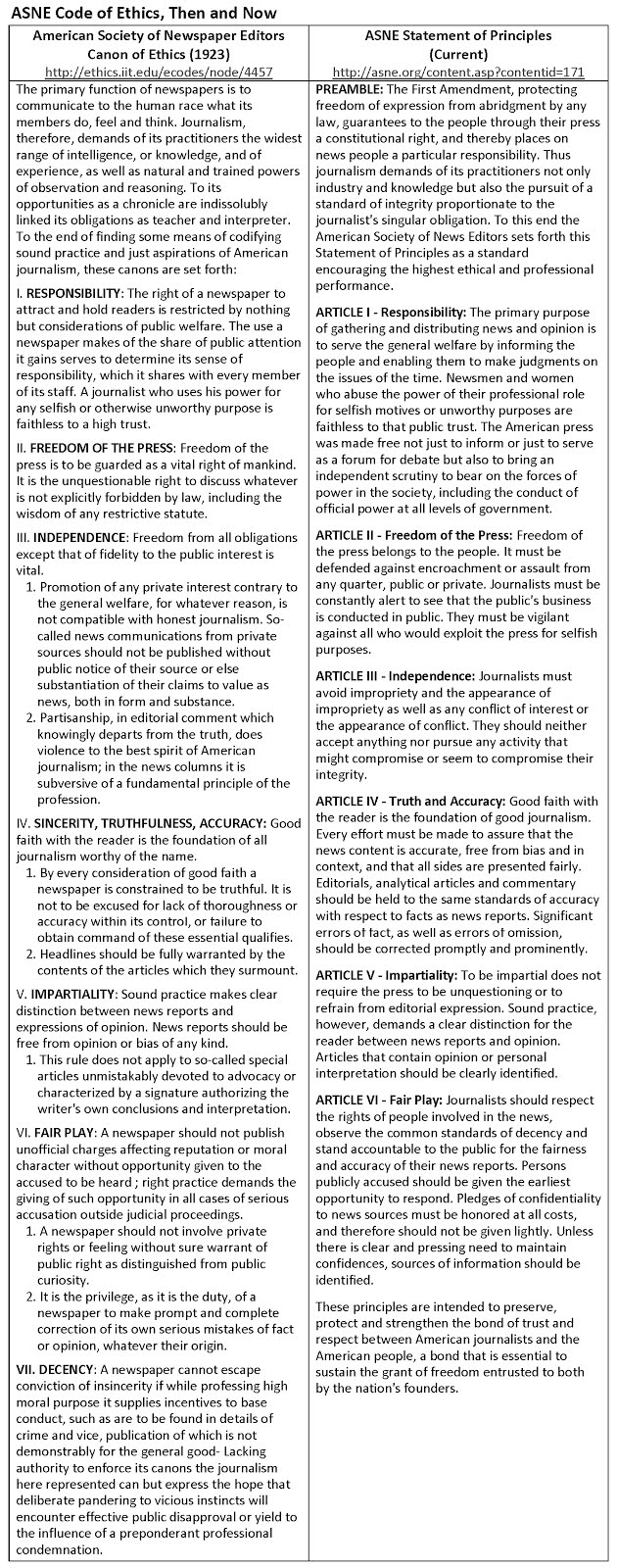
The Fairness Doctrine, when instituted, was sorely needed. The ethics the Fairness Doctrine meant to codify in the face of new broadcasting technologies were still quite young in 1949. They weren’t even industry norms until the early 20th century. (It should be noted that, even now, media ethics are entirely voluntary and, ironically, unenforceable by virtue of the First Amendment.) While the question of ethics and values in this industry goes back to the 17th century in Europe, the answers, in America at least, are much more recent.
The Society of Professional Journalists (SPJ), arguably the modern keeper of this canon of ethics, was not formed until 1909 (then—and until 1960—a men’s fraternity called Sigma Delta Chi). The American Society of Newspaper Editors (as of 2009, the American Society of News Editors) (ASNE) was formed in 1922 for the express purpose of developing and codifying norms and ethics for the industry, which were set in type the following year. The SPJ borrowed this code in 1926, and these remained their central tenets until 1973. 
However, if we travel further back, sixty or so years before the ASNE and SPJ began their work to make the news business honest, trustworthy, and accountable, we reach the beginnings of the Civil War, when the glorious olden days of media integrity didn’t exist. Not only that, just about any reporter, if presented with the concept of “fair and balanced,” would have either given you a blank stare or laughed at you outright.
On the question of partisanship, our modern media has nothing on the early 19th century. 
So, back to the Civil War: the current president asks, “Why couldn’t we just work that out?” Of course, the thought process is reductive; in short, it couldn’t be worked out because slavery could not, should not, and would not stand. But as to why emotions ran to such a fever pitch at just that moment in history? Perhaps because newspapermen were screaming about it.
Even given the risk inherent in trying to separate a man from his money (even when that “money” is invested in ownership of other humans); and given the (pseudo)religious and (im)moral justifications for slavery, and their opposite refrains in the Abolitionist movement; and given the innate tension between federalism and community sovereignty that threads through our entire democratic history; and given that Europe would quite possibly have used slavery (in due course) as a pretext for embargo or another war; and given, finally, that an armed black uprising probably would have eventually succeeded, why did the rhetoric heat to a boil then? Why did we end with a conflagration then
At the risk of also becoming reductive (probably inevitable when discussing the causes of the Civil War): 
It might have had something to do with the fact that nearly every newspaper in America was associated with one political party or another, and no political party was without its conjoined newspapers. Not only was this the norm and accepted practice, it wasn’t even considered unethical. If a man (and, of course, it was always men) was smart enough to own a printing press, erudite enough to make his opinions matter to his readership, and wealthy enough to expand his newspaper’s reach, why would he not use it to trumpet his own views? If he had once held elected office or planned to in the future, would that not just make him better informed about the issues of the day? And why would he not affiliate with the politicians who agreed with him, to expand his circulation, lend weight to his message, and defray his costs? It is capitalism in action. The American Way. (For both Americas—freedom of the press was enshrined in both Constitutions, and the norms of the burgeoning industry crossed the Mason-Dixon line.)
Thus, a partisan, vocal, and influential news media (in part) drove conflict into war, and now, it seems, we have forgotten the lessons of the past. To provide a bit of necessary perspective, it should be noted that without the constraints of the Fairness Doctrine, and owing, in part, to the expanded technological landscape, partisanship in the news business is once again the norm, as are the use of political relationships and affiliations for purposes of profit and influence. The primary differences between the media now and in 1860 are: the increased speed with which news travels and the expanded breadth of its reach.
References:
"American Society of Newspaper Editors Code of Ethics or Canons of Journalism." (1923) Illinois Institute of Technology Ethics Codes Collection, 10 Nov. 2016, http://ethics.iit.edu/ecodes/node/4457.
"American Society of Newspaper Editors: History." (2014) ASNE website, 10 Nov. 2016, http://asne.org/content.asp?contentid=83.
"American Society of Newspaper Editors: Statement of Principles." (2014) ASNE website, 10 Nov. 2016, http://asne.org/content.asp?contentid=171.
 “Society of Professional Journalists: Code of Ethics [2014]." SPJ website, 10 Nov. 2016, https://www.spj.org/ethicscode.asp.
“Society of Professional Journalists: History of the Society." SPJ website, 10 Nov. 2016, https://www.spj.org/spjhistory.asp.

https://youtu.be/m9oihJUkTBk
 Excerpt from Blind Tribute
The general looked as if he were sucking a lemon. “As it happens, Mr. Wentworth, your note was prescient. The Army has need of your services.”
“I can’t imagine what the Army could possibly need from me.” Harry didn’t need to imagine, as the subject had been raised twice by his contacts in Lincoln’s cabinet, and both times, he had politely declined their requests. Harry was not of a mind to be as polite a third time, and this man wasn’t nearly important enough to warrant restraint.
“Clearly, I am here to discuss it.” 
Judging by the shade of his face, the general’s mood was devolving every minute, and Harry expected it wasn’t going to get any better before he left.
One might assume a man wanting someone’s help would at least drink his whiskey. 
“As we move into new territory,” the general said, “we are coming across abandoned newspaper offices.”
“Abandoned?”
Stevens looked away briefly. “What do you call it when a building full of printing presses is found with no owner?”
“I’d call it violent suppression of information at the hands of an invading army. In line with President Lincoln’s actions against the Journal of Commerce and other newspapers in the North, but presumably involving more bloodshed and fewer arrests.” Harry struggled to calm his tone, in pursuit of the other goals to be accomplished before the general left in his inevitable huff. “But I’ve seen such actions all over the world, both subtle and brazen. Perhaps, for some, it isn’t so easy to identify.” 
“The president had every right to—”
Harry held up a hand and shook his head, stopping the general’s speech. He smiled, taking in every motion as Stevens shifted in his seat. Showing his teeth, he said, “No. There is no argument to be made on Lincoln’s side of this issue, if you would call yourself a patriot. Not if you wish to be received in my home. So, what is it you’d like me to do about these newspaper offices?”
A wiser man would have been distracted by Harry’s canines. “We’d like you to organize them into a logical structure to… assist us in achieving our military objectives.”
“Is it not enough you have a stranglehold on the Associated Press and American Telegraph? Now you want to operate a misinformation service, and you think I should manage it?”
The general stiffened. “I would not express it in those words.”
“Of course not.” Harry sat back silently, and Rink followed his lead. The captain tapped out and refilled his pipe, and Harry took out a cigar. He offered the box to Stevens, but the man declined with a quick shake of his head. Stevens sat staring, but was more than self-disciplined enough to also remain quiet. Eventually, Harry said, “You’d like me to print articles favorable to the Union in areas you’ve occupied.”
“Well… yes.”
“The dictionary definition of misinformation. No.”
“No?”
“No. To begin with, Lincoln and I do not see eye-to-eye on the role of the Fourth Estate. He may thank his treatment of the opposition press, in part, for this decision, and he well knows it, as he has heard my opinion on the topic at great length. This is why he did not approach me directly, and why you have been sent against your will to have your ears blistered in his stead. There are plenty of correspondents milling around the South who believe far more in your cause; I daresay some would do it purely for the dubious prestige. Choose one of them.”
“We have… I mean, for individual… we need someone who can oversee the entire…” The general trailed off at the look on Harry’s face. He managed a blush before he regained his military composure. “It’s a sizable enterprise…”
“I imagine. The more sizable, the more my answer is no.”

To pre-order Blind Tribute for July 28 delivery: www.Books2Read.com/BlindTribute

Giveaway

Mari will be giving away a quill pen (like Harry's) and powdered ink, a swag pack including Harry's Editorials Collection, and a e-copy of the book to one winner.

If you can’t embed here is the direct link: http://www.rafflecopter.com/rafl/display/16e4beaa15/?

Book Blurb
Every newspaper editor may owe tribute to the devil, but Harry Wentworth’s bill just came due.

As America marches toward the Civil War, Harry Wentworth, gentleman of distinction and journalist of renown, finds his calls for peaceful resolution have fallen on deaf—nay, hostile—ears, so he must finally resolve his own moral quandary. Comment on the war from his influential—and safe—position in Northern Society, or make a news story and a target of himself South of the Mason-Dixon Line, in a city haunted by a life he has long since left behind?
The day-to-day struggle against countervailing forces, his personal and professional tragedies on both sides of the conflict, and the elegant and emotive writings that define him, all serve to illuminate the trials of this newsman’s crusade, irreparably altering his mind, his body, his spirit, and his purpose as an honorable man. Blind Tribute exposes the shifting stones of the moral high ground, as Harry’s family and friendships, North and South, are shattered by his acts of conscience.

Author Bio

Mari was “raised up” in journalism (mostly raising her glass at the Denver Press Club bar) after the advent of the web press, but before the desktop computer. She has since plied her trade as a writer, editor, and designer across many different fields, and currently works as a technical writer and editor. 
Under the name Mari Christie, she has released a book-length epic poem, Saqil pa Q'equ'mal: Light in Darkness: Poetry of the Mayan Underworld, and under pen name Mariana Gabrielle, she has written several Regency romances, including the Sailing Home Series and La Déesse Noire: The Black Goddess. Blind Tribute is her first mainstream historical novel. She expects to release the first book in a new family saga, The Lion’s Club, in 2018.

She holds a BA in Writing, summa cum laude and With Distinction, from the University of Colorado Denver, and is a member of the Speakeasy Scribes, the Historical Novel Society, and the Denver Press Club. She has a long family history in Charleston, South Carolina, and is the great-great niece of a man in the mold of Harry Wentworth.


Links

Universal Link
books2read.com/blindtribute

Mari’s Website
Amazon

Barnes & Noble

Smashwords

iBooks

Kobo

Scribd

24Symbols.com

Indigo
Mari Christie Social Media  
Facebook Launch Party, July 28th, 2pm - 8 pm MDT: https://www.facebook.com/events/724880974366499/

Author Website & blog: www.MariAnneChristie.com 
Street Team: https://www.facebook.com/groups/marismuses/

 ASNE Code of Ethics table


Thursday, 15 December 2016

Lady Anne Barnard

It's a pleasure to welcome Stephen Taylor, author of the fantastic, Defiance, to the salon. This wonderful biography of the estimable Anne Barnard, a most remarkable adventuress, is not to be missed!

---oOo---

She lived vividly at the heart of Georgian society, wrote a ballad acclaimed by Scott and Wordsworth, was privy to one of the great secrets of the age and left a body of papers that bear comparison with those of Fanny Burney. So why is she better known today in South Africa than in her native land? As the biographer of Lady Anne Barnard, it is a question I puzzled over for years.

I knew when I started my research that the materials were rich. Anne’s years at the Cape of Good Hope from 1798 established her as one of those indomitable women travellers of the early empire, a free spirit who mixed as easily with indigenous Africans as with aristocratic proconsuls sailing to and from India. Her diaries, published in South Africa and pored over by historians, showed too that she was a brilliant writer and artist.

What I did not realise when I asked her descendants for access to her papers was how much broader the sweep of her pen had been. Rather than a starting point, the Cape had been a climax in Anne’s bewilderingly busy and adventurous life; and her chronicle of it – unpublished and virtually unseen – is a trove of fresh information and insights into the Georgian age.

But to go back to the starting point: why is she not better known?

The eldest child of the Fifth Earl of Balcarres, Anne Lindsay grew up in the brilliant milieu of the Scottish Enlightenment, sharpening her wits among the likes of David Hume and Adam Smith. James Boswell used to relate a story from their Scottish tour how this 23-year-old “lady of quality” could hold her own in exchanges with Samuel Johnson.

But hers was an age when the daughters of impecunious lairds were commonly married off to men of fortune, and from the outset Anne stood her ground against such a fate. She rejected at least eleven suitors, insisting that marriage must go with love. “Matrimony, I am not ready for thee!” she wrote. “To say Yes to a proposal that would thwart the heart as long as I existed? To cheat an honest man out of the only fortune he can expect to get with me, a free heart? No, I can’t”. 

Her defiance of convention sat ill with Edinburgh’s pillars of rectitude. When Anne rejected the son of a judge, Lord Kames, he called her “a witch and a she-devil.” Attempting to turn a page, she fled to London.

Brilliance in company quickly established her as a figure in fashionable society. The Prince of Wales became a close friend and Anne introduced him to Maria Fitzherbert, the Catholic widow with whom he became infatuated. As his attentions intensified, Anne and Maria escaped to Europe, travelling together for almost a year before Maria’s resistance melted.

Meanwhile reputation started to catch up with Anne. To the cream of the social whirl, the haut ton, she was always an outsider. The respectable thought her eccentric – what a later era would have termed bohemian – because she lived independently, buying, decorating and renting houses in fashionable locations like Berkeley Square.

There were also scandals. London loved gossip and though Lady Anne Lindsay never gained the notoriety of Frances Villiers or Mary Coke, her love affairs attracted a good deal of attention. An incident involving a dissipated wastrel, Lord Wentworth, led to Anne being dubbed “the Devil in Scarlet” by Lord Byron’s mother-in-law. In the course of another doomed liaison, with the politician William Windham, she travelled to France to observe the Revolution.

These episodes left scars. As became clear when I discovered her papers, it was Anne’s sensitivity about her past that resolved her, in effect, to blot out her story.

The prospect that she would marry appeared to have passed when she received what was her thirteenth proposal at the age of 42. Andrew Barnard, a handsome but unknown former army officer, was 30. She accepted, and began the biggest adventure of her life.

Together they sailed to the Cape where she had obtained him the post of secretary to the governor. The Barnards lived in a simple cottage called Paradise at the foot of Table Mountain where she kept a small menagerie of wildlife. At the same time she acted as the governor’s hostess. 

For this land, which they both came to love, she had a wider vision. When the Barnards set off on a wagon tour of the interior, Pitt’s government saw the Cape as no more than a strategic bastion to protect its vital shipping network to India from the French. Anne did her best to convince influential friends at home that Africa too had potential. “Here is scarcity, but here will be plenty,” she wrote to Pitt’s deputy, Henry Dundas. “It is in the power of activity to make this the finest scene in the world by planting.”

Andrew Barnard died at the Cape. It is clear from their letters that the marriage had been supremely happy and nothing could replace him in her life. Anne lived at Berkeley Square until her death aged 74 in 1825, devoting her final years to the creation of six volumes of memoirs in which she recorded her life with wit and irony, along with a searing honesty. Hence the edict she issued shortly before her death that they were for the eyes of family only and never to be published.

When writing to the Earl of Crawford and Balcarres, custodian of the memoirs, I had no idea of their scope and content. As it transpired, they opened the door to exhilarating and ever more astonishing places. Anne kept me fascinated, and had surprises in store right to the end. So for the reader too, I hope, will Defiance: The Life and Choices of Lady Anne Barnard.


Wednesday, 20 July 2016

Passing the Mantle

I'm delighted to welcome my regular guest, Avellina Balestri, to discuss the relationship between Braddock and Washington.

---oOo---

Passing the Mantle: The Complex Relationship Between General Edward Braddock and Colonel George Washington

By Avellina Balestri
    

     The British General Edward Braddock and his young colonial aide George Washington are often portrayed as symbols of the antagonism brewing between Britain and her Colonies during the French and Indian War, which would soon burst forth in the form of the American Revolution. This is partly true, but their relationship and the relationship between Britain and America were and are much more complex than has often been portrayed in grade school history texts and Hollywood motion pictures. There was also something deeply human about their interaction that is often overlooked in favor of a more easily understood narrative that chooses sides rather than seeks out the middle way.

   In February of 1755, Edward Braddock, a 62-year-old veteran of the prestigious Coldstream Guards and native of Perth, Scotland, was sent to North America to ostensibly “put the French in their place” and push them further west to make room for the expanding British colonies in the Ohio River Valley. The colonists themselves were enthusiastically behind this push for supremacy, and initially welcomed the regular troops sent from the Mother Country to aid them in the territorial struggle, known as The French and Indian War in America and The Seven Years War in Europe.

     But problems arose almost immediately, involving the proper accoutrement of these newly arrived troops and misunderstandings on both sides. The British viewed the colonists, by and large, as low-life opportunists who tried to get best edge on every deal and refused to obey orders or conform to disciplinary regulations. The colonists, on the other hand, resented the pompous and bullying attitude of the British officers, including Braddock, who refused to acknowledge that the Americans could ever stand on equal footing with them in social, political, or military spheres.

     Nevertheless, both sides realized it would be mutually advantageous to put up with one another in order to successfully overthrow the common enemy. In the process, a variety of interesting Anglo-American relationships were forged, turning some people into long-time friends, some into long-time enemies, and others into something in between. Still, “all for one and one for all” proved easier said than done in the majority of these instances.

    Meanwhile, Colonel George Washington, a 23-year-old officer in the first Virginia Regiment, was just coming off the disgrace of firing on French dignitaries, losing control of his tomahawk-wielding Indian allies, and getting bottled up in his ill-constructed, valley-based Fort Necessity. He managed to get out of the jam only after promising the French commander he would stay off the field of battle for a year. But then General Braddock selected him to be one of his aides. Maybe, in spite of Washington’s past blunders, Braddock saw a spark of talent in the young man and wanted to be the one to bring it out.

     The general soon took to mentoring Washington in the methodical and oft times brutal ways of the regular British army, in which soldiers were often flogged within an inch of their lives for minor offenses, and strict discipline ensured that they were a feared fighting machine on the fields of Europe, with precision and coordination to match their best continental competitors. And yet in America, frontier warfare required more flexibility and imagination to meet with success, especially when facing off against Native American tribesmen. Braddock was an regular officer of the old school, who was adept at teaching but loathe to learn anything new. These contentions were to be brought to a head as they set out to capture Fort Duquesne in Western Pennsylvania so that the British would have a stronghold in the Ohio River Valley.

     On July 9, 1755, as the British troops marched towards Fort Duquesne, Washington was feeling sickly from a nasty bout with dysentery, and Braddock advised him to keep to the rear for the sake of his health. But Washington was determined to stay where the action might be, perhaps in order to redeem himself as a fit officer. Also, he seemed to have hopes of convincing Braddock to alter his tactics to better fit the North American theatre. But the general’s ego would never allow him to even consider taken advice from a subordinate colonial, and he bellowed that he had a mind to “thrust a blade through his body” should he dare to be so presumptuous again.

    Evidently Braddock felt a bit sorry for going so over-the-top a few minutes later, especially since his young charge was looking pretty miserable, and even had a pillow tied to his saddle. So in his bluff yet slightly affectionate manner, he called his other aides over and made a general announcement that, although he had advised him to the contrary, young Washington had determined to make a local hero of himself and turn out as sick as a dog. Hence, it was their duty to look after the under-the-weather pup and make sure they were on-call to assist him. No doubt this embarrassed the proud young man, but he swallowed it the best he could, perhaps knowing that the general meant well, and it was his way of trying to patch-up his latest and greatest (thus far!) rant. But this was just the beginning of the ordeal.

     Along the Monongahela River, 10 miles from their destination, the British came into contact with the French and their Indian allies making a sortie from Fort Duquesne. Colonel Thomas Gage was the young British officer in charge of the advance guard. By nature mild-mannered and bookish, he had a knack for doing the exact wrong thing in combat situations. When he realized they were being surrounded by creepers in the woods, he decided for some bizarre reason that everyone should just STOP while he figured out the best-laid text-book solution to elude and/or counteract war-painted Indians shrieking and shooting from behind trees. Hence Gage ordered his column to stop…but failed to alert the brush-cutters behind them who crashed into the soldiers, causing total confusion, and more so as the other ranks behind the wood-cutters got entangled with them! By now, the British were hopelessly entrapped, and the French and Indians opened fire. It was doomed to be a massacre form the very start.

    Finally, news reached Braddock and his aides in the rear that the battle had broken out, and they galloped to the front. Again, Washington saw the lunacy of trying to use European tactics in this situation, but Braddock insisted the men should hold to their ranks and fire in accord, as if on a battlefield facing an opponent directly. Any man caught taking cover and abandoning his post would be instantly executed as a coward and deserter. This was the way Braddock had been trained when he was the same age as Washington, and it had served him well for some 40 years. He could not and he would not be convinced that it could fail him now. But the men could not see their enemies, picking them off from behind the trees, to pour a volley into them. This was pure guerilla warfare, for which the British were woefully unprepared

     As the situation spun out of control, Washington begged Braddock to allow his men to take cover and save themselves from the slaughter. Braddock emphatically refused, and he himself stayed in the hottest part of the action to set an example. Both he and Washington had multiple horses shot out from underneath them, but kept getting back into the saddle. Meanwhile, the general’s other two aides were shot down. Now the “sick pup” was his sole support. But the feeling between the two was none-too-amicable as the casualties mounted and the folly of Braddock’s stubbornness became increasingly apparent. Still the general rode through the thick of the battle with bullet whizzing around him, flashing his sword and trying to steady his men, while at the same time slashing down any who dared to run. Washington continued to plead with him to change his orders, but the general only swore at him and mocked him as a “beardless boy.”

    One of the many tragic scenes taking place in the meantime was the death of Sir Peter Halkett, a high-ranking British nobleman and officer whose two sons were fighting under his command during the battle. When he was shot off his horse, his younger son went over to help him, and was himself shot and killed, with his arms still around his father. His man-servant then went to try to rescue both of them, and was also shot. His one surviving son would be haunted by this, and go off to find his brother and father’s remains several years later. He did discover their skeletons, still clinging to each other as they had fallen, and had them buried wrapped in their native Highland tartan.

    As the day grew late and the dead and dying littered the woods along the Monongahela River, Washington made a final desperate plea: this time that Braddock should call a retreat. The old general gazed at his decimated command and was overcome with the realization of what he had done. Finally his pride had been punctured, and he agreed to order a retreat. But just then a bullet smashed into Braddock’s side. Legend has it that it was fired by a colonial, whose brother had been cut down by Braddock for leaving his post. The general reeled in the saddle and fell to the ground, before he could give the word to pull back. Now Washington was the only one left to try and restore some sense of discipline and carry out an orderly retreat. He rode wildly along the lines as the bullets whizzed around him, tearing holes in his coat as he tried to direct the frantic survivors who had now decided it was every man for himself.

    The colonials were particularly fed up with their British counterparts, and hijacked officers’ horses to escape. They also were none-too-keen on helping Brits in any meaningful way to get off the battlefield. One badly wounded redcoat recalled that he had asked an American to help him. Instead, he presented his musket and shot at him, in order to “save him” from a worse fate at the hands of the Indians! Fortunately for the Brit, yon Yank proved to be a terrible shot, and the bullet ricocheted off the tree the wounded man was leaning against. The redcoat had already been sold a bum horse in America, and now decided never to ask help from an American again! However, he did manage to flag down a fellow Brit who rescued him at long last.

    Meanwhile, Washington returned to his fallen general, and with another officer started to carry him off the field. But Braddock now had something of an emotional break-down, realizing the full extent of the carnage. “I don’t want to live!” he groaned. Then he asked that he be given a pistol and left there to face the Indians with the others too badly wounded to run. He said that they would have a better chance of getting away without him. But Washington ignored the melt-down and helped get Braddock into the back of a wagon which was driven off the field.   

   The bullet had penetrated Braddock’s lung, and although his breathing became labored, he still remained conscious and fairly lucid. He called Washington over and ordered him to go check on Colonel Gage, who was still back on the field. Washington did so, and was relieved to find Gage, wounded in the thigh yet still hobbling around giving orders. In fact, it seemed that Gage’s true talent for administrative organization had finally kicked in, and he had managed, against all odds, to rally the stragglers and survivors into an orderly formation. After Gage calmly assured him that everything was under control (“Keep calm and carry on”, what?), Washington returned to the general.

    Again Braddock seemed distraught, and begged Washington to be his emissary and get through enemy lines to the nearest British fort in order to bring back reinforcements and much-needed medical supplies for all. It was a near suicide mission, but Washington, exhausted and increasingly ill though he was, did not hesitate, and galloped off through the woods. It was an all-night ride through the pitch-black wilderness, surrounded by hostile Indians on all sides, and it was a miracle he got through alive. Dismounting in the fort, he just managed to blurt out that the battle was lost, Braddock was dying, and help was needed immediately. Then he almost collapsed, and had to be ushered inside the fort and given a cot to lie down on.

     Meanwhile, the next few days of Braddock’s retreat elapsed. They were painful, lingering ones for the general. Sometimes he was coherent, and able to give orders. Sometimes he went into rants, repeating, “It’s all over!” and “Who would have thought it?” (Washington might have raised his hand then…but the subject was better not broached!). After a while the suffering from being jostled in the wagon became excruciating, and he had to be carried by two soldiers using his long ceremonial military sash as a make-shift stretcher. Finally, he declared that he would just remount his horse, and proceeded to ride along propped up until weakness overcame him, and had to be put back in the wagon.

     When the party finally paused for a rest, we can only imagine all the thoughts that must have assaulted Braddock as he lay gasping in his tent. The army had been his whole life. He had no family, and few friends. Who would remember him after he had gone? Who would think of him as a person, and not just identify him with the massacre at Monongahela where he had decimated his own command? British and Americans, soldiers and female camp followers, officers of the highest ranks and privates of the lowest, all had been cut down in the blood-bath, and were still being tormented by the Indians searching for scalps and booty on the field. Many of the captives would be gruesomely tortured and burned alive.

    Braddock must have known he would be painted as the butcher, the madman who refused to allow his men to save their lives by taking cover, and who had hacked them down if they tried. But would they ever think that that was the way he had been trained to keep his men safe? In Europe, it was stand together and fire as a force or be destroyed. But this was not Europe. And it was too late to go back now. The blood was on his head. He did not want to live to face the guilt, the shame, and dishonor of a trial in London. Why did they not just leave him where he fell?

     His thoughts must have turned to Washington. That young, impudent, stubborn little fool! He should have stayed to the rear instead of trying to show off. But he had done well under fire…marvelously well in fact. The gangly, sickly fellow had done the work of three aides, and remained staunchly at his post in the face of enemy bullets and Braddock’s own curses and insults. Did he hate him for being haughty now, as he was riding through the wilderness alone? Or was he lying dead somewhere, hacked apart by Indians, a final casualty of Braddock’s folly? No, not that! It mustn’t end that way! Perhaps Braddock had been unable to see it through the smoke of battle and the fire of his own pride, but now he felt…a twinge of a different sort of pride. A pride in a boy not his own. But he had no boy of his own to be proud of, to carry on his legacy, and honor his name. This one…this young colonial would have to do it. 

    Braddock called over his loyal manservant and spoke to him kindly, telling him that he had seen enough of war in his service, and should take up farming in America. He said that he should now go into the service of Mr. Washington, and to be sure to take as good care of young man as he had taken care of Braddock. Then he instructed that his long scarlet ceremonial sash be given to Washington as well. It had once belonged to Braddock’s father, also a military man, and embroidered with the date he had joined the army, 1705. It had been given to Braddock upon the death of his father, to carry with honor. But Braddock had no son to pass it on to. The closest person to it was Washington.

    Then Braddock had two letters dictated. One was a report of the battle in which he exonerated the conduct of the officers (including Washington), but severely censured the conduct of the men. It was an old-fashioned fall-back in the aftermath of a disaster in order to preserve the authority of the leaders, allowing the lower ranks to take the blame for disorderly conduct. This was the age of the class system, and with it came breaches of justice in the name of preserving confidence for those in command and maintaining society. Braddock was complicit in this.

     The second letter was written to one of Braddock’s only “friends”: George-Anne Bellamy, a young actress back in England with whom he had a complex relationship. She was the illegitimate daughter of one of his old army comrades who had been abandoned by her vain actress mother and rakish father. Braddock had helped raise the girl, and they grew to be mutually devoted. Whether the relationship remained purely platonic or branched into something more upon her adolescence, she obviously loved him dearly, and he turned into an almost completely different person around her. His usual crusty veneer fell away, and he became as gentle as a lamb.

   Interestingly, George-Anne commented in her memoirs that she never understood why some people complained of Braddock’s rudeness, since he was always the epitome of sensitivity around her. In fact, it was said she was one of the only people who could get him to change his mind or show clemency to those for whom she acted as intercessor. Now, as he lay dying, he knew how effected George-Anne would be by his death, but true to his soldier’s code, he remained unemotional in his message, instructing that she simply be informed Braddock had died bravely at the head of his troops.

    Braddock’s last hours continued to be plagued with fits of delirium. The doctors who finally arrived to treat him realized he was beyond help, both because of his ruptured lung, blood loss, and his own death wish. It was hard for those around him not to pity him, even though many were embittered over his stubborn pride and unyielding sense of superiority that had cost so many lives. Perhaps they realized he was suffering for all of it inside. He knew what would become of his reputation, and the sheer magnitude of the human cost was not lost on him either. He had given up on life, and now prepared with befitting stoicism to face death alone. Seeming to seek some comfort amidst his raging thoughts, he murmured to himself, “We will know better how to deal with them another time…” And then he died. It was July 13, 1755.

    Washington returned to the British camp to learn that Braddock had left him his butler and his sash, and that it was his duty to perform the Christian burial rites for the general since the regimental chaplain had been severely wounded. But when it came time to deliver a eulogy, he found it hard to contain his own sizzling anger at what he had been forced to endure under Braddock, watching his Virginians butchered due to British incompetence and arrogance. Perhaps this was one of the defining moments of Washington’s life, realizing that he was different from the British, even as he was intricately bound up with them.

   So his eulogy was blunt and to point: Braddock’s good and bad qualities were decidedly mixed, and he could be arrogant, stubborn, block-headed, foolish, a rage-a-holic, and just plain rude! But still, he admitted, he was also brave, honest, and generous to those whom he favored. There was a definite edge in his tone, nonetheless, and when Braddock was laid in a common grave below the road so the Indians could not mutilate the corpse, few believed Washington had buried the hatchet. He proved this by joining the throng of Braddock detractors in the aftermath of the battle.

   Washington’s criticisms became so scathing at a certain point that one of Washington’s friends who had also fought under Braddock wrote him a letter begging him to cease and desist. This friend remarked that he had never expected him to join in the cat-calls against their old chief, even though the man’s character was being dragged through the mud in almost every newspaper across Britain and the colonies. After all, he said, Braddock himself had not been one to sully another man’s reputation behind his back out of malice. If he wanted to take them to task, he would do so to their face. He may have been rough and rude at times, but he cared about honor. He also cared about Washington. He may not have always known how to express his feelings, but he did. People were callously saying that Braddock’s death was of no consequence to anyone, that that he was as good dead as alive; now his friend begged Washington to break the painful trend.

    The fact was that Washington was struggling to make sense of his own mixed emotions. There was no doubt that he had come to love his old mentor too, and the anger at being mistreated by him on the battlefield stung all the more because of it. His own father had died when he was but a boy, and his beloved half-brother Lawrence, who had been an officer under the command of British Admiral Edward Vernon, had recently succumbed to illness, leaving him his manor of Mount Vernon. Washington had yearned to find his place in society as a British officer, only to meet with a series of red-tape hold-ups and self-inflicted disasters.

    What hopes must have been aroused when he was selected by General Braddock to be his aide! At last, he must have thought, his dream of recognition would be realized. And yet at Monongahela, the young American realized that he would never be allowed to become what Braddock was…the impenetrable walls of the class system would never allow it. Braddock would not heed advice from him because he was a “mere colonial”, and Washington knew he would be doomed to remain a second-class citizen forever if he remained within the British sphere. His high spirits and manly ambitions could not stomach that. This was exacerbated by Braddock’s own blazing temper directed at him. For Washington, it was the feeling of being rejected by two parents: one was his semi-father-figure Braddock, and the other was Mother England.

    With all these emotions raging, Washington had to watch Braddock shot. No matter the suppression of the class system, the plausible father-son antagonism, or the horrors of the hour. To watch the man he had assisted day in and day out, who had often shown him a gruff yet sincere kindness, and who had proven himself to be a brave if fatally stubborn man suffocating with blood gushing from his lung must have shaken him to the core. And then he had been given his blood-stained sash, the symbol of his mentor’s honor, and the honor of his father before him who had served king and country. The implications were deeply profound, and were not lost on Washington. For Braddock, it had been an act of passing the mantle, and saying in one gesture all the things he had been unable to put into words before the end.


    In spite of his initial verbal hostility to his late mentor, Washington took the sash and put a place of honor in Mount Vernon. But when he was called away from home on his travels, he always took the sash along with him. Even after he had joined in rebellion against the British and became commander-in-chief of the Continental Army, he still kept this heirloom from his old British superior among his personal belongings on his many campaigns, and brought it safely back home with him again. What were his reasons for keeping this tangible link to the past so near to him at all times? Perhaps it is one of the more unique demonstrations of that “special relationship” that Britain and America have always shared, and always will share. Some roots run too deep for anything to pull out.


About the Author

Avellina Balestri is a blessed-to-be-Catholic homeschool graduate from Maryland, USA. She has long had a fascination with British history and culture, originating with her interest in Robin Hood and devotion to the Catholic English Martyrs. She reads and writes extensively on the subject, and has established various international contacts via email correspondence, phone calls, and snail-mail parcel swapping. She also did a stint of political activism for the Unionists during the Scottish Independence Referendum. Her other sources of enjoyment include reading musty historical tomes, listening to Celtic artists such as Loreena McKennitt, and watching classic films such as A Man for All Seasons and TV shows such as Kung Fu. She also sings, composes, and plays the penny whistle and bodhran drum. Avellina is proud to be among the founding "Three Musketeers" of the online magazine The Fellowship of the King (under the alias “Rosaria Marie”) and work as its editor-in-chief.


Written content of this post copyright © Avellina Balestri, 2016.