Showing posts with label Batoni (artist). Show all posts

Saturday, 30 November 2013

A Triple Murder at Sea

Well, it seems to be a week for nautical tragedies of one sort or another and today's tale is another sorry story of violence and chaos. It is a tale of adventure and ambition that begins in Scotland and ends in the ocean, with the brutal murder of a family.

George Glas was born in Dundee in 1725 and trained as a ship's surgeon, making numerous voyages in this capacity before he took command of his own vessel. His ship traded between Africa, the Canary Islands and Brazil, and eventually Glas discovered an apparently unexploited river near Senegal that he was sure would be an excellent spot for a trading port. Glas took his idea to the English government and obtained an agreement that he would be given £15000 if he could obtain the port in the name of the king.


Portrait of Wills Hill, 1st Marquess of Downshire by Pompeo Batoni, 1766
Portrait of Wills Hill, 1st Marquess of Downshire by Pompeo Batoni, 1766; Hill gave his name to Port Hillsborough

Glas accepted the challenge and, in 1764, set off to secure the port. He took his wife and daughter along on the expedition, intending to settle them in the new settlement that he would establish once negotiations were complete. In fact, Glas' confidence initially appeared to be well-founded and he was able to peacefully negotiate the use of the land.

By the end of the year Glas had founded the small  settlement of Port Hillsborough, named in honour of Wills Hill, Earl of Hillsborough and President of the Board of Trade and Plantations. However, when Glas undertook a trip to Lanzarote towards the end of the year, he was captured by the Spanish and imprisoned at Santa Cruz de Tenerife. Glas wrote to England requesting assistance, telling the authorities that the Spanish believed that the port should rightfully be theirs. Indeed, as he languished in prison, the Spanish authorities began a campaign to prove their claim.

During Glas' imprisonment, Port Hillsborough was attacked by locals and many members of the settlement killed, though Glas' wife and daughter were able to flee. They made for Tenerife where, following diplomatic efforts, Glas was freed and the family were reunited once more.

With their dreams of life at Port Hillsborough in tatters, the Glas family set off for England aboard the Spanish and Portuguese crewed barque, Earl of Sandwich. As the ship neared Ireland on 30th November 1765, word spread through the crew that the vessel was carrying a fortune in treasure. The sailors mutinied and when Glas left his quarters to investigate what was happening, he was stabbed to death. His wife and child were dragged from their  cabin and thrown overboard to drown as the mutineers scuttled the ship and made off with its cargo.

However, fate had a final twist to play in the tragic story of the Glas family and rather than sinking, the crew less ship drifted on to beach on the Irish coast. The body of George Glas was found on deck where he had fallen and it took little deduction to realise that the sailors who had recently come on shore and were currently getting soundly drunk in a  local alehouse may know something about the crime. The mutineers were swiftly rounded up and confessed to their crime. Within days they were hanged at Dublin, concluding the sorry story of the family Glas.

Wednesday, 31 July 2013

Art, Antiquity and Absolutism: John V of Portugal

John V (Lisbon, Portugal, 22nd October 1689 – Lisbon, Portugal, 31st July 1750)
João Francisco António José Bento Bernardo, affectionately known as, "The Magnanimous"

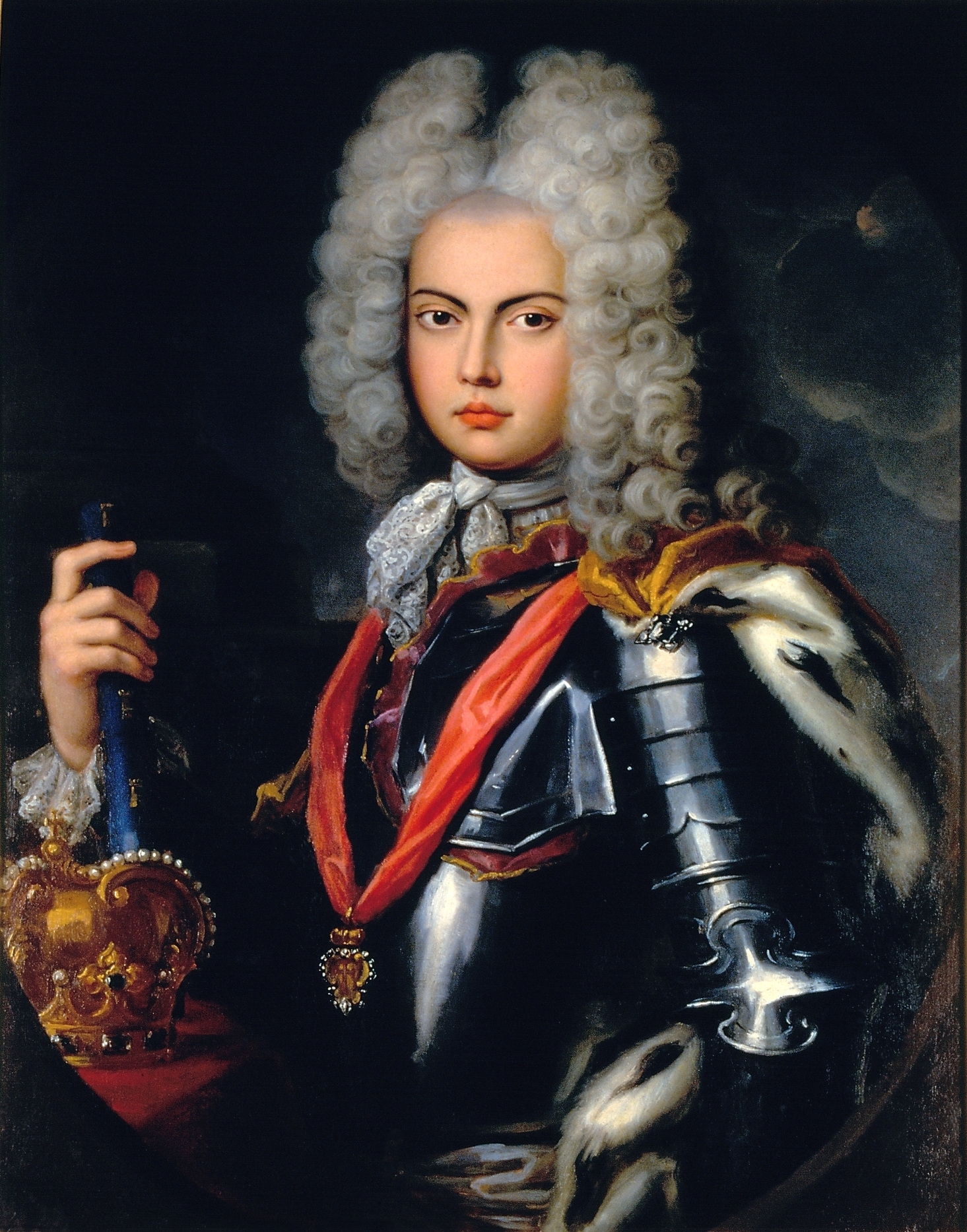
Portrait of John V of Portugal by Pompeo Batoni
 John V of Portugal by Pompeo Batoni

We have spent a fair few days on the continent of late with stories of revolutionary France and Austria; let's continue our tour with a trip to Portugal, for an audience with John V, the Magnanimous, King of Portugal and the Algarves. 

When John was born to Peter II and Maria Sofia of Neuburg, the house of Braganza was already in crisis, with no male heirs to succeed to the throne. In fact John's birth would mark the start of a period of new fecundity for the king and queen, with seven children following after this newborn son, styled as Prince of York and 11th Duke of Braganza. 

John was 16 when his father died in 1706 and was proclaimed king on 1st January 1707; just one year later he married Archduchess and Princess Imperial Maria Anna of Austria, Princess Royal of Hungary and Bohemia, daughter of Leopold I, Holy Roman Emperor and his third wife, Eleonore Magdalena of the Palatinate-Neuburg. This was a shrewd tactical move, ensuring a strong alliance with Austria and flourishing connections in Europe including France and Spain.


Portrait of Queen Maria Anna of Portugal by Pompeo Batoni
Queen Maria Anna of Portugal by Pompeo Batoni

John was a gifted business strategist and achieved what so many of his contemporaries sought for, an absolute monarchy. Portuguese prospectors were growing rich on gold and diamonds mined in Brazil, a Portuguese colony, and John recognised the invaluable source of revenue this could provide. Taking a fifth of the spoils from the mines, the crown grew immensely wealthy and with that money came power, the monarch now absolute ruler of his domains and what rich domains they were!

Portugal was raking in the sort of wealth that other kingdoms could only dream of and John set about spending the spoils of colonisation. He constructed enormous ornate  palaces as grandiose proof of his financial clout and set about filling them with works of art, literature and antiquities. In addition to indulging his own love of the arts, John established Portugal as a strong and growing centre of manufacturing. Not content with this, he created seats of learning and education where, he hoped, his own love of art and antiquity would be passed to subsequent generation. A passionate follower of the art, literature and music, John amassed an enormous and priceless collection in Lisbon and, like so much of that same city, much of this was lost in 1755 when an earthquake struck, bring floods and fires that raged unchecked for days. It was a devastating blow to the cultural heritage of Portugal and one that would no doubt have broken the heart of the man who cared so much for the collection he had gathered from across the world, had he been alive to see it.

When many other countries were actively pursuing aggressive expansion, John instead remained neutral in European conflicts and focussed his energies and his bribery skills on building a relationship with the Vatican. More than anything he was determined to win the recognition and support of the Pope for his absolutist policies, an ambition that was realised in 1748. After years of lobbying and negotiation, John was awarded the title of Most Faithful Majesty of Portugal by Pope Benedict XIV, a successful triumph at the end of a long campaign.


Portrait of John V of Portugal by Carlos Antonio Leoni
 John V of Portugal by Carlos Antonio Leoni 

However, all the wealth and privilege were of no help when John suffered a serious and debilitating stroke in 1742. Unable to return to his political duties he devoted himself to religion as the country, so dependent on his guidance, began to stumble. An absolute monarch is never popular amongst the ruling classes and with the King indisposed, the people of the nation became pawns in a game played by those who now jostled for influence. When he died in 1750, his son, Joseph, inherited a country in turmoil and passed the day to day running of it to  Sebastião José de Carvalho e Melo, the Marquis of Pombal, a man we'll meet on another day.

Life in the Georgian Court, true tales of 18th century royalty, is available at the links below.

Pen and Sword
Amazon UK
Amazon US
Book Depository (free worldwide shipping)