Showing posts with label Bavaria. Show all posts

Friday, 20 February 2015

The Execution of Andreas Hofer

Andreas Hofer (St Leonhard, Tyrol, 22nd November 1767 – Mantua, Italy, 20th February 1810)

On this day in 1810 Andreas Hofer, Tyrolean innkeeper, cattle drover and former soldier, was executed for his pivotal role in the rebellion against the French and Bavarian forces who had occupied his land during the War of the Fifth Coalition.

Hofer was so incensed at the occupation of Tyrol that he organised a resistance force in the Passeier Valley and, when the rebellion broke out on 9th April 1809, Hofer was ready as leader of a militia force. The rebels knew that the time to act had come when the agreed signal was received in Innsbruck of sawdust floating down the river. Church bells sounded over the city calling the people to arms and they attacked the occupying soldiers with all they could muster.

The shooting of Andreas Hofer in Mantua by Anonymous, 1810
The Shooting of Andreas Hofer in Mantua by Anonymous, 1810
As the rebels gained ground, Hofer led a force some twenty thousand strong in defence of his homeland, driving back the Bavarian and French occupying forces time and again yet as the tide of battle turned against Austria and in favour of Napoleon, so too did the tide begin to turn against the Tyrolean rebels. Austrian troops were forced to retreat from Tyrol, leaving the rebels hopelessly outgunned and they in turn fled to the mountains to regroup as the city of Innsbruck fell to Bavarian occupation.

By now there was a price on Hofer’s head and he took refuge in Hofburg, where he declared himself the de facto ruler of the Tyrol, even going so far as to introduce his own currency. The Emperor promised him time and again that he would never abandon Tyrol to opposing forces yet the hope was a faint one. As French and Bavarian troops swarmed into the country, it was only a matter of time before the rich reward on offer for Hofer’s capture found a foothold and it was Franz Raffl, a neighbour of Hofer, who eventually gave him away.

The captured rebel leader was taken to Mantua to face a court martial where officers found themselves unable to agree on a sentence. They claimed to have received a communication from Napoleon himself telling them to "give him a fair trial and then shoot him" though Napoleon claimed later that he had never wanted Hofer dead. Whatever the truth of the sentence, Hofer went before a firing Squad on 20th February 1810. He told the gunmen to be sure they shot straight and refused to either wear a blindfold or kneel before the firing squad. Indeed, when the time came to give the order to fire, it was Hofer who did, a man in charge to the bitter end.


Thursday, 21 August 2014

Rumford's Soup

Sir Benjamin Thompson, Count Rumford FRS (Woburn, Massachusetts, America, 26th March 1753 – Paris, France, 21st August 1814)


Benjamin Thompson, Count Rumford

Today marks the anniversary of the death of physicist Benjamin Thompson, a much-decorated gentleman who lived a life that could never be called dull. He went from his birthplace of Massachussetts to England and then to Bavaria and Europe, all the time working on inventions as diverse as the drip coffeepot, the Rumford fireplace and even the occasional warship.

It is for a culinary achievement that Rumford has piqued my interest today thanks to a recipe developed by the Count in response to the poverty that he saw during his life in Bavaria. Shocked at the hunger and suffering he witnessed, Rumford prevailed upon the government to develop a system of workhouses where people might be able to eat a nourishing meal. To this end, he developed a recipe for a dish that became known as Rumford's Soup and consisted of the following ingredients:

1 part pearl barley
1 part dried (yellow) peas
4 parts potato
Salt according to need
Old, sour beer

The mixture was cooked slowly and though perhaps not delicious, provided a low cost, nutritious and simple meal.

The soup was served in the workhouses of Munich where the poor were employed to make military uniforms and though children were expected to work to earn their keep too, they were also educated and given time in which to play with their peers. At mealtime, the soup was served with rye bread and workers went back to their tasks with full bellies; in fact, the soup was adapted to serve as a basic military ration and with some amendments to recipe, remained in use by some militaries for two hundred years.

Tuesday, 27 May 2014

A Lucky Accident for Joseph von Fraunhofer

Maximilian I Joseph of Bavaria (Schwetzingen, Baden, 27th May 1756 - Munich, Bavaria, 13th October 1825)

Maximilian I Joseph of Bavaria by Joseph Karl Stieler, 1820

Today we make the reacquaintance of Maximilian I Joseph of Bavaria, a king who was well-liked by his subjects and court. He was a a monarch who loved to mingle with the citizens of his country and on the anniversary of his birthday, it seems apt to share a story that demonstrates the very personal interest he took in the lives of those over whom he reigned.

On 21st July 1801 the house of glassmaker Philipp Anton Weichelsberger collapsed. Buried beneath the rubble of the building was Weichelsberger's 14 year old apprentice, Joseph von Fraunhofer. Rushing to the scene of the disaster, Maximilian directed the rescue efforts at the scene of the catastrophe and the young lad was pulled from the wreckage, shaken but alive. Also present at the rescue was Joseph von Utzschneider, a prominent figure in the world of glassmaking and between Utzschneider and Maximilian, the young man's life was to be transformed.


Joseph von Fraunhofer

Maximilian took a personal interest in the future welfare of Fraunhofer and donated money and books in order that he might continue his studies. He prevailed upon Weichelsberger, a stern taskmaster, to allow his apprentice time away from work to study under Utzschneider's care. With Maximilian's financial and moral support, Fraunhofer was eventually able to leave the employ of Weichelsberger and become apprentice to Utzschneider instead. 

It was to prove a fateful decision; the young man who had been rescued from the remains of his master's house went onto become famed for his experiments, inventions and discoveries in the field of optical instrumentation and science. His name lives on today, immortalised in  Fraunhofer Lines, a scientific term still used by scientists to this day.

Life in the Georgian Court, true tales of 18th century royalty, is available at the links below.

Pen and Sword
Amazon UK
Amazon US
Book Depository (free worldwide shipping)

Sunday, 9 February 2014

The Philanthropic Life of Caroline Augusta of Bavaria

Caroline Augusta of Bavaria (Karoline Charlotte Auguste von Bayern; Mannheim, Germany, 8th February 1792 – Vienna, Austria, 9th February 1873)


Caroline Augusta of Bavaria, 1816

Another noble lady visits the salon today today with the story of Caroline Augusta of Bavaria, a shrewd and charitable sort!

Caroline Augusta was the daughter of Maximilian I Joseph, King of Bavaria and his wife, Augusta Wilhelmine of Hesse-Darmstadt. As a striking and vibrant young woman of an influential house, she was in demand as a dynastic match but was not willing to be a pawn to marriage.


The Imperial Family (l. to r., Caroline Augusta, ; Francis I, Napoleon II, Princess Sophie, Duchess Marie-Louise, Ferdinand I, Archduke Franz Karl) by Leopold Fertbauer, 1826

On 8th June 1808 she married Crown Prince William of Württemberg; the marriage was not one of love but was an arrangement of convenience to ensure that she could not be subjected to a marriage brokered by Napoleon. The couple lived apart and were never husband and wife in anything but law, eventually divorcing on 31st August 1814. Caroline Augusta ensured that the marriage was dissolved by Pope Pius VII, ensuring that she would be able to marry again should she wish.


Caroline Augusta of Bavaria, 1873
Caroline Augusta of Bavaria photographed in 1873
In fact, Caroline Augusta remarried just two years later, when she became the wife of Francis I, Emperor of Austria, King of Hungary and Bohemia, having had the choice of the Emperor and his brother, Ferdinand. A well-liked and unassuming  woman with a love of philanthropy, she retired to Salzburg when widowed and indulged her charitable interests until her death.

Life in the Georgian Court, true tales of 18th century royalty, is available at the links below.
Pen and Sword
Amazon UK
Amazon US
Book Depository (free worldwide shipping)

Sunday, 13 October 2013

Diplomatic Flip Flops: Maximilian I Joseph of Bavaria

Maximilian I (Maximilian Joseph; Schwetzingen, Germany, 27th May 1756 – Munich, Germany, 13th October 1825)


King Maximilian I Joseph of Bavaria by Joseph Stieler, 1822
Maximilian I Joseph of Bavaria by Joseph Stieler, 1822

After yesterday's flights of fancy we are firmly back on solid ground today with no trace of or need for a parachute! I've had the girl get the best china out again in honour of another royal guest, a member of the very grand-sounding house of Palatinate-Zweibrücken-Birkenfeld... try saying that after a few clarets!

The boy who would become Maximilian I Joseph of Bavaria was born to Count Palatine Frederick Michael of Zweibrücken-Birkenfeld and Maria Francisca of Sulzbach; as has been the case with so many of our noble guests, the young man's education was focussed on preparing him for a military life in the service of his country. His schooling was supervised by his uncle, Duke Christian IV of Zweibrücken, and the boy proved himself an able and dedicated student. 

A follower of enlightenment and sympathetic to many French policies, Maximilian entered French army at the rank of colonel and rose swiftly up the career ladder. However, when Revolution came to France and some serious sabre rattling could be heard coming from the direction of Austria, the young man found himself under pressure to change allegiance. Eventually he resigned his commission and joined the Austrian army instead, though his he would eventually become allied with Napoleon himself.


Auguste Wilhelmine Marie of Hesse-Darmstadt and her Youngest Children

In 1785 Maximilian married Auguste Wilhelmine Marie of Hesse-Darmstadt, with whom he had five children; she died in 1796 aged just 31 and the following year he married again, this time to Karoline Friederike Wilhelmine of Baden, later to have eight children with her husband. The couple enjoyed many happy years together and Karoline was notable among Bavarian consorts as she was the only one to remain a Protestant throughout her marriage.

With the death of his brother, Charles II, on 1st April 1795, Maximilian became Duke of Zweibrücken. Four years later he acquired a very impressive collection of new titles if not the land to go with them when the death of Elector of Bavaria Charles Theodore saw Maximilian become Elector of Bavaria and Count Palatine of the Rhine, the Arch-Steward of the Empire, and Duke of Berg. Almost immediately Maximilian enacted a sweeping programme of reform across an enormous range of policies and procedures including criminal justice, religion, taxation and education. A born organiser, Maximilian and his minister, Maximilian, Graf von Montgelas, gathered together the disparate territories of Bavaria and began to create a coherent, united Bavarian state.


Karoline Friederike Wilhelmine of Baden

Maximilian founded both the Academy of Fine Arts and the National Theatre in Munich and prided himself on his easy relationship with his subjects. He would often walk through the city and chat to the people he encountered, winning their loyalty and respect due to his down to earth manner and abiding interest in their stories, regardless of their social status. He even personally intervened in efforts to rescue a boy trapped in the rubble of a collapsed building, changing that young man's life in the process.

As his reign went on and Austria made repeated efforts to move into Bavarian territory, Maximilian allied himself with Napoleon and agreed to a marriage between his own daughter and Eugène de Beauharnais. Napoleon rewarded his loyalty in 1806 when Maximilian was given the title of King and a generous parcel of land to seal the deal. He remained an ally of Napoleon until the Treaty of Ried in 1813 when France's defeat in Russia saw Maximilian switch sides in return for an Austrian guarantee that his kingdom would be safe. However, the Treaty was set aside at the Congress of Vienna when Maximilian found himself forced to hand over large amounts of territory once more.


Maximilian I Joseph of Bavaria

Despite his territorial disputes and disappointments, Maximilian remained hugely popular with the Bavarian people. He died in 1825 in his beloved Nymphenburg Palace and was laid to rest at the Theatinerkirche in Munich amid much mourning.  and was succeeded on the throne by his son, Ludwig, whose own reign would end in abdication.

Life in the Georgian Court, true tales of 18th century royalty, is available at the links below.

Pen and Sword
Amazon UK
Amazon US
Book Depository (free worldwide shipping)

Tuesday, 3 September 2013

Marriage, War and Living up to Napoleon: Eugène de Beauharnais

Eugène Rose de Beauharnais (Paris, France, 3rd September 1781 – Munich, Bavaria, 21st February 1824)
Eugène de Beauharnais by Andrea Appiani, 1810
Eugène de Beauharnais  by Andrea Appiani, 1810
We met a lady by the name of de Beauharnais just a few days ago and now it's time to meet a gentleman by the same name. We're staying in France and not straying too far from Napoleon as we say happy birthday to Eugène Rose de Beauharnais.

Eugène was the eldest child of Alexandre de Beauharnais, later to die on the revolutionary guillotine, and Joséphine Tascher de la Pagerie, better known to history as the wife of Napoleon Bonaparte. When his mother and father were incarcerated during the Reign of Terror, Eugène's time was devoted to his military education,  initially under General Lazare Hoche and then at the Collège Irlandais.


Eugène de Beauharnais by Henry Scheffer, 1906
Eugène de Beauharnais  by Henry Scheffer, 1906

Eugène first encountered Napoleon when he requested an audience to demand the return of Alexandre's sword, taken from him at his arrest. The young man was thoroughly was unimpressed with Napoleon at that meeting but the feeling was far from mutual. Impressed with Eugène's loyalty and courage, Napoleon duly saw to it that the sword was returned.

Already making a name for himself as a soldier, following his mother's marriage to Napoleon, Eugène's career improved in leaps and bounds. Although he initially disliked his new stepfather, he went on to fight alongside Napoleon in Egypt, where he was wounded at the Siege of Acre in 1799. The young man's injuries caused him to return to Paris where he found his mother and Napoleon at odds, each furious at the infidelities of the other. Proving himself a shrewd negotiator on the domestic front Eugène brought the couple back together, though their relationship would continue to be rocky.


The Marriage of Eugene de Beauharnais and Princess Augusta by Francois Guillaume Menageot

With his injuries healed, Eugène returned to active service and was given command of the Army of Italy, eventually earning himself the title of Viceroy of Italy in 1805, one in a growing pile of honours. The following year would prove eventful for our hero as he was legally adopted by Napoleon and subsequently given the title, Prince de Venise. He also married Princess Augusta of Bavaria in a union arranged between Napoleon and her father, Maximilian I Joseph of Bavaria, Their politically astute marriage was to mature into a contented and happy bond, with the couple eventually having seven children together.

Princess Augusta of Bavaria by Joseph Karl Stieler
Princess Augusta of Bavaria by Joseph Karl Stieler

Eugène proved himself a popular leader in Italy, taking an interest in the country's constitutional reform and defending his territory against Austrian forces during the 1809 War of the Fifth Coalition. It was here that he experienced his first significant defeat in battle at the Battle of Sacile. Following this failure he regrouped, returned to the strategy table and went on to win a series of victories, securing his position and reputation.

Eugène's glittering career would come to a juddering halt with the fall of Napoleon. Seeking advice from his father-in-law, Maximilian I Joseph of Bavaria, he retired with his family to Munich and remained there until his death, his reputation as a fearless soldier and gifted military strategist secure.

Life in the Georgian Court, true tales of 18th century royalty, is available at the links below.


Book Depository (free worldwide shipping)

Thursday, 29 August 2013

The Political Manoeuvrings of Maria Anna, Electress of Bavaria

Maria Anna Sophia of Saxony (Maria Anna Sophia Sabina Angela Franciska Xaveria; Dresden, Germany, 29th August 1728 – Munich, Germany, 17th February 1797) 


Portrait of Maria Anna by Georg Desmarées
Maria Anna by Georg Desmarées

We're graced with the presence of another regal lady here on Gin Lane today, so we've got the best tea service out. A shrewd negotiator, talented politician and even more of a force to be reckoned with than grandmother Gilflurt herself, it's time to hear the story of Maria Anna Sophia, Electress of Bavaria.

Maria Anna was born to privilege as one of fifteen children of King Augustus III of Poland and his wife, Maria Josepha of Austria. Among her siblings she could count at least one monarch and the mother to three French kings; raised to expect the best of everything, she was by all accounts an intelligent and thoughtful young lady.


Maximilian III Joseph, Elector of Bavaria by Georg Desmarées, 1776

In 1747 Maria Anna married the Bavarian Elector, Maximilian III Joseph, son of Holy Roman Emperor Charles VII. Maximilian Joseph was noted as an enlightened monarch who championed industry and education. The couple were together for thirty years but their marriage remained childless, meaning that succession was far from assured when Maximilian Joseph died in 1777.

Fearing for the future of the lands her husband had commanded, Maria Anna watched in horror as Austria began to encroach on Maximilian Joseph's territory, heralding the start of the War of Bavarian Succession. With her late husband's sister, Maria Antonia of Bavaria, Maria Anna opened secret negotiations with Frederick II of Prussia. She set out the case for the independence of Bavaria against its ever-more aggressive Austrian neighbours and ensured the succession of the dynastic line of her choosing. Deals were struck, bargains were made and Maria Anna secured the future of her adopted homeland.


Photograph of Fürstenried Palace
Fürstenried Palace

This intervention secured her place in the affections of the Bavarian people and she remained beloved of both public and nobility for the remainder of her life. Retiring from the public eye, Maria Anna took up residence in Fürstenried Palace and remained there happily until her death.

Life in the Georgian Court, true tales of 18th century royalty, is available at the links below.

Pen and Sword
Amazon UK
Amazon US
Book Depository (free worldwide shipping)

Thursday, 18 July 2013

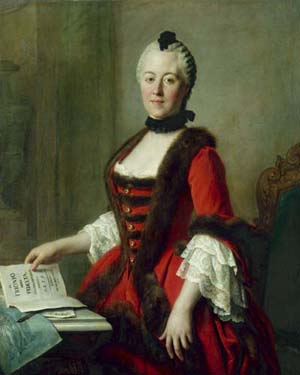
The Musical Duchess Maria Antonia of Bavaria

Maria Antonia, Princess of Bavaria (Munich, Bavaria, 18th July 1724 – Dresden, Bavaria, 23rd April 1780)

The Gilflurts have always been a musical bunch; many's the evening when we gather round the piano and lead the gents in a bawdy singsong. Indeed, great grandmother Gilflurt continues to be a devil with a harmonica, as many a minor peer could attest. Still, despite our efforts with aria, none of us is quite as accomplished as Maria Antonia Walpurgis Symphorosa, the Electress of Saxony who enjoyed a highly respected operatic career as both composer and singer, and that's before we even think about the way she could tickle a harpsichord.

The Electress of Saxony was the fourth child of Maria Amalia of Austria and Elector Karl Albert of Bavaria (later Emperor Karl VII). Passionate about the arts, she became a member of the Accademia dell’Arcadia of Rome, an institution devoted to the preservation of opera. Upon her marriage to Friedrich Christian at the age of 23 she moved to Dresden to join her husband's court. Here she was able to give full rein to her love of music, writing the libretti for two operas and a number of compositions of her own. Not content with this, she performed as a singer and musician at court and studied under Johann Adolph Hasse.


Painting of Maria Antonia and family by Johann Eleazar Zeissig
Maria Antonia sits at the centre of this family painting, Johann Eleazar Zeissig, 1772

Her best known compositions remain Il Trionfo Della Fedeltà (1754) and Talestri, Regina Delle Amazoni (1760), published under the pseudonym Ermelinda Talea Pastorella Arcadia (ETPA). The notices for Maria Antonia's works were favourable and she continued to write and perform throughout her exile from Dresden during the Seven Years War. In 1763 she was widowed and served as a formidable joint Regent with her brother-in-law, Franz Xaver, until her son, Frederick Augustus, was crowned king in 1768.

A woman of prodigious artistic and political talents, it is an honour to take a moment from our piano recital here on Gin Lane and say happy birthday, Maria Antonia!


Portrait of Maria Antonia by Pietro Rotari
Duchess Maria Antonia of Bavaria by Pietro Rotari, 1755

Life in the Georgian Court, true tales of 18th century royalty, is available at the links below.


Pen and Sword
Amazon UK
Amazon US
Book Depository (free worldwide shipping)