Showing posts with label Beechey (artist). Show all posts

Friday, 25 April 2014

The Long Life of Princess Mary, Duchess of Gloucester and Edinburgh

Princess Mary, Duchess of Gloucester and Edinburgh (London, England, 25th April 1776 - London, England, 30th April 1857)
Princess Mary by William Beechey
By William Beechey

On several occasions here at the Guide I have introduced daughters of the house of Hanover. Their lives were not always long and nor were they always happy, married off for political expediency or gain. Today's guest is Princess Mary, aunt to Queen Victoria and loyal sister to a number of our previous guests. Her life was longer than many of her siblings and though her marriage came relatively late in life, it proved to be a settled union.

Mary was born to George III and Charlotte of Mecklenburg-Strelitz at the Queen's residence of Buckingham House and like so many of her siblings, she was christened at St James's Palace. Presided over by the Archbishop of Canterbury, Frederick Cornwallis, the event was attended by many illustrious names from European nobility.


Princess Mary by Thomas Gainsborough, 1782
By Thomas Gainsborough, 1782

The young princess was known for her wit, impeccable behaviour and beauty and it was soon considered that she would make somebody a fine royal bride. At her 1792 debut she charmed the court and at the age of 20, had a fateful meeting with Prince Frederick of Orange, who was exiled to London with his family. The young couple fell in love with one another yet their desire to marry would be unfulfilled. When he learnt of his daughter's attachment to the prince, George III decided that any such union must be postponed in favour of marrying Mary's three elder sisters off first. It was to prove a fateful decision as the young prince died in 1799 whilst on military service in Italy.

Princess Mary was utterly devastated by the loss of her beloved and in recognition of their bond, she was permitted to go into official mourning. Members of her family, particularly Princess Amelia, were Mary's strongest allies during this unhappy time and presently she emerged from mourning, though there was to be no more talk of marriage for some years.


Prince William Frederick, Duke of Gloucester and Edinburgh

In 1810 Mary suffered another devastating loss when her closest sibling, Amelia, died. Like the rest of her family she felt the loss deeply and the death greatly affected Mary. However, a perhaps unexpected turn of events was set in place when Mary's first cousin, Prince William Frederick, Duke of Gloucester and Edinburgh, learnt that Princess Charlotte of Wales was to marry. Despite rumours of whirlwind passionate liaisons with continental ladies, William had not married, having been viewed as a possible match for Charlotte. Now though, Charlotte had been betrothed to another and the 40 year old Duke was left without a bride; it was swiftly decided that Mary, his equal in age and superior in status, would be the ideal candidate.


Daguerreotype of Queen Victoria, Princess Alice, the Prince of Wales (later King Edward VII) and Princess Mary, Duchess of Gloucester, 1856
 Read more at the Royal Collection

The cousins were married on 22nd July 1816 at St James's Palace and took up residence in Bagshot Park. Here they passed many happy and devoted years together; though their marriage was childless, they were respected and loved by their families and Mary would remain a firm favourite into her old age.


Mary finally left Bagshot on the occasion of her husband's death in 1834, when she moved to White Lodge in Richmond Park. Here she remained for the rest of her life, as faithful and close to her family as ever she had been.

Life in the Georgian Court, true tales of 18th century royalty, is available at the links below.

Pen and Sword
Amazon UK
Amazon US
Book Depository (free worldwide shipping)

Saturday, 17 August 2013

Family Feuds and Rumours of Scandal: Princess Victoria, Duchess of Kent

Princess Marie Luise Victoria of Saxe-Coburg-Saalfeld, Princess of Leiningen, Duchess of Kent and Strathearn (Marie Luise Victoire, Coburg, Saxe-Coburg-Saalfield, 17th August 1786 – Windsor, England, 16th March 1861) 

Princess Victoria by Richard Rothwell, 1832

Well, we've been getting a bit caught up in the gents again of late, haven't we? Looking through my bureau in search of gossip about Queen Adelaide, I was reminded of the bitter feud between King William and his sister-in-law, Princess Victoria, the woman who would one day be mother to the ruler of an Empire. From Germany to England by way of a couple of shrewd marriages, it's time to say happy birthday to Princess Victoria, Duchess of Kent.

Born as the seventh child of Franz Frederick Anton, Duke of Saxe-Coburg-Saalfeld, and Countess Augusta of Reuss-Ebersdorf, Victoria enjoyed a privileged upbringing. Bright, charming and attractive she was a cultured young woman with one eye set on making a good match. In fact, that match would come in the shape of Carl Friedrich Wilhelm Emich, Prince of Leiningen, the husband of Victoria's aunt, Henriette of Reuss-Ebersdorf. More than twenty years the young woman's senior, the Prince married Victoria two years after Henriette's death. The couple had two children and little more than a decade after the wedding Victoria was both a widow and Regent of Leiningen. Not content with the lot that fate had dealt her, the social-climbing Victoria would not be single for long.


Edward, Duke of Kent and Strathearn by Sir William Beechey, 1814

In England, something of a monarchial storm was brewing; the Prince Regent's only child, Charlotte, was dead, his brothers either unmarried or estranged from their wives and his sisters apparently past childbearing age. With no legitimate heir to the throne on the horizon it was left to the Duke of Kent, the Duke of Cambridge and the Duke of Clarence (later King William IV) to find suitable wives as quickly as possible. Victoria already had links to the Hanover family as her brother had been married to Charlotte until her death and the young princess had actively encouraged the Duke of Kent to take an interest in her sister in law. Now, with the throne at stake, he redoubled that interest and the courtship became a more formal affair.

Still in her early thirties, the Regent of Leiningen was something of a safely respectable prospect and on 29th May 1818, Edward, Duke of Kent and Victoria were married in Amorbach, Bavaria, the union sealed once more on 11th July at Kew Palace. Their only child, Princess Alexandrina Victoria of Kent, was born in May the following year, destined to become better known to history as Queen Victoria. Edward doted on his daughter but he would not live to see her grow and before the girl was one year old, her father was dead of pneumonia.


The Duchess of Kent and Victoria by Henry Bone, 1824

The newly-widowed Victoria took stock of her situation at this point, considering the options that now lay before her; unable to speak English and no great fan of the country, she seriously considered returning home to Coburg where life would be comfortable, respectable but utterly unremarkable. Saddled with her husband's debt and with her daughter's claim to the throne far from assured, the Duchess instead chose to remain in England, pinning all her hopes on the lack of other suitable heirs. With Parliament refusing to either increase her allowance or settle the debt, Victoria and her daughter took up residence in the somewhat dilapidated surroundings of Kensington Palace, occupying a small suit of rooms there. However, her brother, Prince Leopold, could not see his sister struggle and he supported her from the £50,000 annual allowance he had been granted on his marriage to the late Princess Charlotte. Later to be King of the Belgians, Leopold would remain a strongly supportive figure, eventually introducing the young Queen Victoria to his nephew, Prince Albert of Saxe-Coburg and Gotha,


Sir John Conroy by Henry William Pickersgill

Another source of support to the widowed Duchess was her private secretary, John Conroy. As ambitious as Victoria herself, Conroy allied himself strongly to the widow in the hopes that her daughter would be crowned Queen whilst still a child, ensuring that her mother would become Regent and rely on his guidance. Under the influence of the charming Conroy, the Duchess prevailed upon her daughter to appoint him as her own private secretary, a decision that would later cause friction between the two women. Conroy created an idealised public image for the Duchess of Kent whilst behind closed doors he and his patroness imposed strict rules and systems on the young Princess Victoria that saw her isolated and increasingly unhappy. Rumours swirled that the Duchess and the Welsh officer were more than friends and though Queen Victoria's very paternity has been questioned, she utterly rejected any suggestion that her mother and Conroy were lovers.

For all the scheming and manoeuvring, King William IV seemed determined not to die. Well aware of the plans for a Regency, his fraught relationship with the Duchess deteriorated further into a full blown feud. Once her daughter's succession was assured, Victoria decided that she deserved grander quarters and moved into the refurbished State Apartments of Kensington Palace.  William was furious and made no effort to hide his dislike of his sister in law, though both he and Queen Adelaide were devoted to the young heiress to the throne. The King and the Duchess would never be reconciled and at his final birthday banquet he railed against Victoria, making it clear that his one wish was that she would never be Regent.


Princess Victoria by Franz Xaver Winterhalter, 1857

In fact, William was to get his wish and by the time of his death, the heiress to the throne was a young woman and the ambitious Duchess and her private secretary's plans for a Regency lay in tatters. Finally emerging from their shadow, the new Queen exiled the debt-ridden pair to Buckingham Palace where they remained until 1839, when Conroy left England for the continent at the urging of the Duke of Wellington. The Queen distanced herself from the mother she saw as scheming and domineering and this discord would persist until the birth of Queen Victoria's first child, Victoria, Princess Royal, when the Duchess was finally welcomed back into the bosom of the family. Her debts were settled and the she embraced life as a grandmother, remaining devoted to her daughter and grandchildren until her death.

Despite their fractious early relationship, Queen Victoria was devastated by her mother's passing; she clung to her husband amid her grief yet the year was to bring even more devastation and by the end of 1861, Prince Albert of Saxe-Coburg and Gotha was also dead, the Queen plunged into a deep mourning from which she would never fully recover.

Life in the Georgian Court, true tales of 18th century royalty, is available at the links below.

Pen and Sword
Amazon UK
Amazon US
Book Depository (free worldwide shipping)

Tuesday, 13 August 2013

"Free from vanity and pomp": Queen Adelaide

Adelaide of Saxe-Meiningen (Adelaide Amelia Louise Theresa Caroline, Meiningen, Thuringia, Germany, 13th August 1792 – Bentley Priory, Middlesex, England, 2nd December 1849) 


Portrait of Queen Adelaide by William Beechey, 1831
Queen Adelaide by William Beechey, 1831

After yesterday's flamboyant festivities with George IV, we're celebrating another royal birthday today. It's not quite as wild a party though, as Queen Adelaide was a little bit more subdued than Prinny.

Born in Germany as the daughter of George I, Duke of Saxe-Meiningen and Princess Luise Eleonore of Hohenlohe-Langenburg, Adelaide grew up in the highly democratic state of Saxe-Meiningen, which covered less than 500 square miles. An intelligent and charming young lady with a deep religious faith, Adelaide shunned the glamour of society in favour of a more homely life. However, she would one day travel far beyond her native land, eventually finding herself on the throne of England.

George IV was very fond of theatricals and his brother, Prince William, Duke of Clarence, was no different. Though unmarried, his liaison with actress Dorothea Jordan had produced a number of illegitimate children, but no legal heirs. He cast his regal eye over the likely candidates for marriage and, spurred on by the promise of a fat parliamentary payout in return for a respectable bride, eventually settled on Adelaide. She was a little way down his list of preferential candidates and almost three decades his junior, but the match was made.

Adelaide travelled to England in summer 1818 and met her husband-to-be at Grillon's Hotel in Bond Street on 4th July. A week later she and William were married in a double wedding at Kew Palace alongside Prince Edward, Duke of Kent, and Victoria, Dowager Princess of Leiningen.


Portrait of William IV by Sir Martin Archer Shee, 1833
William IV by Sir Martin Archer Shee, 1833

The ingredients were all in place to create a recipe for disaster: an arranged marriage, a huge age difference and a marriage to secure a throne and financial settlement. However, against all odds William and Adelaide were to become a happy couple. Whilst George was drowning in debt in England the newlyweds made their home in the far more affordable Hanover and lived a quiet life, with Adelaide by all accounts improving her husband's temper and curing a number of bad habits! 

The couple were overjoyed when Adelaide fell pregnant in 1818 yet their happiness was to turn to tragedy when the baby, Charlotte, was born prematurely, dying just a few hours later. A second miscarriage followed in 1819 and in 1820, the couple's four month old daughter, Elizabeth, died after complications from bowel disease. Further tragedy followed in 1822 when Adelaide delivered stillborn twin boys and though rumours persisted of pregnancies, there were to be no further children. Despite a bitter feud with her mother, the Duchess of Kent, both William and Adelaide were devoted to their niece, Princess Victoria of Kent (later Queen Victoria) and the young girl was fond of her aunt and uncle in return and would remain so throughout her life.

By the time of George's death in 1830, William and Adelaide had returned to England and were happily ensconced at Bushy House. Unlike the vitriolic scenes at Westminster Abbey when Caroline of Brunswick tried to be crowned alongside George, William and Adelaide attended the coronation together. Whilst William played the buffoon throughout the ceremony on 8th September 1831, his devoted wife behaved with utmost dignity and won the respect and admiration of all present.


Portrait of Queen Adelaide by Sir Martin Archer Shee, 1836
Queen Adelaide by Sir Martin Archer Shee, 1836

After the profligacy and scandal of George's reign, Adelaide and William were popular monarchs, representing a return to the less extravagant style of George III and Queen Charlotte. Adelaide performed a number of charitable deeds and donated large sums of money to further her charitable interests. Although apparently not interested in political manoeuvring, rumours were rife that the Queen heavily influenced her husband's decisions in favour of her own Tory opinions. 

In 1837 the King fell gravely ill and his wife nursed him for nearly two weeks at Windsor Castle, remaining constantly by his side until he died on 20 June. The Queen Dowager remained beloved of the public through the remaining years of her life, and after her death was buried with her husband at Windsor according to her own wishes, "free from the vanities and pomp of this world.".


Life in the Georgian Court, true tales of 18th century royalty, is available at the links below.


Pen and Sword
Amazon UK
Amazon US
Book Depository (free worldwide shipping)

Wednesday, 7 August 2013

"Tell Charles I die blessing him": Princess Amelia of the United Kingdom

Princess Amelia of the United Kingdom (Windsor, England, 7th August 1783 – Windsor, England, 2nd November 1810) 


Portrait of Princess Amelia (1783-1810), 1797
Princess Amelia by Sir William Beechey, 1797

It has been a bit of a male-dominated Guide of late, what with Emperors, poets and politicians, so I decided the time was right to redress the balance and give a woman who was by all accounts charming, intelligent and beautiful her turn on the front page. Today I shall be wishing happy birthday to a young lady whose short life was beset by ill health and sadness and who was so badly behaved, she contributed to the retirement of a famed portrait painter when she was just two years old!

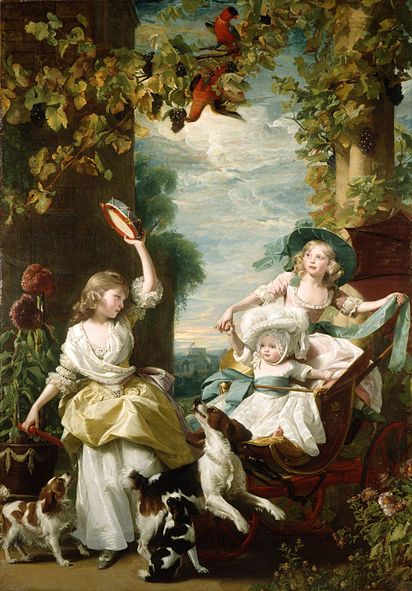
Princess Amelia was the fifteenth and youngest child of George III and Queen Charlotte, born at the Royal Lodge, Windsor, just three months after the death of four year old Octavius, her father's favourite son. Amelia was doted on by her family (who called her Emily) and in particular by George, who had been hit hard by the death of the boy and now transferred his adoration to the new princess. With a wide range of ages amongst her siblings, Amelia spent most of her infancy with her sisters, Mary and Sophia, and it was this badly-behaved trio of girls who drove John Singleton Copley into retirement. 

Being given a commission to paint the three girls in 1785 would have seemed like a fairly run of the mill job for the artist, an acknowledged master of his craft. However, his experience of painting the sisters with various favourite animals and birds was such a trying experience that Copley completed the portrait and then set down his brushes once and for all, entering into retirement.


Portrait of the Three Youngest Daughters of King George III by John Singleton Copley, 1785
The Three Youngest Daughters of King George III by John Singleton Copley, 1785

When Amelia was five years old, her father suffered the first of many recurrent episodes of mental illness. As she grew older these periods of sickness grew more frequent and prolonged and the King's initial plans to take his youngest daughters to Hanover in search of husbands began to falter. Unsettled by the unhappy marriages within his own family George had no desperate wish to see his girls wed and Queen Charlotte welcomed their company as her husband grew more disturbed, keeping her daughters in her own secluded circle. No suitable suitors existed at court and Amelia and her sisters were not exposed to society so, with little opportunity to meet gentlemen of their own, they settled into a quiet domestic life as companions to their mother.


Portrait of Princess Amelia by Andrew Robertson, 1807
Princess Amelia by Andrew Robertson, 1807

As she grew older, Amelia was plagued by ill health and was dispatched to Worthing to take the air and enjoy the benefits of sea bathing following a serious infection in her knee. Though she seemed to recover from that ailment, by 1798 she was already showing early signs of tuberculosis. As her health continued to deteriorate, the young Princess travelled to Weymouth to further take the coastal air, accompanied by the Honourable Sir Charles FitzRoy, an equerry more than two decades her senior. She and FitzRoy fell in love and hoped to marry but their dreams of domestic bliss were dashed when the Queen refused to tell her husband of the affair, terrified of the impact on his mental health. Without her family's consent the marriage could not take place and Amelia never forgave her mother for standing in the way of her love. However, she and FitzRoy continued to correspond and Amelia never lost hope that she might one day be his equerry's wife, even styling herself as AFR, Amelia FitzRoy. 

Recalled to Windsor, Princess Amelia grew increasingly despondent and in 1808 suffered a severe attack of measles, an infection that dramatically weakened her already frail body. In Summer 1810 she took to her bed with Princess Mary as her constant companion and nurse, growing more unwell with every passing day. The intelligent, spirited young woman recognised that her life was drawing to an end and commissioned a mourning ring for the father who doted on her. With the help of her sisters, FitzRoy was given leave to make  visits to Amelia's bedside and this must have given her some small comfort during these final, painful months. On 2nd November, as the family gathered to quietly celebrate Prince Edward's birthday, Princess Amelia passed away. Her final thoughts were for the man she loved; her dying words were were "tell Charles I die blessing him".


Engraving of Apotheosis of the Princes Octavius & Alfred, and of the Princess Amelia byWilliam Marshall Craig, 1820
Apotheosis of the Princes Octavius & Alfred, and of the Princess Amelia by William Marshall Craig, 1820

Her father was distraught at the loss of his youngest daughter and refused to accept that she had gone. In his deluded state he believed that she was living in Hanover with her non-existant husband and children, enjoying rude health and the best of everything.  The royal family were plunged into deep mourning at her passing and it would be a long time before Amelia's siblings could begin to adjust to her loss. FitzRoy was not invited to attend the funeral at Windsor and bore his grief alone, comforted by the letters of Princess Mary and her siblings. 

The Princess left her worldly possessions to Charles FitzRoy, the man to whom she had promised her hand in marriage. Her life cut tragically short, Princess Amelia was laid to rest in St George's Chapel at Windsor Castle, just three miles from the Lodge where she had been born.

Life in the Georgian Court, true tales of 18th century royalty, is available at the links below.

Pen and Sword
Amazon UK
Amazon US
Book Depository (free worldwide shipping)