Showing posts with label Boilly (artist). Show all posts

Tuesday, 6 May 2014

Maximilien Robespierre Welcomes Louis XVI

Maximilien François Marie Isidore de Robespierre (Arras, France, 6th May 1758 – Paris, France, 28th July 1794)

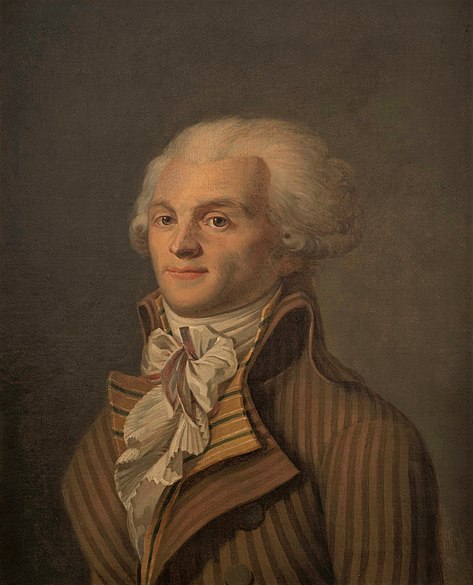
Maximilien Robespierre by Louis-Léopold Boilly, 1791

On this day in 1758, Maximilien Robespierre was born in somewhat humble beginnings in Arras. A divisive figure if ever there was one, since opening the salon last year I have met monarchists and Jacobins alike and heard a myriad of differing opinions on the man whose name has come to symbolise the French Revolution. On this, the anniversary of his birth, I thought we would look at an episode early in the young man's life when  Robespierre first encountered the king and queen of France, long before he came to power as President of the National Convention.

Following the death of his mother when he was six years old, Robespierre was raised by his maternal grandparents as his father left Arras to travel the continent. He was a precociously intelligent child and when he was just eleven years old won a valuable scholarship to study at the Lycée Louis-le-Grand. In Paris the young man flourished; he excelled among even his most illustrious classmates. Here he began to develop the ideas that would become the cornerstone of his adult convictions, studying politics and philosophy and joining a group of young intellectuals who would go on to lead the Revolution.


Maximilien Robespierre, 1790

At the age of seventeen Robespierre was chosen above all of his fellow pupils to represent the school when Louis XVI and Marie Antoinette visited the establishment on their return from their recent coronation. Robespierre was to read an address in Latin to welcome the couple and prepared at length for the prestigious engagement. In the event, the royal visitors were delayed by hours and the pupils waited outside in the driving rain to welcome their illustrious audience. When at last they did arrive, Robespierre delivered his address to the carriage, the king and queen having elected not to leave their vehicle. 

Upon completion of the address the royal couple thanked Robespierre with a smile before their carriage rolled on. No words were exchanged with the young man who had welcomed them to the Lycée Louis-le-Grand. In the centuries that have passed it has been posited that this was a pivotal moment that set Robespierre on his revolutionary journey. Of course, we have no evidence of this fact and indeed, it would be a petty man indeed who nursed such a complaint to the very guillotine itself.

Years later Maximilien de Robespierre met Louis XVI and Marie Antoinette again but this time, of course, things were to be very different...

The Death of Marie Antoinette
The Death of Louis XVI

Life in the Georgian Court, true tales of 18th century royalty, is available at the links below.

Pen and Sword
Amazon UK
Amazon US
Book Depository (free worldwide shipping)

Sunday, 28 July 2013

"Pity is Treason": The Execution of Maximilien Robespierre

Maximilien François Marie Isidore de Robespierre (Arras, Artois, France, 6th May 1758 – Paris, France, 28th July 1794)


Portrait of Maximilien Robespierre, 1790


After her fourth or fifth gin, my grandmother Gilflurt is a bit of a one for her portentous announcements and on more than one occasion she has chewed on her pipe, refilled her glass and told us that you can tell much of a man from the manner of his death. I don't know if that is true but as I sifted through my broadsheets and came across news of the death of Maximilien Robespierre, her words came fluttering back.

I shall revisit the life of the infamous Frenchman at another time but for today my mind is on his passing, and the gruesome events that led up to it.

By Spring of 1794, France was in turmoil. The leaders of the revolution had never been more unpopular with the public and as the Reign of Terror swept through the country a culture of fear and suspicion began to permeate society, infecting those in the highest office as it did those in the lowest straits. Whilst government envoys across Paris were apparently committing acts of excessive and extreme terror, their punishments were minimal. Expelled from the Jacobin Club and recalled to Paris for disciplinary action they instead went on the run, speaking out against Robespierre at every opportunity.

Gripped by the threat of possible assassination Robespierre pushed the 22 Prairial into existence, a move that was to prove fatally misjudged.  The new law was aimed at those suspected of being counter-revolutionaries; with the passing of the 22 Prairial such suspects could be executed without due process. Citizens were appalled not only at what the law allowed but also at what they saw as Robespierre's gross misuse of his powers. The 22 Prairial had been passed without discussion in the Committee of General Security and this only solidified suspicions that Robespierre was out of control, making sweeping and dictatorial decisions without proper consultation.

Portrait of Robespierre by Louis-Léopold Boilly, 1791
Maximilien Robespierre by Louis-Léopold Boilly, 1791

On 8th Thermidor (26th July), Robespierre attended the National Convention and gave an impassioned speech in his own defence. For two hours he railed against charges of tyranny, denouncing his opponents of enemies of the Republic and detailing an extensive and powerful conspiracy that involved the Convention itself. Outraged and fearful that they might be next to face the executioner, members of the Convention reacted with fury and the debate grew increasingly vitriolic. That same evening Robespierre retired to the Jacobin Club and repeated his speech, this time to a rapturous reception.

Louis de Saint-Just added his own voice to Robespierre's the following day, addressing the Convention on his friend's behalf. He had barely begun to speak before the heckling started and as Saint-Just fell silent, Robespierre made futile attempts to speak in his own defence. Eventually the voices that were raised against him proved overwhelming and demands were made for his arrest as the deputies railed against him, with one famously calling, "The blood of Danton chokes thee!".


Painting of Robespierre's Arrest by Max Adamo, 1870
Robespierre's Arrest by Max Adamo, 1870

We cannot know what thoughts must have gone through Robespierre's mind as the the Convention finally ordered his immediate arrest; perhaps he knew the almost inevitable fate that awaited him or maybe he believed he might still be able to escape the charges of despotism laid before him. Whatever his long-term plans, he fled to the Hôtel de Ville that night. With him were those loyal followers who also faced arrest, Saint-Just,  François Hanriot, Philippe Le Bas, Georges Couthon and Robespierre's brother, Augustin as well as a small number of other supporters.

In the early hours of 28th July troops arrived at the Hôtel de Ville to arrest the fugitives and the men, apparently, panicked. Le Bas shot himself as Augustin leaped from a window in an effort to escape, breaking both legs in the process; for Robespierre suicide seemed like the only option and he too took up a pistol. However, he survived the shot and shattered his jaw, spending the night in the offices of the Committee of Public Safety, bleeding profusely from the terrible wound. Once the blood flow was stemmed somewhat by means of handkerchiefs and bandages, he was moved to the self same anteroom where Marie Antoinette had awaited her own fate.

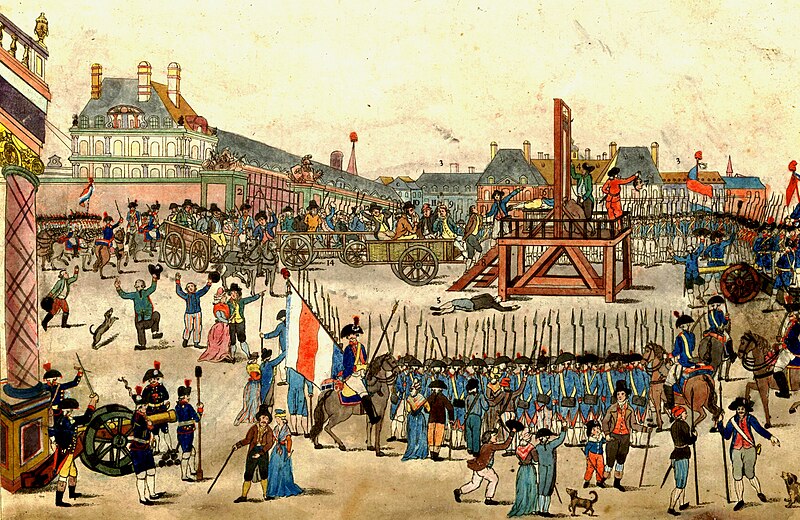
Painting of the Execution of Robepsierre and his Supporters
The Execution of Robepsierre and his Supporters

On 28th July 1794 Robespierre fell victim to his own 22 Priarial as he was taken to the Place de la Révolution with almost twenty of his supporters. One by one they went to the guillotine, their bodies thrown into a mass grave at Cimetière des Errancis. 

It was an ignoble end for the man who had risen to the highest offices of the land; in the end the very suspicion and fear that he played a part in sowing were to bring him down as friends and colleagues jockeyed for power and influence. The government of France would not stabilise for decades as the country adapted to life after Terror, but that is a story for another day.