 |
| Prise du Palais des Tuileries by Jean Duplessis-Bertaux, 1793 |
By summer 1792, France was a nation in turmoil; embroiled in the Revolutionary Wars, Louis XVI was prevaricating with regard to his cabinet and had abandoned the Girondists in favour of a staunchly monarchist Feuillant cabinet. This decision was to prove badly misjudged as the people of Paris regarded their king to be wildly out of touch with the wishes of the populace and he further aroused their ire by vetoing a number of Legislative Assembly decisions.
 |
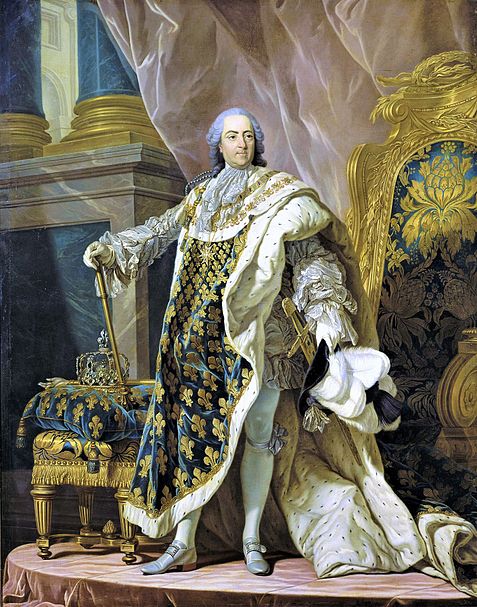
| Louis XVI by Antoine-François Callet , 1789 |
The Assembly itself was at a dead end, caught in a series of endless discussions about the deteriorating situation in France and how to deal with the seemingly immovable monarch. As the politicians debated, the people grew restless and on 9th August the situation boiled over as a revolutionary Commune with Georges Danton at its head took control of the Hôtel de Ville and a mob gathered at the Tuileries. As the night drew on they were joined by revolutionary militias and the National Guard, this drastic solution fully supported by a new municipal Parisian government that was to be known as the “insurrectionary” Paris Commune.
As dawn broke Louis inspected his troops and found himself faced with a mixture of loyal support and utter contempt as members of his forces heckled him with revolutionary comments. As he retreated back to the palace a number of battalions turned their guns on Tuileries, where the loyal Swiss Guard stood ready to defend the King. Within hours thousands of insurgents arrived at the Tuileries and though the Assembly appealed for calm, the crowd were in no mood to be placated, nor to let politicians enter into further debate with the monarch.
 |
| the Mob at the Tuileries by Henri-Paul Motte, 1892 |
As the royal family and loyal ministers gathered within the walls of the palace the situation seemed dire, their only hope of safety offered by the promise of refuge in the National Assembly. Faced with the fury of the mob and flanked by columns of troops, the fearful procession made its journey to what Louis and Marie Antoinette must have prayed was sanctuary. Following their departure the crowd finally swarmed into the palace, where they were fired on by the Swiss Guard. Vastly outnumbered, the Swiss Guard were massacred by the mob along with other members of the royal household and court who had found themselves unable to escape before the fighting began.
 |
| Memorial in the Catacombs of Paris, where many victims of the massacre are buried |
Buoyed by this victory, the insurgents followed the fleeing family to the Assembly; upon their arrival the King was sent to the Temple, supposedly for his own protection. Following this bloody night the city descended into chaos and six months later, King Louis XVI was dead, France set firmly on the road to the Reign of Terror.
 |
| The Lion Monument to the Swiss Guard |
Life in the Georgian Court, true tales of 18th century royalty, is available at the links below.
Book Depository (free worldwide shipping)

,_rev%C3%AAtu_du_grand_costume_royal_en_1779_-_Google_Art_Project.jpg/425px-Antoine-Fran%C3%A7ois_Callet_-_Louis_XVI,_roi_de_France_et_de_Navarre_(1754-1793),_rev%C3%AAtu_du_grand_costume_royal_en_1779_-_Google_Art_Project.jpg)