Showing posts with label Cook. Show all posts

Tuesday, 1 December 2015

Merchant Ships Ruled the Waves

It's my pleasure to welcome Stephen Baines to the salon, to tell us of a time when merchant ships ruled the waves!


---oOo---


History used to be taught in the United Kingdom as a series of battles on land and sea, usually depicted as heroic British victories. The 18th Century was presented as the glorious Age of Sail in which the Royal Navy ruled the seas, due to its wonderful ships and fearless Admirals. It was not quite like that. Two questions need to be asked: Why did Britain want to rule the seas? And how was it achieved?

A crucial factor in beginning to answer these questions was the merchant marine. In the mid to late 18th Century there were some 81,000 British-owned ships, of which the Royal Navy owned a mere 5%, and of those only 270 were ships-of-the-line. Not enough, by themselves, to rule the waves. 

The 95% were merchant ships, and The Royal Navy needed them. The Admiralty hired and bought merchant ships as victuallers, storeships, troopships, and for voyages of exploration.
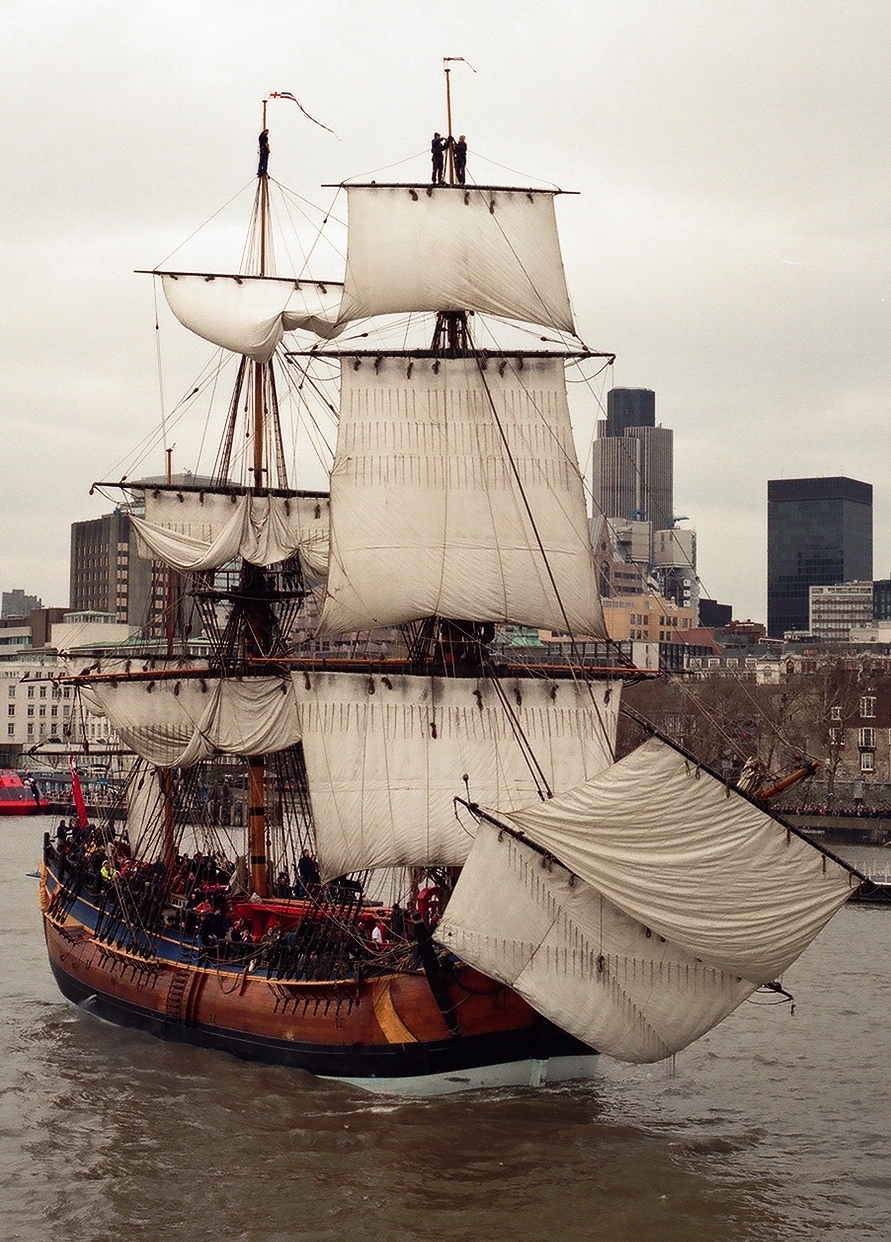
The Endeavour Replica. Endeavour  was a merchant ship, then bought and later sold by the Admiralty, was again a merchant ship and was contracted out to the Admiralty as a transport.
The Endeavour Replica. Endeavour  was a merchant ship, then bought and later sold by the Admiralty, was again a merchant ship and was contracted out to the Admiralty as a transport.
The 18th-century marine contribution to warfare was largely overlooked until the work of Ralph Davis and David Syrett.
Money spent by the Navy hiring transports during the Seven Years War. £50,000 pounds then was roughly equivalent to a billion pounds today. (Data fromTNA 106/3524.listed in Syrett Shipping and Military Power in the Seven Years War.)
Money spent by the Navy hiring transports during the Seven Years War. £50,000 pounds then was roughly equivalent to a billion pounds today. (Data fromTNA 106/3524.listed in Syrett Shipping and Military Power in the Seven Years War.)

Reciprocally the merchant marine needed the Royal Navy because the reason why it was important to rule the seas was to protect and expand trade. An island like Britain must be a maritime trading nation, and to safeguard the wealth which commerce could bring, the merchant shipping had to be supported and protected by the government. 

The common assumption was that there was only a finite quantity of commerce, so the more that was had by other nations the poorer and weaker a country would be. Britain’s main trade rivals were the Dutch, the French and the Spanish; and the 18th Century can to an extent be considered as a struggle between these four countries to gain the largest slice of the mercantile cake.
The Custom House London, a temple to commerce.

Voyages of discovery, like those of James Cook, were undoubtedly scientific ventures, but primarily they were to refine navigation and to help find new territories which had commercial potential: either because they had a useful flora (and to a lesser extent fauna), or as customers for British products, or as a victualling stop. Ideally all three. As a harpooner claimed possession of a whale for his ship by being the first to plunge his harpoon into it, so an explorer planting a Union flag on an uncharted island claimed it for Britain. If another of the major maritime powers contended ownership, there were problems, as in the festering Falkland Islands, which escalated to the brink of war in 1771. Endeavour and the kit-ship Penguin played an important part in the aftermath. Clayton, master of Penguin, made a thorough scientific account of the plants and wildlife of the islands; but his main intention was to evaluate the usefulness of the islands. He concluded that the climate was ‘very agreeable to European Constitutions’ and that the Falklands could be ‘a good port to touch at for Refreshment in the Passage round Cape Horn’.

The goals of Enlightenment and Commerce frequently clashed. Joseph Banks was not simply finding and classifying new plants, but also ascertaining their properties and, if possible, transplanting them into different places where they could be useful and profitable. 

 A breadfruit tree, Artocarpus altilis.
 A breadfruit tree, Artocarpus altilis.

Benjamin Franklin helped persuade the French to join the Americans in their struggle for independence; the French sent them gunpowder manufactured according to Antoine Lavoisier’s latest and secret process. The details of Cook’s Endeavour voyage were shrouded in secrecy. 

But on the other hand Franklin persuaded the American Navy and also Louis XV not to attack Cook’s ships as his mission was for the ‘benefit of Mankind’. Banks, Franklin, Lavoisier and Cook were all Fellows of the Royal Society, where knowledge was shared.


Stephen Baines’ new book “Captain Cook’s Merchant Ships”, which has been described as ‘marvellous’ and ‘a must read’, is published by The History Press www.thehistorypress.co.uk.


Captain Cook sailed in or with eight ships which began as merchant vessels. This detailed history tells the story of these vessels and the people who sailed in them. In placing these ships and people in the personal, political, social, financial, scientific and religious contexts of their time, this book provides a comprehensive and readable account of the ‘long eighteenth century.’

Using contemporary sources, this gripping narrative fills a gap in Cook history and attempts to catch something of the exciting, violent, gossipy but largely untaught and unknown period through which these vessels and their people sailed literally and figuratively between the old world and the new.


Written content of this post copyright © Stephen Baines, 2015.

Wednesday, 26 November 2014

Captain Cook Sights Maui

We have met Captain Cook several times here at the salon. Here we have read of his trips to Botany Bay and Possession Island, learnt the story behind a famed portrait and even been present at his most gruesome death. Today we welcome the good Captain once more and though this story might have been one of another landing on foreign soil, Cook found his plans beaten by weather and tide.

In November 1778, Cook's ship, HMS Resolution, was continuing her second voyage under the Captain's command. The eventful expedition had been underway since July 1776 and would, of course, be Cook's last adventure though for now, he knew nothing of the fate that awaited on Hawaii. this was a voyage of exploration, a time to discover new lands and, in particular, the famed Northwest Passage. 


Captain James Cook by Nathaniel Dance-Holland, 1776
After a difficult voyage beset with illness and problems with their vessel, the crew of the Resolution spotted land on 26th November 1778. As the first Europeans to lay eyes on Maui, Cook resolved to land there and explore but found his plans vexed by nature itself. With no natural harbour and high waves, he eventually had to face defeat and abandon his plans to land. With no other option he sailed onwards, leaving Maui so that another might one day make the first landing.

That day would not come until nearly ten years later and the first European to set foot on Maui was French explorer, Jean-François de La Pérouse. He arrived on the island in May 1786, by which time Captain Cook was dead, though his name and voyages were anything but forgotten. 

Wednesday, 15 October 2014

Captain Cook by Nathaniel Dance-Holland

Sir Nathaniel Dance-Holland, 1st Baronet RA (London, England, 8th May 1735 – Winchester, England, 15th October 1811) 


Self Portrait by Sir Nathaniel Dance-Holland, 1st Baronet RA, 1773
Self Portrait, 1773

On the three occasions that I have told tales of Captain James Cook, I have featured the same 1776 portrait of the famed explorer. That portrait was painted by Sir Nathaniel Dance-Holland and, since today marks the anniversary of the artist's death, I thought the time was right to offer a little insight into iconic portrait of Cook. Of course, all of us Georgians know the Captain by reputation and there's many a seafaring gent pays his bar bill with stories of adventures alongside the Captain, half of them as fanciful as they false! Still, if today's post piques an interest in his voyages, you can also join him on Possession Island, Botany Bay and learn more of his grisly murder elsewhere on the Guide.


In this rather fine portrait, Cook is certainly in his Sunday best and sports full dress uniform, as well as a suitable grave expression. As befits a gentleman given to exploration and charting the furthest oceans, the items depicted with the Captain are suitably iconic and chosen with great care. On the table what could be any chart is actually Cook's own chart of the Southern Ocean. With his finger he gestures to the east coast of Australia which, of course, he chartered. This hand is notable for what it doesn't show too, as Dance-Holland has elected not to paint Cook's right hand with a scar left by a burn some twelve years earlier.


The portrait was commissioned by Sir Joseph Banks, who had sailed with Cook in the past, and the captain sat for Dance-Holland portrait on 25th May 1776 so that he might begin work. Whether Cook sat for the artist again we do not know but what is certain is that, upon its completion, the portrait was hung over the fireplace in Banks's home in London. Here it remained until Banks died in 1820 when it went first to Greenwich Hospital and then on to the National Maritime Museum, where it remains to this day.

Friday, 22 August 2014

Captain Cook Lands on Possession Island

We have met Captain James Cook on a couple of occasions in the past, sharing the landing at Botany Bay and witnessing his murder after a disastrous foray into Hawaii's Kealakekua Bay. Today marks another anniversary for Cook, that of the discovery of Possession Island off the coast of Queensland, Australia.


Captain James Cook by Nathaniel Dance-Holland, 1776

Following his discovery of Botany Bay, Cook sailed on and eventually discovered a group of islands in the Torres Straits. These islands were home to the Kaurareg people and Cook eventually made landfall on an island that its inhabitants knew as Bedanug or Bedhan Lag. 

However, the Captain came ashore and raised the flag as the sunset on 22nd August, 1770, claiming the eastern coast for Britain in the name of King George III and declaring it as New South Wales.

More than two centuries later, the Kaurareg people were successful in their petition to have the native title rights of Possession Island and its neighbours returned to them in perpetuity. Today the island is celebrated for its rich flora and fauna and Cook's landing is marked by a monument on the spot where he once raised his flag and claimed the land for the king.

Tuesday, 29 April 2014

Captain Cook Lands at Botany Bay

We have met Captain James Cook here at the Guide before, when I told the story of his somewhat grisly Hawaiian end. Today we welcome the Captain back to the salon to commemorate his first landing at what came to be known as Botany Bay.


James Cook by Nathaniel Dance-Holland, 1776

In 1770, though Cook's rank was that of lieutenant, he served as captain of HMS Endeavour, engaged in a mission to charter the coastline of southern Australia and observe the transit of Venus. It was whilst undertaking these important tasks that Cook identified a place of safe anchorage in a natural bay located between what is now Cape Banks and Point Solander. With Cook keen to go ashore and discover more about this new territory, it was decided that the Endeavour would drop anchor so members of her crew could investigate further. 


Botany Bay by Charles Gore, 1789

The area was inhabited by the Gweagal, a tribe of Indigenous Australians. As the ship drew near, a few Gweagal warriors gathered on the rocks to watch its approach whilst the majority took shelter further inland. In fact there was to be no further action that day as the crew waited overnight and on 29th April 1770, a party from the ship went ashore. The contact between the Gweagal and the Europeans was understandably tense. When the local people remonstrated with the landing party, shots were fired by the British but there was no escalation in conflict.

In fact, in the eight days that the British were on land, the Gweagal did their best to avoid their visitors. Though the men from the Endeavour attempted to make contact their efforts were in vain. Instead the local people went about their daily routines, all the while keeping a close eye on their visitors.


The crew of the Endeavour come ashore; from Australia: the first hundred years, by Andrew Garran, 1886

As the Endeavour lay at anchor, the crew coined the name Stingrays Harbour, to reflect the large number of that fish in the bay. However, as Cook wrote in his own journal, so verdant were the flora of the region and so many specimens were available to the ship's botanists that he renamed the area Botanist's Bay, later amending this to Botany Bay.

Eventually the Endeavour resumed its iconic voyage; four months later, Cook claimed his newly-chartered coastline as British territory and set sail for home.


Landing of Captain Cook at Botany Bay, 1770 by E. Phillips Fox, 1902

Friday, 14 February 2014

The Murder of Captain James Cook

Captain James Cook, FRS, RN (Marton, Middlesbrough, England, 7th November 1728 – Kealakekua Bay, Hawaii, 14th February 1779)


Portrait of James Cook by Nathaniel Dance-Holland, 1776
Captain James Cook by Nathaniel Dance-Holland, 1776

Well, it occurs to me that today's post should be one with a little romance but I've plumped for something a little darker! It is off to Hawaii for a tale of murder and the final hours of Captain James Cook.

By February 1779 Captain James Cook was well-embarked on his exploration of the Hawaiin Islands, then known as the Sandwich Islands, and had spent an enjoyable period at Kealakekua Bay where he participated in festivities for the Makahiki, a Hawaiian celebration. However as the Resolution resumed her exploration of the ocean her foremast broke, and Cook ordered her return to Kealakekua Bay.

With their festivities concluded the islanders did not welcome the returning crew and tensions rose between the Hawaiians and their visitors that reached a head on 14th February. With thefts not uncommon, the theft of one of Cook's smallest boats was hardly unexpected, nor was the method of taking hostages that would be held as collateral for the stolen property. However, Cook decided to make a point by taking the King of Hawaiʻi, Kalaniʻōpuʻu, as hostage against the stolen boat.


The Death of Captain James Cook, 14 February 1779 by Johann Zoffany, 1795

The Hawaiians furiously defended their king and in the confusion a chief named Kalimu was shot dead. Pursued by the islanders, Cook and his men were forced to retreat to the beach, intending to return to their boats. However, before they could flee Cook was struck on the head by the pursuing villagers and fell to the ground, where he was stabbed to death. According to Hawaiian lore Cook's killer was a chief named Kalaimanokahoʻowaha or Kanaʻina, and following Cook's death and that of some of his men, the murdered captain's body was carried away by the islanders.

Due to their earlier respect for Cook, the Hawaiians prepared his corpse according to rituals reserved for their most illustrious people. His body was first disemboweled before being baked in order for the flesh to be removed and boned cleaned to be presented as religious icons. Some of the captain's remains were eventually presented to his crew and were buried at sea.