|
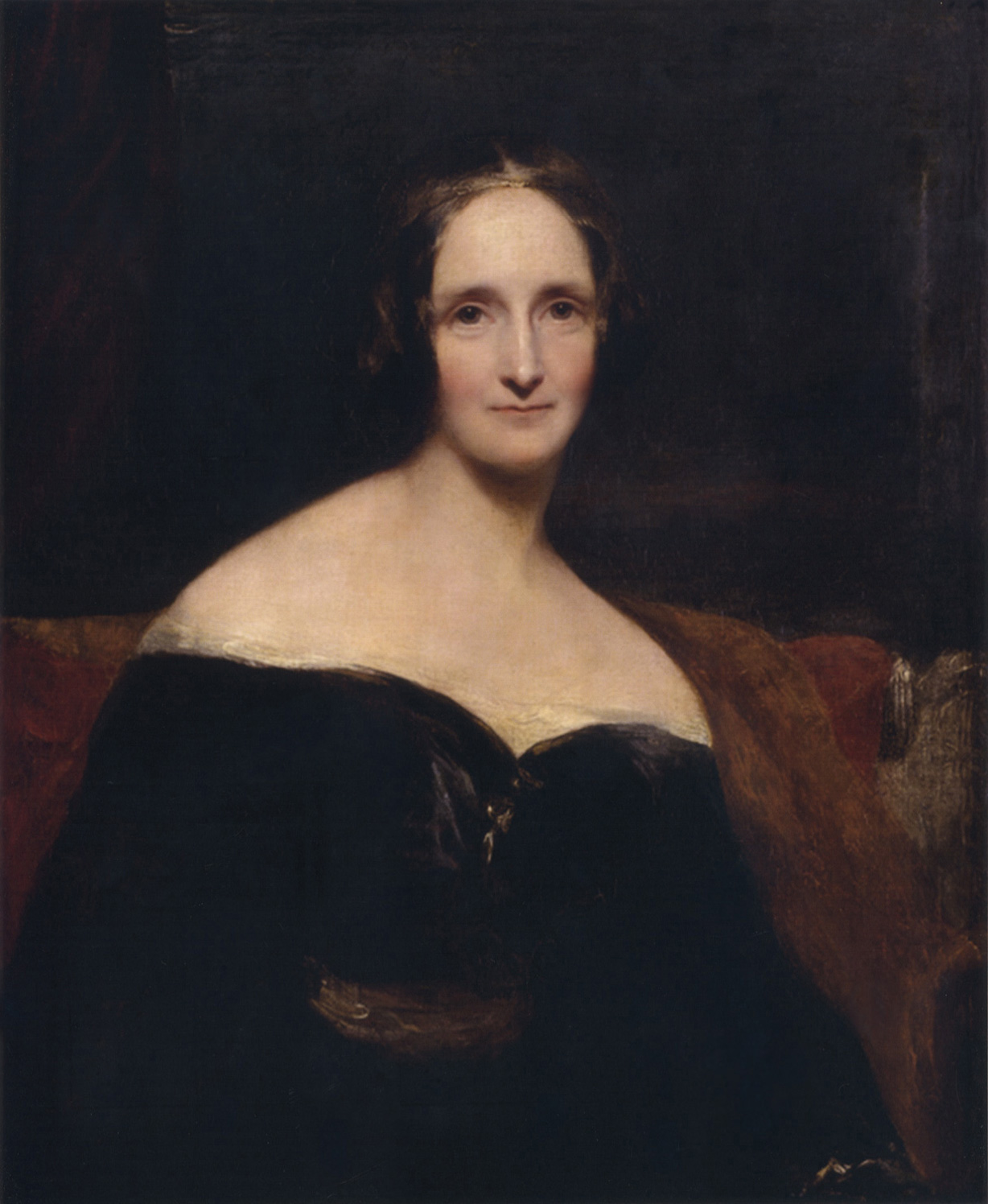
| Mary Shelley by Richard Rothwell, 1840 |
A few weeks ago I put quill to paper for a very popular post on Percy Bysshe Shelley and his short, tragic life. Since I was a mere slip of a thing I have nursed a fascination for the remarkable woman who, among many other things, was Shelley's wife and so, on the anniversary of her birth, it seems only right to spend some time in the company of Mary Shelley.
Born to Mary Wollstonecraft and William Godwin, Mary lost her mother to puerperal fever less than ten days after her birth. She was brought up and educated by Godwin with Wollstonecraft's other daughter, Fanny Imlay; the girls were raised to honour their mother's memory, steeped in her work and philosophy. However, Mary's loving childhood was to be shattered by the arrival of Godwin's second wife, Mary Jane Clairmont, whom the little girl would come to loathe. She devoted herself to learning, writing stories that have since been lost and composing comical asides for the amusement of her father.
Mary met the man who would become her husband in 1814 when Shelley was visiting Godwin; with the older man deeply in debt the poet was providing him with financial assistance to stave off his many creditors. There was a definite spark between Mary and Percy and the young couple began to enjoy secret liaisons. Percy was five years Mary's senior and she was utterly besotted with him but when her beau refused to pay off all of Godwin's debts, it became apparent that her father would never give the romance his blessing. With Percy estranged from his heavily pregnant wife, the couple fled for France with Mary's French-speaking stepsister, Claire Clairmont, to complete the party. Having developed a strong attachment to Shelley, Fanny was devastated to be left behind in England.
 |
| Mary Wollstonecraft by John Opie, 1797 |
Later that year the family travelled to Geneva to spend the summer with Lord Byron and Dr John Polidori in the Villa Diodati. Their days were spent in pastoral pursuits and it was during this trip that Mary wrote a book that has passed into literary legend. When Byron suggested that the guests each write a supernatural story Mary retired to her bed where she experienced a waking dream that inspired her to write Frankenstein: or, The Modern Prometheus. Initially intended as a short story, it would be two years before the novel was completed.
 |
| William Godwin by Henry William Pickersgill |
Mary devoted herself to writing and editing an account of the earlier journey through Europe, eventually publishing the History of a Six Weeks' Tour in 1817; a year later she anonymously published the novel she had begun in Geneva. Frankenstein caused a sensation and Mary would revise and reprint the novel several times, crediting her husband with writing the preface and inspiring and encouraging her to complete the work.
A few months after the birth of the couple's daughter, Clara, in September 1817, the family left England for Italy. Embarking of a tour of the country, the couple enjoyed an intellectual and social life that filled them with optimism and happiness. These cheery times were not to last though and both William and Clara died in Italy, the children passing away within a year of one another. Mary withdrew into a deep and agonising grief, immersing herself in solitary intellectual pursuits from which she would not begin to emerge until the birth of her son, Percy Florence, on 12th November 1819.
 |
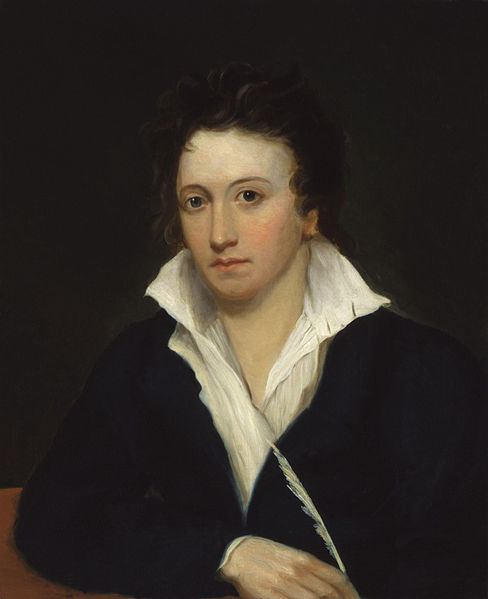
| Percy Bysshe Shelley by Alfred Clint, 1819 |
Mary's depression would return at intervals throughout her life and she struggled with her husband's infatuations with other women even as she enjoyed intense and abiding relationships of her own. At some point whilst visiting Naples the couple acquired another baby and though Mary and Percy were registered as parents to the little girl, the true maternity of the infant has never been established. Here on Gin Lane there was plenty of gossip that Claire had had yet another indiscretion or that Percy's free love had finally caught up with him, perhaps even that they had adopted a local babe. Whatever the truth of the tale, Elena Adelaide Shelley died in Naples before she was even two years old.
 |
| Draft pages from Frankenstein |
Mary would lose another unborn child in Italy, her health frequently failing and her depression darker than ever yet there was to be one final tragedy before the Italian trip was over. On 8th July 1822 Shelley set sail from Livorno for Lerici on board his new sailing boat; caught in a storm at sea, he would never reach his destination nor see his wife and child again.
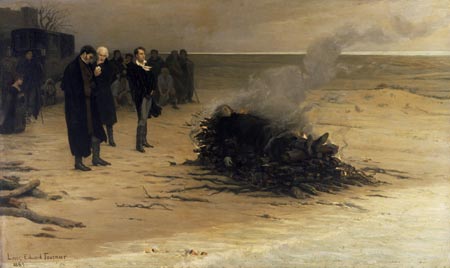
Shelley was missing for ten days and a desperate Mary searched fruitlessly for her husband in Livorno until her darkest fears were realised when the poet's body was washed ashore near Viareggio. Here his body was cremated, though Mary did not attend this ceremony.
 |
| Mary Shelley by Reginald Easton, 1857 |
With some difficulty Mary managed with her limited finances and devoted herself to protecting and preserving the names and works of both her late husband and her parents. She continued with her own literary career, producing a number of novels and factual works and forged new friendships and liaisons. Under Mary's stewardship Shelley's writings enjoyed new acclaim and popularity and she devoted herself to her son, who adored her in return. Indeed, when Percy eventually married, Mary moved in with the new couple and enjoyed a happy and contented life.
 |
| The tomb of Mary and her parents |
Mary died at the age of just 53 of what was apparently a brain tumour. She was buried in Bournemouth and, in accordance with her wishes, her parents were exhumed and buried alongside her. Among her final effects she left locks of her dead children's hair and a parcel of Shelley's ashes.
Today Mary is rightly celebrated as a towering figure of the Romantic movement, a hugely talented and intelligent woman who forged her own path and survived unthinkable tragedies, pouring her very soul into the writings that are her legacy. There is no doubt, I think, that her beloved mother would have rightly been proud of all her daughter achieved and her name lives on, a literary legend.