Showing posts with label Pickersgill (artist). Show all posts

Friday, 16 May 2014

Floating to Jamaica: Matthew "Monk" Lewis is (Not Quite) Buried at Sea

Matthew Gregory Lewis (London, England, 9th July 1775 – Died at sea, 16th May 1818)

Matthew "Monk" Gregory Lewis by Henry William Pickersgill, 1809

Back in the early days of the salon I told the tale of Matthew "Monk" Lewis, celebrated purveyor of literary gothic and erstwhile Member of Parliament. Today marks a somewhat sadder anniversary as we mark the passing of Lewis, though in suitably gothic style, he would not go quietly to his grave.

Lewis was the owner of a large and profitable sugar plantation in Jamaica and these experiences would posthumously be immortalised in Journal of a West India Proprietor, published in 1833. The author visited his plantation now and again to observe the workings and oversee the business and it was on one of these trips that fate dealt him a most displeasing hand.

Not long before he was due to leave Jamaica and return to England in 1818, the author contracted yellow fever. Dangerously ill, he sailed for home and as the ship left Jamaica in the distance, Lewis began to deteriorate. He died during that final voyage and it was decided that a burial at sea would be the most appropriate method of disposal so Matthew Lewis was prepared for his final journey.

As the coffin sank beneath the waves the weights that had been fastened to it slipped loose and fell clean off. The unweighted coffin bobbed merrily back to the surface and as the ship sailed on for England, the mortal remains of Matthew "Monk" Lewis were last seen floating off in the direction of Jamaica.

Saturday, 7 September 2013

Abolition, Faith and Education: Hannah More

Hannah More (Fishponds, Bristol, England, 2nd February 1745 – Clifton, Bristol, England, 7th September 1833)


Hannah More by Henry William Pickersgill, 1821

It must be something in the air because this seems to be a time for tales of ground-breaking women. Yesterday we met a scandalous, radical lady and today we're staying in female company, this time to meet a passionate advocate of education who found time to be a celebrated author on the side!

Hannah was one of five daughters born to Mary and schoolmaster Jacob More, a man who believed unequivocally that education was not only the right of boys and men. He home-schooled his children until 1758 when he established two school, one for boys and one for girls, which he passed to the keeping of his eldest daughters. It was here than Hannah completed her education; she was a passionate and dedicated student and as a young lady took up the position of teacher there. Teaching was Hannah's passion and she searched for a play that might be suitable for her students to perform as part of their studies. When nothing suitable presented itself, she wrote her own and in 1762, completed The Search After Happiness. The play captured the public imagination and copies of it were sold throughout England.

Hannah More, 1882


Continuing to write, Hannah left her teaching career behind when she became engaged to a landowner, William Turner. Turner's initial enthusiasm seemed to cool and after six years without marriage, the engagement was ended. Hannah was devastated and suffered a breakdown; perhaps feeling a sense of responsibility for her predicament, William provided his heartbroken former-bethrothed with a £200 annuity and she left her home behind to travel to London. A meeting with David Garrick proved pivotal for Hannah and before long her plays were being performed on the London stage, the playwright herself forming friendships with the likes of Horace Walpole, Elizabeth Montagu and Samuel Johnson. Her pivotal involvement with the Blue Stockings Society inspired her to write her 1782 poem, The Bas Bleu, or, Conversation, and Hannah became an intimate member of the most elite intellectual circles in London.

With Montagu, Hannah championed the efforts of Ann Yearsley, a Bristol poet who found herself in financial straits. In order to protect Yearsley's earnings from her husband, Hannah kept her royalties in trust but Yearsley came to resent this arrangement and the women fell out spectacularly. Upset by this turn of events, Hannah withdrew somewhat from her social life and concentrated instead on her work.


Portraits in the Characters of the Muses in the Temple of Apollo by Richard Samuel, 1778
Portraits in the Characters of the Muses in the Temple of Apollo by Richard Samuel, 1778 (Hannah More is standing, second from right)

Although Hannah had always had a strong religious faith, her faith deepened throughout the 1780s and she left behind her literary circle to move among prominent abolitionists including William Wilberforce. She produced articles and books on the subjects of religion and emancipation, as well as works that dealt with female education and a number of poems and stories. By now settled permanently in Somerset, Hannah wrote at an extraordinary rate, collaborating with Beilby Porteus, Bishop of London, on the multi-million selling series, Cheap Repository Tracts.

By 1800 Hannah and her sister, Martha, had followed their father's lead and established 12 schools for the children of farmers and local workers. Here they were educated in religion and taught how to read. However, Hannah drew the line at teaching the poor how to write; as far as she was concerned, being able to read was education enough.


Hannah's cottage in Cheddar

In her dotage Hannah moved to Clifton, where she received dozens of visitors and well-wishers who wanted to meet this remarkable lady. From the most famous to the most humble, all were made welcome and she talked of her work, her faith and the philanthropic acts which she continued to fund. Hannah lived just long enough to see the successful passage of the Slavery Abolition Act and died in 1833, leaving behind not only a fortune in excess of £30,000 but also a legacy of literature, education and philanthropy that is remembered to this day.

Friday, 30 August 2013

Mary Shelley: A Tale of More Than Monsters

Mary Shelley (née Mary Wollstonecraft Godwin; London, England, 30th August 1797 – London, England, 1st February 1851) 


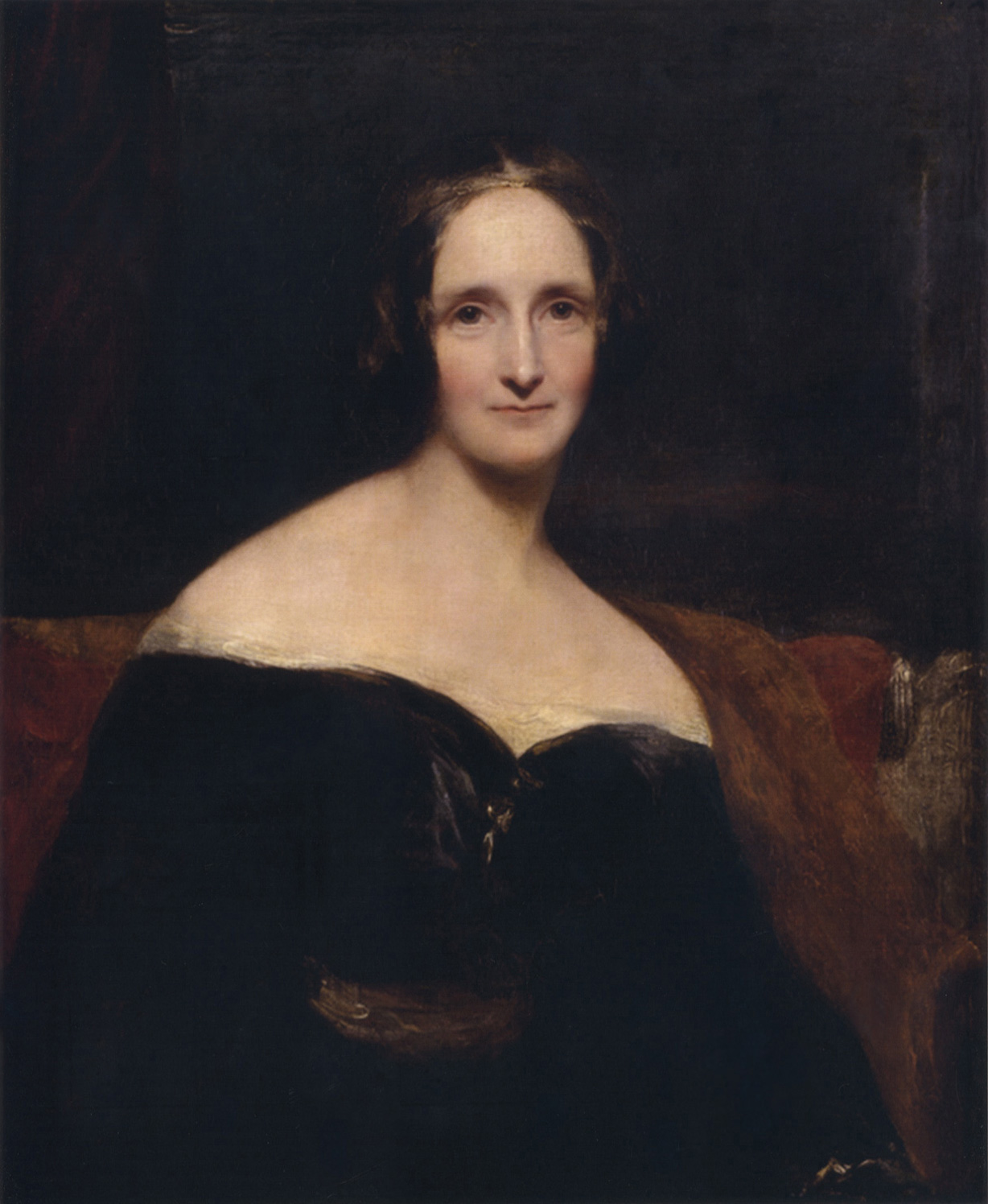
Portrait of Mary Shelley by Richard Rothwell, 1840
Mary Shelley by Richard Rothwell, 1840

A few weeks ago I put quill to paper for a very popular post on Percy Bysshe Shelley and his short, tragic life. Since I was a mere slip of a thing I have nursed a fascination for the remarkable woman who, among many other things, was Shelley's wife and so, on the anniversary of her birth, it seems only right to spend some time in the company of Mary Shelley.

Born to Mary Wollstonecraft and William Godwin, Mary lost her mother to puerperal fever less than ten days after her birth. She was brought up and educated by Godwin with Wollstonecraft's other daughter, Fanny Imlay; the girls were raised to honour their mother's memory, steeped in her work and philosophy. However, Mary's loving childhood was to be shattered by the arrival of Godwin's second wife, Mary Jane Clairmont, whom the little girl would come to loathe. She devoted herself to learning, writing stories that have since been lost and composing comical asides for the amusement of her father.

Mary met the man who would become her husband in 1814 when Shelley was visiting Godwin; with the older man deeply in debt the poet was providing him with financial assistance to stave off his many creditors. There was a definite spark between Mary and Percy and the young couple began to enjoy secret liaisons. Percy was five years Mary's senior and she was utterly besotted with him but when her beau refused to pay off all of Godwin's debts, it became apparent that her father would never give the romance his blessing. With Percy estranged from his heavily pregnant wife, the couple fled for France with Mary's French-speaking stepsister, Claire Clairmont, to complete the party. Having developed a strong attachment to Shelley, Fanny was devastated to be left behind in England. 


Portrait of Mary Wollstonecraft by John Opie, 1797
Mary Wollstonecraft by John Opie, 1797

The trio exhausted their limited finances and returned to England where they found Godwin apoplectic at their behaviour, flatly refusing to provide assistance to his pregnant daughter and her companion. Instead, the couple and Claire moved into lodgings in London. Born in early 1815, Mary's daughter did not survive more than a month and this loss plunged her into a deep depression from which she would not emerge until the birth of her second child, William, in January 1816. 

Later that year the family travelled to Geneva to spend the summer with Lord Byron and Dr John Polidori in the Villa Diodati. Their days were spent in pastoral pursuits and it was during this trip that Mary wrote a book that has passed into literary legend. When Byron suggested that the guests each write a supernatural story Mary retired to her bed where she experienced a waking dream that inspired her to write Frankenstein: or, The Modern Prometheus. Initially intended as a short story, it would be two years before the novel was completed. 


Portrait of William Godwin by Henry William Pickersgill
William Godwin by Henry William Pickersgill

When the family returned to England they found Fanny Imlay in a state of deep unhappiness and by the end of 1816 both she and Shelley's estranged wife were dead, the two women having taken their own lives. Shelley and the pregnant Mary petitioned unsuccessfully for custody of his two children and to support their case, married on 30th December 1816. Godwin gave his blessing to the match and the union ended the bitter feud between father and daughter.

Mary devoted herself to writing and editing an account of the earlier journey through Europe, eventually publishing the History of a Six Weeks' Tour in 1817; a year later she anonymously published the novel she had begun in Geneva. Frankenstein caused a sensation and Mary would revise and reprint the novel several times, crediting her husband with writing the preface and inspiring and encouraging her to complete the work.

A few months after the birth of the couple's daughter, Clara, in September 1817, the family left England for Italy. Embarking of a tour of the country, the couple enjoyed an intellectual and social life that filled them with optimism and happiness. These cheery times were not to last though and both William and Clara died in Italy, the children passing away within a year of one another. Mary withdrew into a deep and agonising grief, immersing herself in solitary intellectual pursuits from which she would not begin to emerge until the birth of her son, Percy Florence, on 12th November 1819.


Portrait of Percy Bysshe Shelley by Alfred Clint, 1819
Percy Bysshe Shelley by Alfred Clint, 1819

Mary's depression would return at intervals throughout her life and she struggled with her husband's infatuations with other women even as she enjoyed intense and abiding relationships of her own. At some point whilst visiting Naples the couple acquired another baby and though Mary and Percy were registered as parents to the little girl, the true maternity of the infant has never been established. Here on Gin Lane there was plenty of gossip that Claire had had yet another indiscretion or that Percy's free love had finally caught up with him, perhaps even that they had adopted a local babe. Whatever the truth of the tale, Elena Adelaide Shelley died in Naples before she was even two years old.


Photograph of draft pages from Frankenstein
Draft pages from Frankenstein

Mary would lose another unborn child in Italy, her health frequently failing and her depression darker than ever yet there was to be one final tragedy before the Italian trip was over. On 8th July 1822 Shelley set sail from Livorno for Lerici on board his new sailing boat; caught in a storm at sea, he would never reach his destination nor see his wife and child again.

Shelley was missing for ten days and a desperate Mary searched fruitlessly for her husband in Livorno until her darkest fears were realised when the poet's body was washed ashore near Viareggio. Here his body was cremated, though Mary did not attend this ceremony.

Portrait of Mary Shelley by Reginald Easton, 1857
Mary Shelley by Reginald Easton, 1857
Following Shelley's death the new widow remained in Italy, supporting herself initially through writing and translation work and then a small allowance gleaned from her father in law, Sir Timothy Shelley. He initially insisted that Mary's surviving child, Percy, be surrendered to him but Mary would not countenance such a suggestion and though he agreed to the allowance, he never met his daughter in law. Though his plans to take guardianship of the boy were unsuccessful, Sir Timothy did secure Mary's agreement never to write a biography of her late husband, on the understanding that her allowance would be cut off if she ever did so.

With some difficulty Mary managed with her limited finances and devoted herself to protecting and preserving the names and works of both her late husband and her parents. She continued with her own literary career, producing a number of novels and factual works and forged new friendships and liaisons. Under Mary's stewardship Shelley's writings enjoyed new acclaim and popularity and she devoted herself to her son, who adored her in return. Indeed, when Percy eventually married, Mary moved in with the new couple and enjoyed a happy and contented life.


Photograph of tomb of Mary Shelley, Mary Wollstonecraft and William Godwin
The tomb of Mary and her parents

Mary died at the age of just 53 of what was apparently a brain tumour. She was buried in Bournemouth and, in accordance with her wishes, her parents were exhumed and buried alongside her. Among her final effects she left locks of her dead children's hair and a parcel of Shelley's ashes. 

Today Mary is rightly celebrated as a towering figure of the Romantic movement, a hugely talented and intelligent woman who forged her own path and survived unthinkable tragedies, pouring her very soul into the writings that are her legacy. There is no doubt, I think, that her beloved mother would have rightly been proud of all her daughter achieved and her name lives on, a literary legend. 

Saturday, 17 August 2013

Family Feuds and Rumours of Scandal: Princess Victoria, Duchess of Kent

Princess Marie Luise Victoria of Saxe-Coburg-Saalfeld, Princess of Leiningen, Duchess of Kent and Strathearn (Marie Luise Victoire, Coburg, Saxe-Coburg-Saalfield, 17th August 1786 – Windsor, England, 16th March 1861) 

Princess Victoria by Richard Rothwell, 1832

Well, we've been getting a bit caught up in the gents again of late, haven't we? Looking through my bureau in search of gossip about Queen Adelaide, I was reminded of the bitter feud between King William and his sister-in-law, Princess Victoria, the woman who would one day be mother to the ruler of an Empire. From Germany to England by way of a couple of shrewd marriages, it's time to say happy birthday to Princess Victoria, Duchess of Kent.

Born as the seventh child of Franz Frederick Anton, Duke of Saxe-Coburg-Saalfeld, and Countess Augusta of Reuss-Ebersdorf, Victoria enjoyed a privileged upbringing. Bright, charming and attractive she was a cultured young woman with one eye set on making a good match. In fact, that match would come in the shape of Carl Friedrich Wilhelm Emich, Prince of Leiningen, the husband of Victoria's aunt, Henriette of Reuss-Ebersdorf. More than twenty years the young woman's senior, the Prince married Victoria two years after Henriette's death. The couple had two children and little more than a decade after the wedding Victoria was both a widow and Regent of Leiningen. Not content with the lot that fate had dealt her, the social-climbing Victoria would not be single for long.


Edward, Duke of Kent and Strathearn by Sir William Beechey, 1814

In England, something of a monarchial storm was brewing; the Prince Regent's only child, Charlotte, was dead, his brothers either unmarried or estranged from their wives and his sisters apparently past childbearing age. With no legitimate heir to the throne on the horizon it was left to the Duke of Kent, the Duke of Cambridge and the Duke of Clarence (later King William IV) to find suitable wives as quickly as possible. Victoria already had links to the Hanover family as her brother had been married to Charlotte until her death and the young princess had actively encouraged the Duke of Kent to take an interest in her sister in law. Now, with the throne at stake, he redoubled that interest and the courtship became a more formal affair.

Still in her early thirties, the Regent of Leiningen was something of a safely respectable prospect and on 29th May 1818, Edward, Duke of Kent and Victoria were married in Amorbach, Bavaria, the union sealed once more on 11th July at Kew Palace. Their only child, Princess Alexandrina Victoria of Kent, was born in May the following year, destined to become better known to history as Queen Victoria. Edward doted on his daughter but he would not live to see her grow and before the girl was one year old, her father was dead of pneumonia.


The Duchess of Kent and Victoria by Henry Bone, 1824

The newly-widowed Victoria took stock of her situation at this point, considering the options that now lay before her; unable to speak English and no great fan of the country, she seriously considered returning home to Coburg where life would be comfortable, respectable but utterly unremarkable. Saddled with her husband's debt and with her daughter's claim to the throne far from assured, the Duchess instead chose to remain in England, pinning all her hopes on the lack of other suitable heirs. With Parliament refusing to either increase her allowance or settle the debt, Victoria and her daughter took up residence in the somewhat dilapidated surroundings of Kensington Palace, occupying a small suit of rooms there. However, her brother, Prince Leopold, could not see his sister struggle and he supported her from the £50,000 annual allowance he had been granted on his marriage to the late Princess Charlotte. Later to be King of the Belgians, Leopold would remain a strongly supportive figure, eventually introducing the young Queen Victoria to his nephew, Prince Albert of Saxe-Coburg and Gotha,


Sir John Conroy by Henry William Pickersgill

Another source of support to the widowed Duchess was her private secretary, John Conroy. As ambitious as Victoria herself, Conroy allied himself strongly to the widow in the hopes that her daughter would be crowned Queen whilst still a child, ensuring that her mother would become Regent and rely on his guidance. Under the influence of the charming Conroy, the Duchess prevailed upon her daughter to appoint him as her own private secretary, a decision that would later cause friction between the two women. Conroy created an idealised public image for the Duchess of Kent whilst behind closed doors he and his patroness imposed strict rules and systems on the young Princess Victoria that saw her isolated and increasingly unhappy. Rumours swirled that the Duchess and the Welsh officer were more than friends and though Queen Victoria's very paternity has been questioned, she utterly rejected any suggestion that her mother and Conroy were lovers.

For all the scheming and manoeuvring, King William IV seemed determined not to die. Well aware of the plans for a Regency, his fraught relationship with the Duchess deteriorated further into a full blown feud. Once her daughter's succession was assured, Victoria decided that she deserved grander quarters and moved into the refurbished State Apartments of Kensington Palace.  William was furious and made no effort to hide his dislike of his sister in law, though both he and Queen Adelaide were devoted to the young heiress to the throne. The King and the Duchess would never be reconciled and at his final birthday banquet he railed against Victoria, making it clear that his one wish was that she would never be Regent.


Princess Victoria by Franz Xaver Winterhalter, 1857

In fact, William was to get his wish and by the time of his death, the heiress to the throne was a young woman and the ambitious Duchess and her private secretary's plans for a Regency lay in tatters. Finally emerging from their shadow, the new Queen exiled the debt-ridden pair to Buckingham Palace where they remained until 1839, when Conroy left England for the continent at the urging of the Duke of Wellington. The Queen distanced herself from the mother she saw as scheming and domineering and this discord would persist until the birth of Queen Victoria's first child, Victoria, Princess Royal, when the Duchess was finally welcomed back into the bosom of the family. Her debts were settled and the she embraced life as a grandmother, remaining devoted to her daughter and grandchildren until her death.

Despite their fractious early relationship, Queen Victoria was devastated by her mother's passing; she clung to her husband amid her grief yet the year was to bring even more devastation and by the end of 1861, Prince Albert of Saxe-Coburg and Gotha was also dead, the Queen plunged into a deep mourning from which she would never fully recover.

Life in the Georgian Court, true tales of 18th century royalty, is available at the links below.

Pen and Sword
Amazon UK
Amazon US
Book Depository (free worldwide shipping)

Sunday, 4 August 2013

"I have drunken deep of Joy": Percy Bysshe Shelley

Percy Bysshe Shelley (Broadbridge Heath, West Sussex, England, 4th August 1792 - Livorno, Italy, 8th  July 1822)


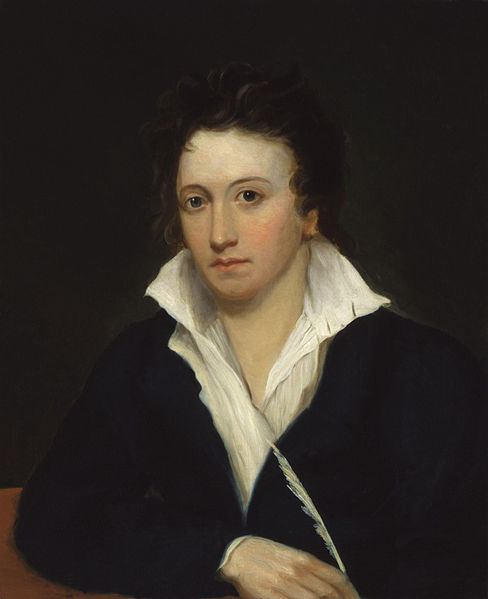
Percy Bysshe Shelley by Alfred Clint, 1819

We've met a few monarchs, revolutionaries and politicians of late as well as a musical lady, so today I thought we would look at a man of letters. Like all the Gilflurt girls I've a weakness for a well-crafted stanza and Shelley certainly composed a few of those in his too-short life.

He was born to privilege, the son of a Whig Member of Parliament and landowner and spent a miserable few years at Eton College before moving to study at Oxford University  in 1810. Within a year he had published several works including a pamphlet entitled The Necessity of Atheism. Called to account by the university, Shelley refused to apologise for the pamphlet and was expelled in March 1811, much to his father's horror.  He would compound that initial disappointment within months, eloping to Scotland with 16 year old Harriet Westbrook, who had threatened suicide if she could not escape the boarding school where she studied alongside the poet's sisters. With a failed romance with Harriet Grove already behind him and increasingly despondent, Shelley impulsively whisked the girl away and made her his wife. At this his father finally cut off his son, refusing to acknowledge the union or the bride. The marriage would end in tragedy but for now, the young couple were happy in one another's company.


Portrait of William Godwin by Henry William Pickersgill
William Godwin by Henry William Pickersgill

Shelley had long been an admirer of William Godwin and, with his time at university prematurely ended, he wrote to Godwin and eventually became an adoring disciple to the writer, beginning an intense friendship with Godwin's daughter, Mary. On 28th July 1814, Shelley abandoned his heavily pregnant wife and fled to Switzerland with 16 year old Mary and her French-speaking stepsister, Claire Clairmont. The trio travelled across Europe for less than two months before they returned to England and a furious Godwin, who refused to take them back into his home and they lived together in London until Clair, wishing to visit her former lover, Lord Byron, asked Mary and Shelley to accompany her to Lake Geneva in 1816.


Portrait of Mary Shelley by Richard Rothwell, 1840
Mary Shelley by Richard Rothwell, 1840

The visit and the creature it spawned have become legendary and Mary and her literary monster are too important for a mere line or two here; indeed, the Guide shall be paying proper tribute to her later. Shelley found the trip to Geneva inspirational, forming a close bond with Byron that inspired him to some of his greatest poems including the existential Mont Blanc. His continued affair with Mary was devastating to her half-sister Fanny Imlay, who had formed a strong attachment to Shelley and in 1816 she killed herself, just two months before his estranged wife was found drowned in the Serpentine. With Shelley now widowed, he and Mary were free to marry and Godwin, miraculously, thawed immediately once they were legally bound.

Though Shelley continued to write following the marriage it would take another adventure with Byron to inspire him back to full creativity and the Shelleys visited the poet in Venice. During this visit to the continent Shelley was to face a double tragedy when two of his children died, as well as a third child whose parentage has never been satisfactorily established. For two years the couple moved around Italy and Shelley continued to write, producing among others The Masque of Anarchy, Ode to Sophia Stacey (in honour of a daughter born during the tour) and the now-legendary Prometheus Unbound. He was gripped by a new creativity whilst in Italy, fired by his friendship with Byron and continued correspondence with other members of his literary circle that fired him to write pamphlets, poetry and criticism.


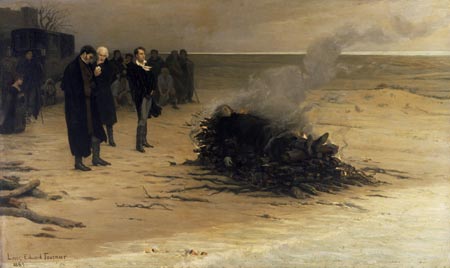
The Funeral of Shelley by Louis Edouard Fournier, 1889

On 8th July, Shelley set sail for Lerici with two companions, but they were never to arrive at their destination; encountering a sudden, severe storm the boat was lost with all hands. The poet's decomposed body eventually washed ashore near Viareggio where it was cremated, an occasion at which Mary was not present. His ashes were interred in the Protestant Cemetery, Rome, the wanderer having finally come to rest. With Byron and Keats, he is memorialised in Poets' Corner at Westminster Abbey.

In life Shelley was a strange, somewhat surreal figure and his now awesome reputation was not easily won in death, nor was he instantly elevated to the post-mortem status of genius. It took years for his work to slowly gain an appreciative audience yet to the generations who followed, he became a legend.


Shelley's bibliography can be found here.

Tuesday, 9 July 2013

Bleeding Nuns and Gothic Monsters: Matthew "Monk" Gregory Lewis

Matthew Gregory Lewis (London, England, 9th July 1775 – Died at sea, 16th May 1818)


Portrait of Matthew Gregory Lewis by Henry William Pickersgill
Matthew "Monk" Gregory Lewis by Henry William Pickersgill, 1809

There are few things guaranteed to annoy grandma Gilflurt more than literature of a scandalous nature so when she caught me at a very tender age with a copy of The Monk clutched to my bosom, barely five seconds elapsed before said book was confiscated and I was dispatched to bed without my posset. Being a resourceful lass it wasn't long before another copy was hidden under the attic floorboard and I've never been without it since.

The contents of The Monk may have caused a scandal upon its publication in 1796, but the early life of its author was far from uneventful in itself. When Lewis was just six years old his mother eloped with her lover, changing her name and eventually bearing a child. Though his father started divorce proceedings, his petition was rejected by the House of Lords and the couple were to remain legally bound and utterly estranged until his father died in 1818.

As a boy Lewis enjoyed an extensive education and travelled widely in preparation for a career in the diplomatic service like that of his father. However, the lure of the theatre became increasingly more attractive than that of the War Office and he began writing plays and submitting them for production. Not content with the stage, he produced novels, translated poetry and even wrote an opera! Posted to the Hague, his burgeoning diplomatic career enabled him to mix with the society he so enjoyed and the money from his literary pursuits was sent on to support his mother in her own writing.

I have always found the Dutch a most charming people but for one reason or another they were not to our hero's liking and he occupied his time with writing, eventually producing the novel that would bring him the literary celebrity, or notoriety, that he so desired.

Ambrosio, or The Monk by Anon was an overnight, scandalous smash when it was published in 1796. Hugely controversial for the explicit nature of its horrors, the book was subsequently banned and immediately became even more popular. By now a Member of Parliament, Lewis made sure that the second edition carried not only his name but also the suffix, MP. He did make a number of cuts to the more lurid content but his reputation for horror was already made and Lewis found fans in the Shelleys as well as that infamous chap, the Marquis de Sade. There are one or two tales of de Sade that one of the better-travelled Gilflurt aunties can tell but I am forbidden to share them - she is saving them up for dotage money!

By the time of the fourth edition he had censored the book even further yet its mystique remained; stripped of sentimentality, Monk's forays into gothic literature leave little to the imagination. His is a world where Bleeding Nuns virtually drip from the page, where the supernatural is not a briefly glimpsed shadow but an intruder into the physical world, ugly, solid and undeniably real. Not for him the diaphanous spectres of Radcliffe, these are spirits who have very definite business with the living.

Followed by accusations of immorality, unoriginality and plagiarism in his work, he remained popular through his life and is still recognised as an important figure of the gothic horror genre. Though The Monk was Lewis's only novel he produced a number of other works, none of which have endured in the public consciousness like that first, horrifying foray into gothic.

In fact, the corpse of Matthew "Monk" Lewis did not rest easy after death but that is a story for another time and you can read of it here. It is a suitably unorthodox end for the gentleman in question!

I still like to revisit The Monk once the nights draw in; in fact, I'm sure I saw a copy hidden in grandmother Gilflurt's reticule. She's a dark horse, that one...