Showing posts with label Danton. Show all posts

Saturday, 5 April 2014

The Execution of Georges Danton and Camille Desmoulins

Georges Danton (Georges Jacques Danton; Arcis-sur-Aube, France, 26th October 1759 - Paris, France, 5th April 1794)

Camille Desmoulins (Lucie Simplice Camille Benoît Desmoulins; Guise, France, 2nd March 1760 – Paris, France, 5th April 1794)


Une Exécution Capitale, Place de la Révolution by Pierre-Antoine Demachy, 1793

It feels like a while since we travelled to Paris and today I had intended to tell the tale of the death of Camille Desmoulins, who makes a cameo appearance in my own yarn, The Star of Marseilles. However, those very same final moments were shared with Georges Danton and the comrades died within minutes of one another so today, both share centre stage here in the salon.

Desmoulins and Danton were vital to the success of the French Revolutionary cause; both were shrewd strategists and moved at the highest levels of the Revolutionary government, though their favoured positions were not to last forever. As the Terror took hold, Danton distanced himself from the Girondins and withdrew from public life, leaving the Convention in late Autumn of 1793 to retire to the country. However, Danton did not stay away long and he soon returned to Paris and resumed his political manoeuvrings, speaking out against extremism in government.


Georges-Jacques Danton by Caron after painting by Jacques-Louis David, 1841

In December 1793, as Danton re-established himself in Paris, Desmoulins published the journal, Le Vieux Cordelier. The journal presented an alternative to radicalism and the first issue was dedicated to Danton and our old friend, Robespierre, a man whom later issues of Le Vieux Cordelier would go on to challenge. Although Robespierre initially encouraged the journal, as the publication began to grow critical of the Committee of Public Safety and the Revolutionary Tribunal, Robespierre's opinion of his friend turned darker. When Desmoulins publicly spoke out against the controversial Law of Suspects, the Jacobins reached the end of their tether and moved to expel the journalist from the Club.

Even now Robespierre attempted to warn Desmoulins of the possible implications of publishing such critical pieces, but the journalist's refusal to moderate the content of Le Vieux Cordelier meant that Robespierre could not afford to be seen to be indulging him. Once Danton's own reputation was thrown into doubt after his secretary, Fabre d'Églantine, was involved in a fraud case, Robespierre joined the voices asking for Desmoulins to be removed from the Jacobin Club. The stage was set for trouble and Desmoulins and Danton were arrested in the last days of March, along with 13 others.


Camille Desmoulins by Joseph Boze, 1791

A chaotic trial began on 3rd April and Danton spoke furiously and passionately in his own defence. In fact, so concerned were his prosecutors that he might swing the verdict that they introduced a new measure that forbade defendants from addressing the jury or calling witnesses and even went so far as to remove the men from the courtroom. It was hardly surprising, therefore, that all of the accused were found guilty and their executions were scheduled to take place on 5th April.

The reactions of Desmoulins and Danton to their impending deaths could not have been more different. On the appointed date they were taken from the Luxembourg Palace to the tumbrel that would carry them to Place de la Révolution and whilst Danton maintained his composure, Desmoulins was flung into a panic at the news that his wife, Lucile, had also been arrested. It took a dozen men to drag him to the tumbrel and he struggled all the way to the scaffold, tearing his clothes and pleading hysterically and fruitlessly for mercy for Lucile. Scheduled to be the first of the Dantonists to die that die, Danton maintained his grim humour to the end. As he went to the guillotine he commented, “Show my head to the people; it is worth seeing.”

Sunday, 15 September 2013

Jean-Sylvain Bailly: Executed Architect of the French Revolution

Jean-Sylvain Bailly (Paris, France, 15th September 1736 - Paris, France, 12th November 1793) 


Jean Sylvain Bailly by Jean-Laurent Mosnier, 1789
Jean-Sylvain Bailly by Jean-Laurent Mosnier, 1789

Well, my old grandmother always said that we Gilflurt girls would get a reputation and it seems that, in some quarters, my reputation is for ending tales with a visit to the National Razor. For those of you who have been missing the shadow of the guillotine for a few weeks here at the Guide, you'll be pleased to know that the fearsome instrument of execution makes another appearance today! We are back in Paris, back on the tennis court and back on the scaffold to learn more about the life of Jean-Sylvain Bailly.

The man who would become one of the architects of the French Revolution was born in the Louvre, the son of Jacques Bailly. Jacques was an artist and supervisor at the Louvre and the son of Nicholas Bailly, a painter at the Bourbon court. With the blood of painters running in his veins, the young Bailly found himself torn between the worlds of art and science but under the tutelage of Nicolas de Lacaille, he eventually developed a fascination with astronomy, a subject in which he was an exemplary student. Passionate about science, Bailly assisted with the construction of the Louvre observatory and was welcomed into the Académie des Sciences in 1763, joining the Swedish Academy 15 years later. Whilst progressing his astronomical research he found time to write on the subjects of literature, history and philosophy and moved in the highest intellectual circles in France.

Bailly was devoted to his academic and scientific career but when the Revolution swept through Paris, he found his life changed. A respected thinker like Bailly was perfect for the new regime and in 1789 he was elected as the Parisian Deputy to the Estates-General, swiftly moving from this office to that of inaugural president of the National Assembly. It was Bailly who presided over the Tennis Court Oath, an event I examined in my post about the ill-fated Louis XVI but to refresh your memory, the relevant snippet follows!


The Tennis Court Oath by Jacques-Louis David,  1791 (Bailly stands in the middle, arm raised)

Furious at their exclusion from a meeting in the Hôtel des Menus Plaisirs in Versailles, members of the Third Estate held a conference on a nearby tennis court. They believed that they were deliberately refused entry to the meeting and swore an oath of allegiance that they would not disband until a French constitution was written. It has been suggested that the doors of the meeting hall were likely locked as the royal family was in mourning for the King's oldest son, who had been dead barely a fortnight. Nevertheless, the Oath was a turning point as French citizens formally declared their opposition to the monarch. Faced with this vote of no-confidence, Louis attempted to make concessions but the damage was done and the idea of constitution began to take root. Less than a month later there were mobs on the streets of Paris and the Bastille fell. Once again Bailly found his political career on the move after the events at the Bastille and on 15th July 1789, just 24 hours after the mob took the fortress, he became the mayor of Paris.


Bust of Jean-Sylvain Bailly by Louis Pierre Deseine

Two days later, Louis attended the Hôtel de Ville where Bailly presented him with a tricolour cockade, a potent symbol of the revolution. However, he was unpopular with other revolutionaries who saw him as too staid to hold the important office of mayor, a role they hoped to see going to someone more radical. He was keenly aware of the limits of his own authority and pushed them as far as he could, in 1791 repealing taxes placed on Jewish residents and declaring them French citizens, a move that was viewed with suspicion by some. It was not this policy that would cost him his career though, it was instead a fateful decision he took later that same year.

On 17th July 1791 a crowd led by Danton and Desmoulins gathered on the Champ de Mars to deliver a petition calling for the removal of the monarch. With the people growing restless, Bailly sent the marquis de Lafayette and the National Guard to control the situation. Warning shots were fired and were met with a volley of stones and abuse, at which point the National Guard fired on the crowd itself, killing some and wounding others. 

This was to prove a disastrous decision and Bailly's popularity plummeted, the mayor suddenly seen as a traitor to public democracy. Faced with such open dislike from the citizens he retired and moved to Nantes, where he wrote several volumes of autobiography. However, whilst visiting Melun he found himself arrested and brought back to Paris to face the Revolutionary Tribunal to testify against Marie Antoinette. When he refused, Bailly was placed on trial for his life. The trial opened on 10th November 1793 and on 11th November he was sentenced to death, his appointment with the guillotine set for the following day.


Plaque commemorating the death of Jean-Sylvain Bailly

For Bailly, the Tribunal made a special recommendation: his scaffold was to be erected on the Champs de Mars, the very site where the National Guard had fired on the crowd. The former mayor of Paris went to his death with dignity and courage, undaunted by the mob that heckled him all the way to the guillotine. Standing in the freezing November rain he awaited his fate apparently without fear, telling the heckling crowd "[If I shiver], it is only the cold"; minutes later, he was dead.


Life in the Georgian Court, true tales of 18th century royalty, is available at the links below.

Book Depository (free worldwide shipping)

Saturday, 10 August 2013

The Insurrection of 10th August

We're back in France to look at the events of 10th August 1792, a day that rings through history. We've met revolutionaries,  been present at the fall of the Bastille and seen the leaders go to the guillotine and today we'll see a king imprisoned and hear the tale of a brutal massacre at the Tuileries Palace.


Painting of Prise du Palais des Tuileries by Jean Duplessis-Bertaux, 1793
Prise du Palais des Tuileries by Jean Duplessis-Bertaux, 1793

By summer 1792, France was a nation in turmoil; embroiled in the Revolutionary Wars,  Louis XVI was prevaricating with regard to his cabinet and had abandoned the Girondists in favour of a staunchly monarchist Feuillant cabinet. This decision was to prove badly misjudged as the people of Paris regarded their king to be wildly out of touch with the wishes of the populace and he further aroused their ire by vetoing a number of Legislative Assembly decisions. 


Portrait of Louis XVI by Antoine-François Callet , 1789
Louis XVI by Antoine-François Callet , 1789

The Assembly itself was at a dead end, caught in a series of endless discussions about the deteriorating situation in France and how to deal with the seemingly immovable monarch. As the politicians debated, the people grew restless and on 9th August the situation boiled over as a revolutionary Commune with Georges Danton at its head took control of the Hôtel de Ville and a mob gathered at the Tuileries. As the night drew on they were joined by revolutionary militias and the National Guard, this drastic solution fully supported by a new municipal Parisian government that was to be known as the “insurrectionary” Paris Commune.

As dawn broke Louis inspected his troops and found himself faced with a mixture of loyal support and utter contempt as members of his forces heckled him with revolutionary comments. As he retreated back to the palace a number of battalions turned their guns on Tuileries, where the loyal Swiss Guard stood ready to defend the King. Within hours thousands of insurgents arrived at the Tuileries and though the Assembly appealed for calm, the crowd were in no mood to be placated, nor to let politicians enter into further debate with the monarch. 


Painting of the Mob at the Tuileries by Henri-Paul Motte, 1892
the Mob at the Tuileries by Henri-Paul Motte, 1892

As the royal family and loyal ministers gathered within the walls of the palace the situation seemed dire, their only hope of safety offered by the promise of refuge in the National Assembly.  Faced with the fury of the mob and flanked by columns of troops, the fearful procession made its journey to what Louis and Marie Antoinette must have prayed was sanctuary. Following their departure the crowd finally swarmed into the palace, where they were fired on by the Swiss Guard. Vastly outnumbered, the Swiss Guard were massacred by the mob along with other members of the royal household and court who had found themselves unable to escape before the fighting began. 


Photograph of the memorial in the Catacombs of Paris, where many victims of the massacre are buried
Memorial in the Catacombs of Paris, where many victims of the massacre are buried

Buoyed by this victory, the insurgents followed the fleeing family to the Assembly; upon their arrival the King was sent to the Temple, supposedly for his own protection. Following this bloody night the city descended into chaos and six months later, King Louis XVI was dead, France set firmly on the road to the Reign of Terror.

Photograph of The Lion Monument to the Swiss Guard
The Lion Monument to the Swiss Guard
Life in the Georgian Court, true tales of 18th century royalty, is available at the links below.


Book Depository (free worldwide shipping)

Sunday, 28 July 2013

"Pity is Treason": The Execution of Maximilien Robespierre

Maximilien François Marie Isidore de Robespierre (Arras, Artois, France, 6th May 1758 – Paris, France, 28th July 1794)


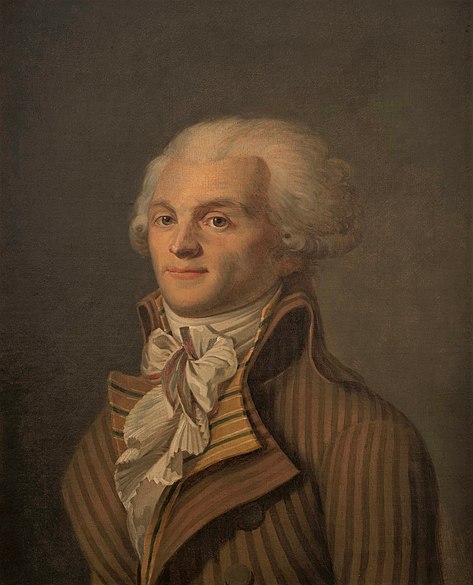
Portrait of Maximilien Robespierre, 1790


After her fourth or fifth gin, my grandmother Gilflurt is a bit of a one for her portentous announcements and on more than one occasion she has chewed on her pipe, refilled her glass and told us that you can tell much of a man from the manner of his death. I don't know if that is true but as I sifted through my broadsheets and came across news of the death of Maximilien Robespierre, her words came fluttering back.

I shall revisit the life of the infamous Frenchman at another time but for today my mind is on his passing, and the gruesome events that led up to it.

By Spring of 1794, France was in turmoil. The leaders of the revolution had never been more unpopular with the public and as the Reign of Terror swept through the country a culture of fear and suspicion began to permeate society, infecting those in the highest office as it did those in the lowest straits. Whilst government envoys across Paris were apparently committing acts of excessive and extreme terror, their punishments were minimal. Expelled from the Jacobin Club and recalled to Paris for disciplinary action they instead went on the run, speaking out against Robespierre at every opportunity.

Gripped by the threat of possible assassination Robespierre pushed the 22 Prairial into existence, a move that was to prove fatally misjudged.  The new law was aimed at those suspected of being counter-revolutionaries; with the passing of the 22 Prairial such suspects could be executed without due process. Citizens were appalled not only at what the law allowed but also at what they saw as Robespierre's gross misuse of his powers. The 22 Prairial had been passed without discussion in the Committee of General Security and this only solidified suspicions that Robespierre was out of control, making sweeping and dictatorial decisions without proper consultation.

Portrait of Robespierre by Louis-Léopold Boilly, 1791
Maximilien Robespierre by Louis-Léopold Boilly, 1791

On 8th Thermidor (26th July), Robespierre attended the National Convention and gave an impassioned speech in his own defence. For two hours he railed against charges of tyranny, denouncing his opponents of enemies of the Republic and detailing an extensive and powerful conspiracy that involved the Convention itself. Outraged and fearful that they might be next to face the executioner, members of the Convention reacted with fury and the debate grew increasingly vitriolic. That same evening Robespierre retired to the Jacobin Club and repeated his speech, this time to a rapturous reception.

Louis de Saint-Just added his own voice to Robespierre's the following day, addressing the Convention on his friend's behalf. He had barely begun to speak before the heckling started and as Saint-Just fell silent, Robespierre made futile attempts to speak in his own defence. Eventually the voices that were raised against him proved overwhelming and demands were made for his arrest as the deputies railed against him, with one famously calling, "The blood of Danton chokes thee!".


Painting of Robespierre's Arrest by Max Adamo, 1870
Robespierre's Arrest by Max Adamo, 1870

We cannot know what thoughts must have gone through Robespierre's mind as the the Convention finally ordered his immediate arrest; perhaps he knew the almost inevitable fate that awaited him or maybe he believed he might still be able to escape the charges of despotism laid before him. Whatever his long-term plans, he fled to the Hôtel de Ville that night. With him were those loyal followers who also faced arrest, Saint-Just,  François Hanriot, Philippe Le Bas, Georges Couthon and Robespierre's brother, Augustin as well as a small number of other supporters.

In the early hours of 28th July troops arrived at the Hôtel de Ville to arrest the fugitives and the men, apparently, panicked. Le Bas shot himself as Augustin leaped from a window in an effort to escape, breaking both legs in the process; for Robespierre suicide seemed like the only option and he too took up a pistol. However, he survived the shot and shattered his jaw, spending the night in the offices of the Committee of Public Safety, bleeding profusely from the terrible wound. Once the blood flow was stemmed somewhat by means of handkerchiefs and bandages, he was moved to the self same anteroom where Marie Antoinette had awaited her own fate.

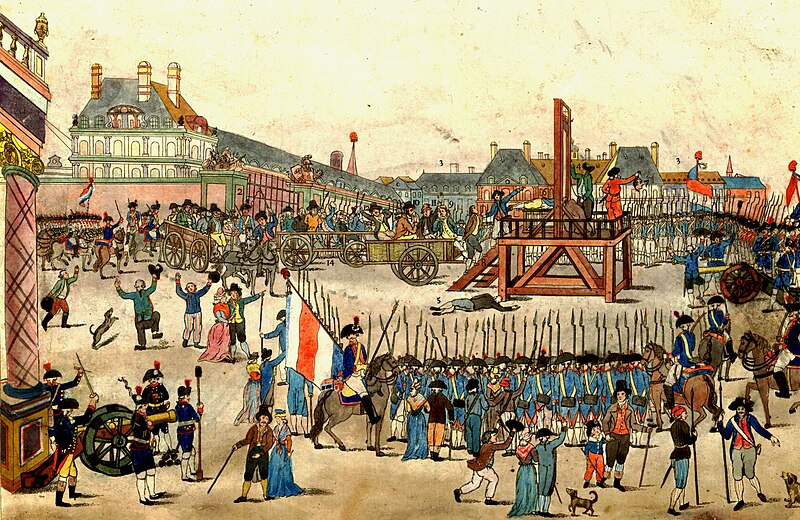
Painting of the Execution of Robepsierre and his Supporters
The Execution of Robepsierre and his Supporters

On 28th July 1794 Robespierre fell victim to his own 22 Priarial as he was taken to the Place de la Révolution with almost twenty of his supporters. One by one they went to the guillotine, their bodies thrown into a mass grave at Cimetière des Errancis. 

It was an ignoble end for the man who had risen to the highest offices of the land; in the end the very suspicion and fear that he played a part in sowing were to bring him down as friends and colleagues jockeyed for power and influence. The government of France would not stabilise for decades as the country adapted to life after Terror, but that is a story for another day.