I had a wonderful time chatting to the folks from History Hack about the mistresses of George I and II. From rumours of murder to ghostly ravens and the grumpiest kings Hanover ever saw, it's all here!
Showing posts with label George I. Show all posts
Showing posts with label George I. Show all posts
Wednesday, 10 November 2021

Wednesday, 3 June 2020
George I: Murder, Marriage and Mayhem
 I'm delighted to be visiting my esteemed publisher, Pen & Sword, to tell the story of the disastrous marriage of George I and Sophia Dorothea of Celle. When a loveless marriage erupted into violence and adultery, the stage was set for a scandal that sent the woman who could've been queen of England into captivity for thirty long years.
Click here
Monday, 25 May 2020
Sophia: Mother of Kings in Paperback

I’m thrilled to announce the paperback release of my new biography, Sophia: Mother of Kings. Sophia was famously the mother of George I but she was much, much more than that. As Stuart, Hanoverian and the Winter Princess, it’s been a real privilege to tell her story and I hope you'll enjoy reading it!
Buy it now
Sophia: Mother of Kings
Sophia, Electress of Hanover, was born to greatness. Granddaughter of James I and mother to George I, she was perhaps the finest queen that Britain never had.
As daughter of Frederick V of the Palatinate and Elizabeth Stuart, Sophia emerged from an impoverished, exiled childhood as the Winter Princess, a young woman of sparky intelligence, cutting wit and admirable determination. Once courted by Charles II, Sophia eventually gave her heart to Ernest Augustus, at whose side she became the first Electress of Hanover and the mother of the first Georgian king of Great Britain.
Sophia: Mother of Kings, brings this remarkable woman and her tumultuous era vividly to life. In a world where battles raged across the continent and courtiers fought behind closed doors, Sophia kept the home fires burning. Through personal tragedy and public triumph, Sophia raised a family, survived illness, miscarriage, and accusations of conspiracy, and missed out on the British throne by a matter of weeks.
Sophia of Hanover became the mother of one of the most glittering dynasties the world has ever known. From the House of Stuart to the House of Hanover, this is the story of her remarkable life.
Buy it now
Sophia: Mother of Kings
Sophia, Electress of Hanover, was born to greatness. Granddaughter of James I and mother to George I, she was perhaps the finest queen that Britain never had.
As daughter of Frederick V of the Palatinate and Elizabeth Stuart, Sophia emerged from an impoverished, exiled childhood as the Winter Princess, a young woman of sparky intelligence, cutting wit and admirable determination. Once courted by Charles II, Sophia eventually gave her heart to Ernest Augustus, at whose side she became the first Electress of Hanover and the mother of the first Georgian king of Great Britain.
Sophia: Mother of Kings, brings this remarkable woman and her tumultuous era vividly to life. In a world where battles raged across the continent and courtiers fought behind closed doors, Sophia kept the home fires burning. Through personal tragedy and public triumph, Sophia raised a family, survived illness, miscarriage, and accusations of conspiracy, and missed out on the British throne by a matter of weeks.
Sophia of Hanover became the mother of one of the most glittering dynasties the world has ever known. From the House of Stuart to the House of Hanover, this is the story of her remarkable life.
Tuesday, 25 February 2020
The Imprisoned Princess: Out Now

My new book, The Imprisoned Princess, is available to buy now. I'm so delighted to have written the biography of this remarkable woman!
When Sophia Dorothea of Celle married her first cousin, the future King George I, she was an unhappy bride. Filled with dreams of romance and privilege, she hated the groom she called “pig snout” and wept at news of her engagement.
In the austere court of Hanover, the vibrant young princess found herself ignored and unwanted. Bewildered by dusty protocol and regarded as a necessary evil by her husband, Sophia Dorothea grew lonely as he gallivanted with his mistress under her nose.
When Sophia Dorothea plunged headlong into a passionate and dangerous affair with Count Phillip Christoph von Königsmarck, the stage was set for disaster. This dashing soldier was as celebrated for his looks as his bravery, and when he and Sophia Dorothea fell in love, they were dicing with death. Watched by a scheming and manipulative countess who had ambitions of her own, it was only a matter of time before scandal gripped the House of Hanover and tore the marriage of the heir to the British throne and his unhappy wife apart.
Divorced and disgraced, Sophia Dorothea was locked away in a gilded cage for 30 years, whilst her lover faced an even darker fate.
Buy it now:
Pen and Sword
Amazon
Monday, 14 March 2016
An Announcement: Kings of 18th Century Great Britain

I'm so excited to announce my next book, Kings of 18th Century Great Britain, which has been commissioned by Pen and Sword, my wonderful publisher.
For over a century of tumult, upheaval and scandal, Great Britain was a Georgian land. From the day the German speaking George I stepped off the boat from Hanover to the night George IV, bloated and diseased, breathed his last at Windsor, the four kings presided over a changing nation. Their reigns were marked by drama and romance, war and crisis. Within these pages monarchs lead their troops into battle, America tears free of British rule and a beloved king finds himself confined to a straitjacket.

Kings of 18th Century Great Britain offers a fresh perspective on the lives of the four Georges and the personal events that shaped their characters and reigns. From love affairs to family feuds, political wrangling and beyond, it is a chance to peer behind the pomp and follow these iconic figures from cradle to grave. As these four very different lives will go to show, being a king isn’t always grand parties and jaw-dropping jewels and sometimes, following in a father’s footsteps can be the hardest job around.

 Take a step back in time and meet the wives, mistresses, friends and foes of the these remarkable kings who shaped the nation and find out what really went on behind closed palace doors. Whether dodging assassins, marrying for money, digging up their ancestors or sparking domestic disputes that echoed down through generations, the Georgian kings of Great Britain were never short on drama.
Kings of 18th Century Great Britain: Coming in 2017

Wednesday, 23 July 2014
The Death of George I
George I (George Louis, Osnabrück, Holy Roman Empire, 28th May 1660 - Osnabrück, Germany, 11th June 1727)
We're not feeling too cheery in the salon today because I have been reflecting on the death of the man whose reign began the glorious Georgian era. Far from a romantic hero, George I did not endear himself to his family, ministers or many of his subjects and on 11th June 1727, the first Hanovarian king of England died during a visit to his beloved native lands.
Since his coronation in 1714, the country of George's birth was never far from his mind though his home was predominantly in England, he had made several trips back to Hanover in the intervening years. The journey of 1727 was to be his last and he was accompanied on the trip by Melusine von der Schulenburg, Duchess of Kendal. Immensely powerful at court, the Duchess was George's mistress of many years standing and, some whispered, his secret wife.
On 9th June, as the group travelled between Delden and Nordhorn, George was afflicted by a major stroke. Barely clinging to life he was rushed to the comfort of Schloss Osnabrück, home of his brother, Ernest Augustus, Duke of York and Albany. Here the king lingered on the verge of death for two days before he died in the early hours of 11th June.
George I was laid to rest in the chapel of the Leineschloss and here he remained for over two centuries. When the palace was destroyed by bombing raids during World War II, George was removed and reburied at Herrenhausen, where he remains to this day.
Life in the Georgian Court, true tales of 18th century royalty, is available at the links below.
.jpg) |
| George I by Godfrey Kneller, 1714 |
We're not feeling too cheery in the salon today because I have been reflecting on the death of the man whose reign began the glorious Georgian era. Far from a romantic hero, George I did not endear himself to his family, ministers or many of his subjects and on 11th June 1727, the first Hanovarian king of England died during a visit to his beloved native lands.
Since his coronation in 1714, the country of George's birth was never far from his mind though his home was predominantly in England, he had made several trips back to Hanover in the intervening years. The journey of 1727 was to be his last and he was accompanied on the trip by Melusine von der Schulenburg, Duchess of Kendal. Immensely powerful at court, the Duchess was George's mistress of many years standing and, some whispered, his secret wife.
On 9th June, as the group travelled between Delden and Nordhorn, George was afflicted by a major stroke. Barely clinging to life he was rushed to the comfort of Schloss Osnabrück, home of his brother, Ernest Augustus, Duke of York and Albany. Here the king lingered on the verge of death for two days before he died in the early hours of 11th June.
George I was laid to rest in the chapel of the Leineschloss and here he remained for over two centuries. When the palace was destroyed by bombing raids during World War II, George was removed and reburied at Herrenhausen, where he remains to this day.
Life in the Georgian Court, true tales of 18th century royalty, is available at the links below.
Monday, 5 August 2013
Arch, Waspish and Indiscreet: John Hervey, 2nd Baron Hervey of Ickworth
John Hervey, 2nd Baron Hervey of Ickworth (London, England, 13th October 1696 – England, 5th August 1743)

Arch, waspish and indiscreet, John Hervey would have been very welcome here on Gin Lane... we always like to be first with the gossip!
The eldest son of Baron Hervey, our subject today lived a life of privilege. He was educated at Westminster School and Cambridge University before he began a career as a Member of Parliament and, far more thrillingly, court favourite to the Hanovers. Married to a lady-in-waiting, Mary Lepell, Hervey was great friends with Frederick, Prince of Wales, but an argument over a mistress led them to part company and Hervey became one of Frederick's greatest critics, his reputation and career protected by his close association with Prime Minister Robert Walpole.
Although physically weak and often unwell, Hervey was popular with ladies and gentlemen alike. Despite his apparently happy marriage he enjoyed at least one affair with Anne Vane, the subject of his quarrel with Frederick, and possibly had more lovers besides. He spent time living with male partners too, his flamboyant private life occasionally seized upon by political opponents. Though some found him magnetic, others found him distinctly repellant and he achieved some small notoriety as a constant target of Alexandre Pope, who based a number of unpleasant characters on the Baron. The reason for this vitriol appears to have been Pope and Hervey's shared affection for Lady Mary Wortley Montagu, rumoured to have been another of Hervey's lovers. In 1735's Epistle to Arbuthnot, Pope apparently described him as, among other things, "this painted child of dirt that stinks and stings...", though the writer denied that his target was Hervey.
Under Walpole's administration Hervey enjoyed no small influence at court, eventually rising to the position of Lord Privy Seal in 1740. His highest office would last only two years though and when Walpole fell, Hervey went with him. He continued to write political pamphlets and remained as opinionated as ever, his name linked with a number of anonymous and unflattering letters and articles, a number of which were addressed to Pope.
In his lifetime Hervey was known to the public mostly as the object of Pope's derision and yet the Baron had written a work of his own, detailing in minute and highly unflattering detail the behaviour of Frederick and the king over the course of a decade, reserving his warmest praise for the women of the royal household. Memoirs of the Court of George II was suppressed by Hervey's family until 1848 and though heavily edited upon release the memoir revealed a bitter court at odds with itself and George II as a man of little intelligence and even less common sense, his decisions taken by Hervey's adored Queen Caroline and a government who saw him as little more than an obstacle to be navigated. Taken alone the book might be seen as a bitter last work but read alongside Walpole's own memoirs of the court one cannot help but be struck by similarities; indeed, it seems that the house of Hanover was anything but a happy place to be!

Arch, waspish and indiscreet, John Hervey would have been very welcome here on Gin Lane... we always like to be first with the gossip!
The eldest son of Baron Hervey, our subject today lived a life of privilege. He was educated at Westminster School and Cambridge University before he began a career as a Member of Parliament and, far more thrillingly, court favourite to the Hanovers. Married to a lady-in-waiting, Mary Lepell, Hervey was great friends with Frederick, Prince of Wales, but an argument over a mistress led them to part company and Hervey became one of Frederick's greatest critics, his reputation and career protected by his close association with Prime Minister Robert Walpole.
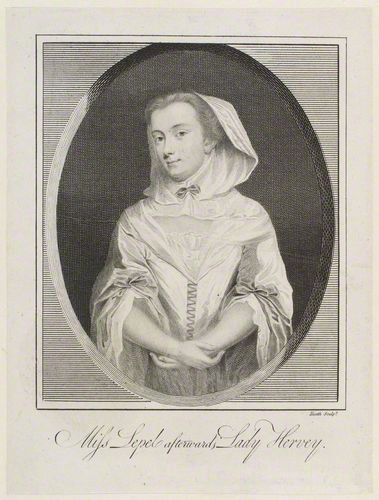 |
| Mary Leppell by James Heath, 1748 |
Although physically weak and often unwell, Hervey was popular with ladies and gentlemen alike. Despite his apparently happy marriage he enjoyed at least one affair with Anne Vane, the subject of his quarrel with Frederick, and possibly had more lovers besides. He spent time living with male partners too, his flamboyant private life occasionally seized upon by political opponents. Though some found him magnetic, others found him distinctly repellant and he achieved some small notoriety as a constant target of Alexandre Pope, who based a number of unpleasant characters on the Baron. The reason for this vitriol appears to have been Pope and Hervey's shared affection for Lady Mary Wortley Montagu, rumoured to have been another of Hervey's lovers. In 1735's Epistle to Arbuthnot, Pope apparently described him as, among other things, "this painted child of dirt that stinks and stings...", though the writer denied that his target was Hervey.
 |
| Portrait of Lady Mary Wortley Montagu by Charles Jervas Lady Montagu said this "world consisted of men, women, and Herveys" |
Under Walpole's administration Hervey enjoyed no small influence at court, eventually rising to the position of Lord Privy Seal in 1740. His highest office would last only two years though and when Walpole fell, Hervey went with him. He continued to write political pamphlets and remained as opinionated as ever, his name linked with a number of anonymous and unflattering letters and articles, a number of which were addressed to Pope.
In his lifetime Hervey was known to the public mostly as the object of Pope's derision and yet the Baron had written a work of his own, detailing in minute and highly unflattering detail the behaviour of Frederick and the king over the course of a decade, reserving his warmest praise for the women of the royal household. Memoirs of the Court of George II was suppressed by Hervey's family until 1848 and though heavily edited upon release the memoir revealed a bitter court at odds with itself and George II as a man of little intelligence and even less common sense, his decisions taken by Hervey's adored Queen Caroline and a government who saw him as little more than an obstacle to be navigated. Taken alone the book might be seen as a bitter last work but read alongside Walpole's own memoirs of the court one cannot help but be struck by similarities; indeed, it seems that the house of Hanover was anything but a happy place to be!
Wednesday, 17 July 2013
The Premiere of the Water Music, 1717
There are no nice ways of saying this, but my great-grandmother Gilflurt was a bit of a one. There was nothing she liked more than a party and nobody she would rather galavant with than that old Hanoverian rogue, George I.
George knew how to throw a bash and he also knew that people expected something more than a round of whist and last year's favourite tunes so he turned to his old Kapellmeister, George Frideric Handel, to commission some musical entertainment to accompany his latest and most ambitious party. Handel had previously served George in Germany and gossip had it that he had left for England under something of a cloud, so this was an invaluable chance to win back the favour of the monarch.
George's vision was of a party for the great and good with a difference. This celebration would take place on a river barge cruising along the Thames on a summer evening, eventually docking at Chelsea. Travelling in the early evening, there would be no need to row as the tide would propel the barge upstream at a leisurely pace, allowing the partygoers to enjoy the view and the company. A second barge would travel alongside carrying fifty musicians, performing the piece of music Handel had been asked to provide.
Handel eventually delivered the Water Music and as the barges began their stately journey from Whitehall Palace at 8.00pm on 17th July, 1717, with George I accompanied by a number of illustrious guests, his orchestra safely ensconced on the neighbouring vessel and all manner of Londoners sailing alongside as the the Thames filled with people eager to hear the new composition. On arrival at Chelsea the royal party took to the shore for a while before returning to their barge at 11.00pm.
Handel's music was an instant hit with the king and it was performed three times during the trip, the orchestra providing a gentle accompaniment to the festivities until just past midnight. As the strains of the orchestra faded away and the people of London returned their boats to the riverside and went to their beds, Handel's favour at court was firmly and permanently re-established.
If that's got you all fired up for more Handel, gallivant over to Two Kings and a Composer by Christopher Antony Meade, a fascinating romp through Handel's relationship with George I and George II!
What? You want even more? Listen to Handel's Water Music here.
George knew how to throw a bash and he also knew that people expected something more than a round of whist and last year's favourite tunes so he turned to his old Kapellmeister, George Frideric Handel, to commission some musical entertainment to accompany his latest and most ambitious party. Handel had previously served George in Germany and gossip had it that he had left for England under something of a cloud, so this was an invaluable chance to win back the favour of the monarch.
 |
| George Frideric Handel by Balthasar Denner, 1726-28 |
George's vision was of a party for the great and good with a difference. This celebration would take place on a river barge cruising along the Thames on a summer evening, eventually docking at Chelsea. Travelling in the early evening, there would be no need to row as the tide would propel the barge upstream at a leisurely pace, allowing the partygoers to enjoy the view and the company. A second barge would travel alongside carrying fifty musicians, performing the piece of music Handel had been asked to provide.
Handel eventually delivered the Water Music and as the barges began their stately journey from Whitehall Palace at 8.00pm on 17th July, 1717, with George I accompanied by a number of illustrious guests, his orchestra safely ensconced on the neighbouring vessel and all manner of Londoners sailing alongside as the the Thames filled with people eager to hear the new composition. On arrival at Chelsea the royal party took to the shore for a while before returning to their barge at 11.00pm.
 |
| The first performance of the Water Music |
Handel's music was an instant hit with the king and it was performed three times during the trip, the orchestra providing a gentle accompaniment to the festivities until just past midnight. As the strains of the orchestra faded away and the people of London returned their boats to the riverside and went to their beds, Handel's favour at court was firmly and permanently re-established.
If that's got you all fired up for more Handel, gallivant over to Two Kings and a Composer by Christopher Antony Meade, a fascinating romp through Handel's relationship with George I and George II!
What? You want even more? Listen to Handel's Water Music here.
Life in the Georgian Court, true tales of 18th century royalty, is available at the links below.
Book Depository (free worldwide shipping)

Subscribe to:
Posts (Atom)