Showing posts with label Jervas (artist). Show all posts

Friday, 25 October 2013

A Routine Trip to the Closet: The Death of George II

George II (George Augustus; Hanover, Electorate of Brunswick-Luneburg, Holy Roman Empire, 9th November 1683 – London, England, 25th October 1760)


George II by Thomas Hudson, 1744
George II  by Thomas Hudson, 1744

Today is a somewhat subdued day in the salon as we mark the anniversary of the death of King George II. My grandmother Gilflurt has oft told a tale of two of this particular monarch but none are really suitable for sharing with our guests, as she can get a little ribald once she's got a gin inside her. Still, it seemed only right the mark the passing of a this long-serving, not always popular, monarch!

In the 33rd year of his reign, the once-lively king had slowed considerably. He had retired from the active political life he had once lived, even his famously hot-temper had perhaps quelled just a little and despite his scandalous love life, more than two decades after the death of his wife, he still mourned her passing. Now in the later years of his life, George's health was failing and he was frustrated by the partial loss of his sign and hearing, though he remained intellectually vibrant.


George II by Charles Jervas, 1727

By the age of 76, George had quite naturally become a creature of habit and on the morning of his death he left his bed in Kensington Palace at six o'clock as was his routine, seeing in the day with his usual cup of chocolate. Suitably refreshed, he retired to perform his toilet and it was then that his valet heard a noise that brought him running to his master's aid. The king had fallen and was prone on the floor, barely alive. As George was carried to bed and settled as well as he could be, Princess Amelia was summoned to her ailing father's side but by the time the princess arrived at Kensington Palace, King George II was dead. George's physician, Frank Nicholls, made preparations to embalm the late monarch and found that the cause of death had been an aortic dissection. 

According to his wishes, George was buried beside his beloved wife, Caroline of Ansbach, at Westminster Abbey on 11th November 1760. As was his wish, the sides of their coffins were removed to allow their bodies to rest together.

George II

Life in the Georgian Court, true tales of 18th century royalty, is available at the links below.

Pen and Sword
Amazon UK
Amazon US
Book Depository (free worldwide shipping)

Wednesday, 21 August 2013

Istanbul, Scandal and Smallpox: Lady Mary Wortley Montagu

Lady Mary Wortley Montagu (London, England, 15th May 1689 – London, England, 21st August 1762) 


Portrait of Lady Mary Wortley Montagu by Charles Jervas
 Lady Mary Wortley Montagu by Charles Jervas

Don't put away your fard or your fan just yet, because we're headed back to sunnier climes than these to hear the story of a life of excitement, scandal and letter-writing! We were in India yesterday and today we're travelling again, this time for a stop in Turkey in the company of a woman of letters, Lady Mary Wortley Montagu.


Born Lady Mary Pierrepont and christened just along from my tottering abode at St. Paul's Church in Covent Garden, Lady Mary's mother died when the little girl was just three years old, and the child took up residence with her paternal grandmother. Six years after her arrival the girl's guardian died and Mary and her three siblings were returned to the custody of their father, Evelyn Pierrepont, 5th Earl of Kingston-upon-Hull and future Marquess of Doncaster. Delighted with the little girl's beauty and intelligence, Pierrepont took her as his guests when he attended the legendary Kit-Cat Club. Here she became a regular fixture, dazzling the illustrious patrons with her wit and charm. 


Although Pierrepont was determined to encourage his daughter's social education, Lady Mary was more interested in furthering her academic horizons and spent long hours in the extensive library of her Thoresby Hall home. As intelligent as she was engaging, by her adolescence Lady Mary had produced dozens of poems and even a novel. She corresponded with a number of friends and thinkers including Anne Wortley Montagu, granddaughter of the Earl of Sandwich, and sister to her future husband.


Portrait of Edward Wortley Montagu by John Vanderbank, 1730

As she entered adulthood, Lady Mary was considered a very eligible young lady and her father had earmarked the wonderfully-monickered Viscount Massereene, Clotworthy Skeffington as the perfect match, rejecting the alternative, Edward Wortley Montagu, as unsuitable. Determined not to marry Skeffington, Mary eloped with his rival and they were married on August 23, 1712. Less than a year later their first child was born Wortley embarked on a high successful political career, rising from Whig Member of Parliament to Lord Commissioner of the Treasury in a very short space of time. With this new role, Mary found herself plucked from her secluded married life and dropped into the centre of George I's court, where she swiftly became a favourite, charming all who knew her. She was very close to Baron Hervey and attracted the admiration of Alexander Pope, who wrote her adoring letters and would continue to do so for years to come.


Entertained by her new lifestyle, Lady Mary wrote vignettes and poetry for her own amusement and produced a series of highly satirical Court Eclogues, written in the voice of a series of amusing characters; these satires were to prove her social undoing. Whilst Lady Mary was gravely ill with smallpox in 1715, one of her fellow courtiers handed out copies of a poem that appeared to be highly offensive towards the Princess of Wales. By the time of her recovery, Lady Mary was utterly ostracised from court and when her husband gained the office of Ambassador at Constantinople, she was happy to accompany him to escape the forced unhappiness of her life in England. Although her time in Turkey was to last only three years, Lady Mary thrived in her new surroundings. 


She immersed herself in this new world and wrote prolific letters detailing every aspect of her life in Istanbul, describing the people she met, their cultures and traditions. Watching the Ottoman women she discoursed on how free they seemed compared to the restrictions placed on their western counterparts, lamenting on the limitations of dress, ambition and behaviour that so confined her gender. Her writings were published as Letters from Turkey, a hugely influential collection that remain an invaluable record of Turkish art, as well as an inspiration to cultural writers. 


Photograph of the Obelisk at Wentworth Castle
The Obelisk at Wentworth Castle

In addition she wrote poetry and letters decrying the experience of women, as well as perceptive articles regarding the treatment of her sister, who suffered from bouts of insanity and whose guardian Lady Mary was later appointed. However, Lady Mary did not seek publication for any of her writings other than her Turkish letters, preferring to keep her creative work to a small circle of friends. Despite this, in 1747 William Wentworth, 2nd Earl of Strafford, erected an obelisk at Wentworth Castle to celebrate Lady Mary's intellectual achievements.


After her own battle with smallpox, Lady Mary was fascinated to learn of the Ottoman Empire's successful experiments with inoculation and brought this knowledge back with her when she returned to England. Despite cynicism towards the procedure, she had her own child inoculated and George I allowed members of his own family to undergo the inoculations under the care of Charles Maitland, Lady Mary's doctor.


Portrait of Alexander Pope by Michael Dahl, 1727
Alexander Pope by Michael Dahl, 1727

The friendship between Pope and Lady Mary dissolved spectacularly when she returned to London and though she always claimed to be utterly ignorant of the reasons for their estrangement, we Gin Lane gossips heard a tale or two. Lady Mary wrote a very arch parody of one of Pope's works that set his teeth on edge and, of course, there was the friendship with Hervey, whom we have already heard that Pope loathed and an even closer relationship with Philip, Duke of Wharton. There was also the suggestion that Pope told the lady he adored her and she laughed in his face, breaking his heart. Whatever the reason, the writer's love turned to loathing and he turned his most poison pen on the woman he had adored, writing vicious and thinly-veiled attacks on her person.

Bored by life in England and looking for something to occupy herself, Lady Mary entered into a romantic correspondence with a French admirer known as Rémond. For one so intelligent Lady Mary proved herself romantically naive and invested and lost a large amount of money in South Sea stock at his request. When he attempted to blackmail her using their love letters, Lady Mary finally revealed her actions to her husband and, in 1739, travelled to the continent alone. Although she and Wortley remained on friendly terms, they were eventually divorced. She enjoyed other love affairs in the years that followed but as her health began to fail, her life entered a period of decline.


Portrait of Lady Montagu in Turkish Dress by Jean-Étienne Liotard, 1756
Lady Montagu in Turkish Dress by Jean-Étienne Liotard, 1756

By the age of sixty the celebrated beauty was in dire straits. Disfigured by smallpox and plagued with ill health, she lived in virtual poverty on the continent and only returned to England at the repeated pleas of her daughter. Their reunion was to be short lived and she died that same year.


Lady Mary remains a literary force to be reckoned with thanks to her perceptive letters from Turkey; although her days ended sadly, these letters and writings reveal a life well lived and a woman of wit, intelligence and conscience who pushed the boundaries of her time.


Monday, 5 August 2013

Arch, Waspish and Indiscreet: John Hervey, 2nd Baron Hervey of Ickworth

John Hervey, 2nd Baron Hervey of Ickworth (London, England, 13th October 1696 – England, 5th August 1743)


Portrait of John Hervey, 1740-1

Arch, waspish and indiscreet, John Hervey would have been very welcome here on Gin Lane... we always like to be first with the gossip!

The eldest son of Baron Hervey, our subject today lived a life of privilege. He was educated at Westminster School and Cambridge University before he began a career as a Member of Parliament and, far more thrillingly, court favourite to the Hanovers. Married to a lady-in-waiting, Mary Lepell, Hervey was great friends with Frederick, Prince of Wales, but an argument over a mistress led them to part company and Hervey became one of Frederick's greatest critics, his reputation and career protected by his close association with Prime Minister Robert Walpole.


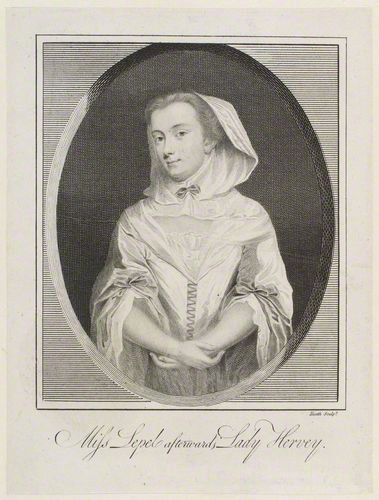
Engraving of Mary Leppell by James Heath, 1748
Mary Leppell by James Heath, 1748

Although physically weak and often unwell, Hervey was popular with ladies and gentlemen alike. Despite his apparently happy marriage he enjoyed at least one affair with Anne Vane, the subject of his quarrel with Frederick,  and possibly  had more lovers besides. He spent time living with male partners too, his flamboyant private life occasionally seized upon by political opponents. Though some found him magnetic, others found him distinctly repellant and he achieved some small notoriety as a constant target of Alexandre Pope, who based a number of unpleasant characters on the Baron. The reason for this vitriol appears to have been Pope and Hervey's shared affection for Lady Mary Wortley Montagu, rumoured to have been another of Hervey's lovers. In 1735's Epistle to Arbuthnot, Pope apparently described him as, among other things, "this painted child of dirt that stinks and stings...", though the writer denied that his target was Hervey.


Portrait of Lady Mary Wortley Montagu by Charles Jervas
Lady Montagu said this "world consisted of men, women, and Herveys"

Under Walpole's administration Hervey enjoyed no small influence at court, eventually rising to the position of Lord Privy Seal in 1740. His highest office would last only two years though and when Walpole fell,  Hervey went with him. He continued to write political pamphlets and remained as opinionated as ever, his name linked with a number of anonymous and unflattering letters and articles, a number of which were addressed to Pope.

In his lifetime Hervey was known to the public mostly as the object of Pope's derision and yet the Baron had written a work of his own, detailing in minute and highly unflattering detail the behaviour of Frederick and the king over the course of a decade, reserving his warmest praise for the women of the royal household. Memoirs of the Court of George II was suppressed by Hervey's family until 1848 and though heavily edited upon release the memoir revealed a bitter court at odds with itself and George II as a man of little intelligence and even less common sense, his decisions taken by Hervey's adored Queen Caroline and a government who saw him as little more than an obstacle to be navigated. Taken alone the book might be seen as a bitter last work but read alongside Walpole's own memoirs of the court one cannot help but be struck by similarities; indeed, it seems that the house of Hanover was anything but a happy place to be!